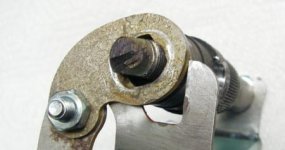
Dropout Failure Experiements, and a call for Fork Donations

Get all your technical information about electric bikes here.

Dropout Failure Experiements, and a call for Fork Donations

Postby justin_le » Fri Nov 13, 2009 8:04 am

The strength of bicycle forks, their ability to handle the torque of hub motor axles, and the importance or non-importance of torque arms, has been a heavily debated topic in the ebike community. And rightly so, since failures that result in a wheel falling out of a vehicle can be more than a little disconcerting. But I haven't seen much in the way of empirical and analytic testing to show the actual range of dropouts strengths that exist among bicycle forks, and the quantified improvement that a torque arm may provide, so here is an opportunity to change that!

First, a bit of a background.

We've been involved with hub motor ebike conversions since 2004 or so and have seen many installations. The vast majority of those didn't have any torque arm at all, and that includes even taboo arrangements like 5304 motors in aluminum suspension forks, 72V setups with 50A modded controllers etc. When we DID see dropout failures and spinout it almost always fit in one of the following 3 categories:
a) Most commonly, somebody forgot to properly tighten the axle nuts after fixing a flat or what not, and hit the throttle when the nuts were still loose.
b) The motor was installed in a fork with quick release lawyer lips, and the large diameter washer/nut didn't sit flat against the flat recess in the dropout but was instead tightened only against the bottom of the lip. or:
c) With aluminum forks, the nuts were made good and tight, but the axle having a curved rather than a sharp transition at the shoulder ended up "wedging" the dropout opening apart, and caused it to crack even without the throttle ever being applied. See below:
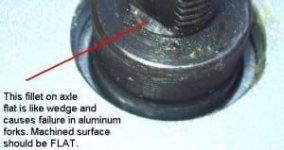
Clyte Axle Wedge.jpg
Picture that I send to Kenny about axle machining
Clyte Axle Wedge.jpg (15.81 KiB) Viewed 3385 times


In installations where the motor was fastened with the axle nuts tight and sitting flat against the dropout, problems were rare. But that changed in early 2008 when we started carrying both the eZee and Nine Continent motors. Both of these motors had higher stall torque than the Crystalyte hubs and both of which lacked the extended 10mm keyway that Crystalyte has machined on one side of their axles.
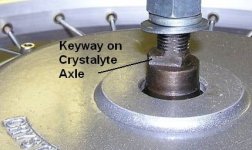
Clyte Axle.jpg
Closeup of Crystalyte Axle
Clyte Axle.jpg (28.21 KiB) Viewed 3385 times
Big Dummy Xtracycle , Nuvinci Rear Hub, Front eZee Motor, 24" wheels.
Planned to do 72V, but started with 48V 8Ah NiCad, and am now happily riding a 36V 10Ah lithium.
Go figure. Need for speed has totally given way to appreciating a slower pace.
my website: www.ebikes.ca
User avatar
justin_le
1 kW
1 kW
 
Posts: 306
Joined: Mon May 28, 2007 3:27 am
Location: Vancouver

Re: Dropout Failure Experiements, and a call for Fork Donations

Postby liveforphysics » Fri Nov 13, 2009 8:13 am

That little fillet is in place to try and avoid a stress riser point on the axle. For this application, perhaps a radius'd undercut fillet would be optimal.
The road of excess leads to the palace of wisdom

Experience is a hard teacher. First comes the test, then the lesson.

Best Lithium battery testing highlight video EVER!!!! :)
http://www.youtube.com/watch?v=dree0rTr1HM
User avatar
liveforphysics
10 GW
10 GW
 
Posts: 4295
Joined: Wed Oct 29, 2008 1:48 am

The original plan

Postby justin_le » Fri Nov 13, 2009 8:24 am

So, in the fall of 2008 we decided it would be a good idea to get involved in torque arm design. But first, it seemed prudent understand and quantify the nature of axle spinout failures a bit more.

What I thought at the time was that the torque required to cause an axle to "spinout" would be highly proportional to how tightly the axle nuts are done up. Clearly, when the nuts are loose it takes very little torque on to spread the dropouts, so that would imply that the main strength wasn't coming from the ability of the metal dropout arms to resist bending so much as the friction between the axle shoulder and inside of the dropout when the nut was really tight. I also thought that the wider 14mm axles would be much better at resisting spinout than the 12mm axles. What I wanted to get was some kind of plot showing the actual torque required to spin an axle vs. the applied tightening torque on the nuts.

We could do this for both 12mm and 14mm axles. Get a sense for how much torque you can put on an axle before it spreads the dropouts, cross reference this to the stall torque of a particular motor combo setup, and then know a a little more scientifically if a torque arm is required or not. Sounded like a straightforward plan.
Big Dummy Xtracycle , Nuvinci Rear Hub, Front eZee Motor, 24" wheels.
Planned to do 72V, but started with 48V 8Ah NiCad, and am now happily riding a 36V 10Ah lithium.
Go figure. Need for speed has totally given way to appreciating a slower pace.
my website: www.ebikes.ca
User avatar
justin_le
1 kW
1 kW
 
Posts: 306
Joined: Mon May 28, 2007 3:27 am
Location: Vancouver

The setup

Postby justin_le » Fri Nov 13, 2009 8:50 am

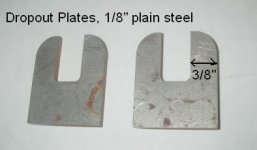
We had a decent stash of rear Crystalyte spare axles laying around, but not many fronts, which unfortunately meant that we couldn't do the test on actual bicycle forks. So I had a water-jet cutter make up a bunch of metal 'dropout' plates from 1/8" steel. Certainly bike fork dropouts come in many shapes and sizes, but this seemed more-or-less representative:

Dropout Plate.jpg
Dropout Plate.jpg (18.94 KiB) Viewed 3356 times


These were welded to some steel tubing 135mm apart so that I could drop the Crystalyte rear axles in them:

Axles Mounted.jpg
Axles Mounted.jpg (13.94 KiB) Viewed 3354 times


We then needed to tighten the axle nuts up to very specific torque values. That was done using a regular wrench with a digital hanging scale for tightening up the nuts:

Nut Tightening.jpg
Nut Tightening.jpg (19.38 KiB) Viewed 3359 times


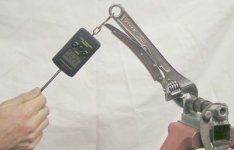
Then, with the simulated dropouts in a sturdy vise, we were able to attach a long lever rod perpendicular to the axle and bend it, again using a hanging scale so that we could see at exactly what torque the dropouts started to give way allowing the axle to spin:

Torqing the Axle to Spinout.jpg
Zev giving the lever arm all he's got.
Torqing the Axle to Spinout.jpg (58.67 KiB) Viewed 3364 times
Big Dummy Xtracycle , Nuvinci Rear Hub, Front eZee Motor, 24" wheels.
Planned to do 72V, but started with 48V 8Ah NiCad, and am now happily riding a 36V 10Ah lithium.
Go figure. Need for speed has totally given way to appreciating a slower pace.
my website: www.ebikes.ca
User avatar
justin_le
1 kW
1 kW
 
Posts: 306
Joined: Mon May 28, 2007 3:27 am
Location: Vancouver

Re: Dropout Failure Experiements, and a call for Fork Donations

Postby TylerDurden » Fri Nov 13, 2009 9:02 am

Thrift stores regularly get abandoned/stolen bikes from the police... many of those (and donated bikes) are discarded because they need repairs.

Our local bike co-op helps the thrift stores with minor repairs (flats, etc.) and get parts/bikes in return.
Have a Nice Day,

TD

___________________________________________________________

FYI: Adding pictures?

Please post your Watts-at-speed in the survey.
User avatar
TylerDurden
100 GW
100 GW
 
Posts: 6254
Joined: Thu Jan 04, 2007 5:50 pm
Location: Wear the fox hat.

The Results

Postby justin_le » Fri Nov 13, 2009 9:37 am

As it is, each set of dropout plates and spare axle could only be used for a single test, so I could only do so many experiments.

For a 12mm axle, with no torque arm installed, here's what we got:

Code: Select all
Nut Torque   Axle Spinout Torque

hand tight   38.7 N-m
30 N-m      78.3 N-m
60 N-m      83.9 N-m
90 N-m      96.6 N-m


Although there was a pretty significant increase in the spinout torque when going from loose nuts to moderately tight nuts, further tightening, up to 60 and then 90 N-m had only marginal effect at increasing the ability of the dropouts to resist spinout. The first 30 N-m gives a full 40 N-m of extra spinout resistance, but doubling the tightness of the nuts to 60 N-m only increased the spinout torque by 7%.

This is interesting, because we've certainly had of a few cases where people have tightened their axle nuts so much as to strip the threads, and it would imply that there perhaps isn't a lot to be gained by going so close to this limit. The other interesting thing was to see how these spinout torque values compare to the torque of typical hub motors setups. Your standard 400 series Crystalyte hub/20A controller arrangement has 35-40 N-m of stall torque, which is pretty much exactly where the dropouts failed with hand tightened nuts. And from our own experience, if you forget to tighten the nuts in the 400 series motor there's a mixed chance that it'll spin in the dropouts or not. At 48V 20A, most likely, but 36V 20A, people have gotten away with pretty loose hardware.

When the nuts are tightened to a pretty reasonable amount (30N-m), the spinout torque increases to almost 80 N-m, and that is a healthy margin over the 35-40 N-m stall torque with these setups. But when you then go to say a 48V 35A controller system, and a higher power motor like the Nine Continent, then the stall torque is more typically in the 70-80 N-m range. That's pretty much exactly where the dropouts here gave way, and it matches our experience that these setups were 'right on the edge' of failing.
Big Dummy Xtracycle , Nuvinci Rear Hub, Front eZee Motor, 24" wheels.
Planned to do 72V, but started with 48V 8Ah NiCad, and am now happily riding a 36V 10Ah lithium.
Go figure. Need for speed has totally given way to appreciating a slower pace.
my website: www.ebikes.ca
User avatar
justin_le
1 kW
1 kW
 
Posts: 306
Joined: Mon May 28, 2007 3:27 am
Location: Vancouver

Re: Dropout Failure Experiements, and a call for Fork Donations

Postby swbluto » Fri Nov 13, 2009 10:05 am

Thanks for the tests and the equivalent data. Do you have any information on what the axle-spinout torque might be on a rear axle with aluminum dropouts? Even a minimum bound as suggested by extreme cases would be informative.
DO NOT BUY FROM ELECTRICSCOOTERPARTS . COM! They are DAMN THIEVES! They will happily take your money, not send you the product, and then claim because you didn't mention something within 15 days (Hello, mail can sometimes take longer than 15 days), they've lost all records and thus they can't help you out.

Check out the latest version of the FREE e-bike/e-scooter( or anything that uses a single brushless or brushed motor) simulator.
User avatar
swbluto
10 GW
10 GW
 
Posts: 4131
Joined: Fri May 30, 2008 5:23 pm

More Results

Postby justin_le » Fri Nov 13, 2009 10:16 am

Next up was to try it with the wider 14mm axle. I only got 2 tests of this in, one with the nuts hand tight and the other with the nut tightened to 60 N-m.

Code: Select all
Nut Torque   Axle Spinout Torque

hand tight   49.5 N-m
60 N-m      79.9 N-m


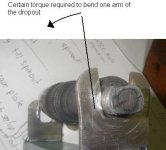
The spinout torque with 14mm axle and loose nuts was 20% higher than for the 12mm axle, OK. But interestingly, with the nuts tightened all the way up, there was NO DIFFERENCE in the spinout torque with the 14mm axle over the 12mm. This at first surprised me, but then made a bit of sense. Ultimately, it takes a certain amount of torque to bend one of the dropout arms and cause the dropouts to appear 'spread out'. It doesn't matter so much whether this torque is applied over a 12mm axle flat surface, or a 14mm, or hell even a 20mm axle. It would start to bend with roughly the same applied torque regardless.

Arm Bending Torque.jpg
Arm Bending Torque.jpg (31.25 KiB) Viewed 3642 times


So in the case of open ended dropouts, where the failure mode is spreading as opposed to metal smearing, we can mostly conclude that the larger axles don't really offer any improvement in resistance to spinout.

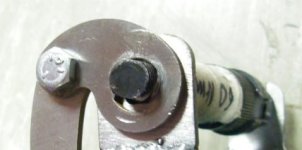
Next up was to see just what the effect of having a torque arm was with the system. Most of the torque arms we'd seen
were cut from 1/8" steel, so that's what we went with at first in our own design.

Spinout with Torque Arm.jpg
Spinout with Torque Arm.jpg (23.23 KiB) Viewed 3587 times


When we had the torque arm in place for 12mm axle tests, the 'loose nuts' spinout torque increased from 38 N-m to 48 N-m. With the axle nut tightened up to 60 N-m, the spinout torque increased from 84 N-m with no torque plate to 110 N-m when the torque plate was installed. So it was an improvement, but much less than I had been expecting. The 12mm axle was able to smear the metal around in the 1/8" torque plate without too much difficulty.

Unfortunately, we ran out of spare axles before being able to do more experiments along these lines. (I didn't want to reuse any axles, since they get somewhat rounded after each test).
Big Dummy Xtracycle , Nuvinci Rear Hub, Front eZee Motor, 24" wheels.
Planned to do 72V, but started with 48V 8Ah NiCad, and am now happily riding a 36V 10Ah lithium.
Go figure. Need for speed has totally given way to appreciating a slower pace.
my website: www.ebikes.ca
User avatar
justin_le
1 kW
1 kW
 
Posts: 306
Joined: Mon May 28, 2007 3:27 am
Location: Vancouver

And the next step

Postby justin_le » Fri Nov 13, 2009 10:39 am

And so, now we get back to the original subject heading.

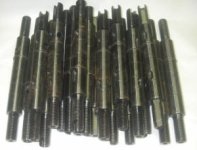
This summer I received from eZee a stash of 20 bare FRONT motor axles.

Front Axles.jpg
Front Axles.jpg (20.31 KiB) Viewed 3303 times


This means that we can repeat exactly the same kind of experiments I did last year, but using actual bicycle forks in the test. With 20 axles we have enough pieces to really characterize the strength of a range of different brands and styles of fork. And if it is possible to get several sets of identical forks in the mix, then we'd be able to more properly quantify the impact of torque arms, nut tightness, and other factors on the ultimate spinout strength of the dropouts.

So do any members on this forum happen to have spare or extra forks that they'd like to donate to see subject to these tests? Anyone have 2 or more of the identical fork lying around to contribute?

I know we can probably find a range of used forks by shopping around at bike stores, but before I do that I wanted to see here first if people had particular units they'd want to donate and see characterized.

Justin
Big Dummy Xtracycle , Nuvinci Rear Hub, Front eZee Motor, 24" wheels.
Planned to do 72V, but started with 48V 8Ah NiCad, and am now happily riding a 36V 10Ah lithium.
Go figure. Need for speed has totally given way to appreciating a slower pace.
my website: www.ebikes.ca
User avatar
justin_le
1 kW
1 kW
 
Posts: 306
Joined: Mon May 28, 2007 3:27 am
Location: Vancouver

Re: Dropout Failure Experiements, and a call for Fork Donations

Postby nicobie » Fri Nov 13, 2009 2:28 pm

Thank you for the excellent tests!

I think it's time to double up and run two arms on my bike. As soon as I'm done here, I'm off to ebikes.ca to order another one :mrgreen:

Thanks again for all the good work over the years.

Nick

.
May your tote always stay tight and your edge eversharp :wink:
User avatar
nicobie
1 kW
1 kW
 
Posts: 410
Joined: Thu Aug 07, 2008 1:48 pm
Location: Central Coast CA

Re: Dropout Failure Experiements, and a call for Fork Donations

Postby dogman » Fri Nov 13, 2009 5:49 pm

I've got a few forks in the junkyard, from roadmaster junk, to decent forks, but ones I'd consider too lightly constructed to use. Mostly fairly old bikes, maybe 10 years old or so. None identical though. I'll line em up and snap a pic so you can see what I have. Some rear drops off steel frames too, that I could cut off and send as well.

Right away I see one thing about your excellent tests. Torque arms are no substitute for tight nuts and perfectly fitting washers. Dang those QR hubs, and the forks designed for them.

I think better axles so we can really tighten on the nuts may be the easiest fix, but getting the manufacurers to temper the axles to grade 8 won't be easy. In the long run, the motors will need to be made with a bigger shoulder on the inside of the dropout. That would eliminate one source of the axle spreading forces. Heinzmann got it right with thier motors, they have a huge shoulder that allows an integrated tourque arm. This allows a regular size round axle, and no way to spinout, no way to lever open the dropouts. That kind of design is what front hubs need.
BE THE PACK LEADER

Front hub Ebikekit 6x10 motor commuter bike on FS Giant OS3 frame.

Rear hub 6x10 9 continent dirtbike on FS Mogoose frame

Front hub 9x7 ebikekit street racing bike on Quicksilver Denali frame, Lyens 72v 12 fet controller.

5600 miles, Aprox 530 cycles on v1 36v 20 ah ping, 50 cycyles on 48v 15 ah ping. 72v 5 ah Turnigy 30c lipo on the race bike.
User avatar
dogman
100 GW
100 GW
 
Posts: 7928
Joined: Sat May 17, 2008 12:53 pm
Location: Las Cruces New Mexico USA

Re: More Results

Postby johnb » Sat Nov 14, 2009 3:27 am

justin_le wrote:The 12mm axle was able to smear the metal around in the 1/8" torque plate without too much difficulty.


Justin, your post was just a few hours late for me. This is exactly what happened to my torque plate yesterday (one I got from you).

I have a 9C motor running at 38V 12A. I have to admit that I was probably to blame as I noticed the day before that they nuts were loose. Of course I tightened them but perhaps the damage had already been done to my alloy forks. The torque plate turned about 1/4 of a turn and jammed on the axle, so damaged some thread but saved the wires.

I am still puzzled at how the torque plate should fail so "easily". Perhaps it could be made from harder metal. Perhaps a spanner (tool steel) would resist more torque.
johnb
100 mW
100 mW
 
Posts: 44
Joined: Wed Mar 12, 2008 10:21 am

Re: Dropout Failure Experiements, and a call for Fork Donations

Postby AussieJester » Sat Nov 14, 2009 3:37 am

I cut up 8 (curbside bikes) bikes today so have 8 sets of forks laying here destined for the bin, pitty your in North America freight would be a killer... :-(

KiM
User avatar
AussieJester
10 GW
10 GW
 
Posts: 4973
Joined: Tue Mar 11, 2008 3:33 am
Location: Western Australia

Re: Dropout Failure Experiements, and a call for Fork Donations

Postby liveforphysics » Sat Nov 14, 2009 4:34 am

Common steel sheet ranges from something like 50ksi to 240ksi.

When a special alloy is not requested, a fabricator normally picks mild steel to work with, as it's very nice to cut, bend, weld etc, and the tooling lasts forever with it.

Perhaps a simple change in alloy/temper grades of the lower part of your torque arm could make a large impact on performance?


Likewise, a chromoly front fork could easily have 3x the yeild strength of a mild steel fork (or mild steel testing drop-out simulator).


I may have an old KHS Chromoly fork laying around, and I will see if I can find it and send it to you.

Best Wishes,
-Luke
The road of excess leads to the palace of wisdom

Experience is a hard teacher. First comes the test, then the lesson.

Best Lithium battery testing highlight video EVER!!!! :)
http://www.youtube.com/watch?v=dree0rTr1HM
User avatar
liveforphysics
10 GW
10 GW
 
Posts: 4295
Joined: Wed Oct 29, 2008 1:48 am

Re: Dropout Failure Experiements, and a call for Fork Donations

Postby justin_le » Sat Nov 14, 2009 6:13 am

swbluto wrote:Thanks for the tests and the equivalent data. Do you have any information on what the axle-spinout torque might be on a rear axle with aluminum dropouts? Even a minimum bound as suggested by extreme cases would be informative.


No idea, but if you want to send me the back of a rear frame with aluminum dropouts that you have in mind, I could do the spinout test and let you and everyone else here know! I suspect in the case of bikes with solid 8mm or so plate aluminum making up the dropout, that the spinout torque is pretty good. Lowell had no torque arm with his 5304 100V 50A setup which had the motor on the rear on a fairly beefy aluminum frame.

Justin
Big Dummy Xtracycle , Nuvinci Rear Hub, Front eZee Motor, 24" wheels.
Planned to do 72V, but started with 48V 8Ah NiCad, and am now happily riding a 36V 10Ah lithium.
Go figure. Need for speed has totally given way to appreciating a slower pace.
my website: www.ebikes.ca
User avatar
justin_le
1 kW
1 kW
 
Posts: 306
Joined: Mon May 28, 2007 3:27 am
Location: Vancouver

Next

Return to E-Bike Technical

Who is online

Users browsing this forum: No registered users and 1 guest