Battery disgust

Chuckles1

🔌 New-ish
Joined
Jan 3, 2021
Messages
26
Location
Maine, west central foothills
I found out my two UPP 48V 20 Ah triangle batteries are fire hazards, so I've been "shopping" for months for a replacement. Unbelievably frustrating.

Best advice is get battery certified UL 2271, as they are supposedly safe. General advice is EM3EV batteries are the sweet spot for quality and price, but they are not UL 2271 certified. Other highly recommended brands (Luna Cycles, Bosche, etc) are generally out of stock and not available in correct voltage and desired capacity.

So maybe UPP learned from their mistakes and are improved. Look on Amazon and you find a good selection of reasonably priced batteries claiming quality cells claiming UL2271 certificated by SGS, but if I try to look up the certification in the SGS database, it is not found. They've even got lots of images of construction details that depict a seemingly well-built battery. But is any of it true? If I'd found the certification, I'd have ordered a UPP already.

So what's a fellow to do. Pay twice as much for a EM3EV battery that's not certified because of positive feedback, buy a newer UPP in hopes it's safe (they also have positive feedback), or give up and lie on the couch?
 
You aren't even asking about the most important part, like are the cells brand name like Samsung and do they have safety vents. Grin has a whole video about battery fires and it boiled down to the cells.

There's also a thread on here with x-rays of the various cells. The parts inside the cheaper brand cells aren't lined up properly due to poor manufacturing tolerances and insufficient QC. It's no surprise they catch fire.

UPP was also famous for selling cheap packs with BMS that couldn't even balance the cells, though. So UPP was basically doubling down on the fire risk.
 
I've been telling people to not buy low quality batteries for a decade.
Most of them would fit the government's definition of 'fire hazard'.

UL2271 certification does not ensure safety. It has all to do with pack design and very little to do with the most important factor: the manufacturing quality of the cells.

UPP sold packs with poor BMS/construction/cells, and could go back to selling garbage because UL2771 isn't anywhere near strict enough if we are to call it a safety standard.

High quality cells extremely reduce the odds of a battery fire, since poor cell quality is the majority reason for a spontaneous fire.
Your best bet is to buy a pack with quality cells, em3ev is one of those suppliers, but there are many others.

Many Chinese companies have lied about UL2771 certification
...and a lot else
..don't expect a claim of UL2771 certification from one of these sellers to say anything about the quality of the battery and therefore the level of risk.

Chinese companies are barely starting to become accountable, there's still a loophole where they can change their name every week, selling stuff under random names with zero accountability.

More info:
Grin’s perspective of Ebike fires
 
Last edited:
You are trying to do the right (safe) thing. (Rare?) The marketplace is conspiring against you. The marketplace greatest demand force seems to be driven by potential buyers prioritizing lowest price. Even here on ES forum, which is more DIY and technical oriented than most, the grand majority of battery seekers start out their thread with "Where can I find the cheapest battery..."

In an effort to cater to this demand, the mfrs/vendors find themselves in a race to the bottom-- of quality, reliability, safety, etc. They must cut corners to stay competitive. Using knockoff or seconds or otherwise lower quality cells, lower quality nickle strips, less effective designs, lower quality BMS, etc., anywhere to cut costs to be able to beat their competitors' price.

Add to this declining standards of honest advertising, deceptive marketing tactics, and reluctance to honor warranties or even issue recalls for unsafe products (see US-CPSC warns of Ridstar e-Bike battery fires for a recent example) and the prospective buyer has little assurance of obtaining a safe product seemingly anywhere. :mad:

em3ev has been a longtime trusted producer, but in this marketplace anything could happen at any time so best to confirm with recent reviews to verify they are still offering safe product.

Otherwise, depending on your location, there may be local or regional battery makers that offer good product. IIRC, there is a fairly new Canadian battery producer that looks promising. (Edited to add: Batteries).

PRO TIP: For any potential battery purchase, see how well they answer your technical oriented questions. And what is their return policy? Those answers will tell you a lot about your post-purchase experience.

OTOH, knowing that most battery fires occur during charge/discharge conditions, you might decide to keep your UPP batteries and charge them outside in a firesafe area, always under observation. 😉
 
Last edited:
So what's a fellow to do.
Bell Helmets had an ad slogan, "You put a $10 head in a $10 helmet." How cheap is your life?

This is about Lithium-Ion cells and batteries. NiMH or SLA are different.

The battery is generally the most expensive part, and it's the part most likely to kill you. Heed what everyone else is posting, and heed the real world experience Grin has posted. New, name brand cells from an established battery foundry from a source you can trust not to lie about it.

Nothing else can make up for poor source cells. Once you have those:
  • Don't smack it, Don't drop it. Don't pretend that you didn't drop it if you do.
  • Don't overcharge it.
  • Don't discharge it below 20% capacity.
  • Don't overheat it (sun, closed car, etc.)
  • Don't charge it when it's cold.
  • Don't let water get into it. Most plastic cases are designed so they keep water out if you don't turn it upside down. I have not had problems with this.
You best practice would be to work out the usual capacity you need, and then keep the charge between ~80-85% top and 20% bottom. The battery will last about 3x times as long and that will save you $$ over buying 3 batteries for the same lifespan. This means work out the usual capacity and then multiply by 1.5 or more and buy that.

The bottom line is that you can SAVE $$ by NOT cheaping out on the battery.
 
Last edited:
You are trying to do the right (safe) thing. (Rare?) The marketplace is conspiring against you. The marketplace greatest demand force seems to be driven by potential buyers prioritizing lowest price. Even here on ES forum, which is more DIY and technical oriented than most, the grand majority of battery seekers start out their thread with "Where can I find the cheapest battery..."

In an effort to cater to this demand, the mfrs/vendors find themselves in a race to the bottom-- of quality, reliability, safety, etc. They must cut corners to stay competitive. Using knockoff or seconds or otherwise lower quality cells, lower quality nickle strips, less effective designs, lower quality BMS, etc., anywhere to cut costs to be able to beat their competitors' price.

Add to this declining standards of honest advertising, deceptive marketing tactics, and reluctance to honor warranties or even issue recalls for unsafe products (see US-CPSC warns of Ridstar e-Bike battery fires for a recent example) and the prospective buyer has little assurance of obtaining a safe product seemingly anywhere. :mad:

em3ev has been a longtime trusted producer, but in this marketplace anything could happen at any time so best to confirm with recent reviews to verify they are still offering safe product.

Otherwise, depending on your location, there may be local or regional battery makers that offer good product. IIRC, there is a fairly new Canadian battery producer that looks promising. (Edited to add: Batteries).

PRO TIP: For any potential battery purchase, see how well they answer your technical oriented questions. And what is their return policy? Those answers will tell you a lot about your post-purchase experience.

OTOH, knowing that most battery fires occur during charge/discharge conditions, you might decide to keep your UPP batteries and charge them outside in a firesafe area, always under observation. 😉
I've considered keeping UPPs (I still have them) and charging outside, but I'm concerned they could spontaneously combust in house
Bell Helmets had an ad slogan, "You put a $10 head in a $10 helmet." How cheap is your life?

This is about Lithium-Ion cells and batteries. NiMH or SLA are different.

The battery is generally the most expensive part, and it's the part most likely to kill you. Heed what everyone else is posting, and heed the real world experience Grin has posted. New, name brand cells from an established battery foundry from a source you can trust not to lie about it.

Nothing else can make up for poor source cells. Once you have those:
  • Don't smack it, Don't drop it. Don't pretend that you didn't drop it if you do.
  • Don't overcharge it.
  • Don't discharge it below 20% capacity.
  • Don't overheat it (sun, closed car, etc.)
  • Don't charge it when it's cold.
  • Don't let water get into it. Most plastic cases are designed so they keep water out if you don't turn it upside down. I have not had problems with this.
You best practice would be to work out the usual capacity you need, and then keep the charge between ~80-85% top and 20% bottom. The battery will last about 3x times as long and that will save you $$ over buying 3 batteries for the same lifespan. This means work out the usual capacity and then multiply by 1.5 or more and buy that.

The bottom line is that you can SAVE $$ by NOT cheaping out on the battery.

if internal cells are leaking. The batteries came well-packaged and have never been so much as bumped let alone dropped. They hang from straps and are thus isolated from shock of hitting bumps in the road. I suspect the fires that prompted warnings from government watchdogs may have been caused by stupid actions of owners, such as wiring batteries together or using the wrong charger; but no way to know.
 
I've considered keeping UPPs (I still have them) and charging outside, but I'm concerned they could spontaneously combust in house

A majority of lithium battery types can spontaneously explode, i'ts just that ones with cheap cells and/or poor construction bring a way higher chance of that happening.

A good BMS would prevent user abuse from being the reason a pack blew up; when i say 'poor construction', that includes BMSes that don't do a good job protecting the cells.
Some UPPs had very primitive, partial BMSes that could allow for a lot of problems, and this might be what got them in trouble.

if internal cells are leaking. The batteries came well-packaged and have never been so much as bumped let alone dropped. They hang from straps and are thus isolated from shock of hitting bumps in the road.

It's rare to see lithium cells leak. At least i have not seen/experienced it or heard of it. A poor quality battery can spontaneously ignite without any physical damage due to construction defects inside the cells themselves. A high quality battery may catch fire if the cells were 'built on a friday'

I suspect the fires that prompted warnings from government watchdogs may have been caused by stupid actions of owners, such as wiring batteries together or using the wrong charger; but no way to know.

USA govt's criteria to call something a fire hazard is that enough people reported fires. They do not take number of units sold or specific flaws in the battery construction into the equation. They also don't take user abuse into the equation. Never do they cite these things. Not very helpful!
 
Last edited:
I was in the same exact situation a couple months ago. My 8-yr old Em3EV triangle battery was wearing out, and I tried to find a replacement. I ordered one from a website that looked legit and had lots of good (fake) reviews, and never heard from them again.

Got my money back from Paypal and went on the search again. In the end I ordered one from Amorge. They communicated well, helped me choose the size and the cell type from a range of options. They'll do custom shapes if you ask them. They use an ANT bms that monitors every last variable and has a bluetooth app. My battery came by sea in about 8 weeks, wrapped in many layers of foam and tape. It has a steel case for extra protection. I would consider the quality and service on a par with Em3ev who I've bought from for ten years. But now with tariffs and shipping costs Em3ev is very expensive, and they don't have many batteries with the newer high capacity tabless 21700 cells yet. (My battery is a 52v35Ah using EVE 50PL cells)

This is my own experience - YMMV. I'm not pushing a brand but this worked for me. Most batteries that fill a frame triangle seem to be junk or vaporware.

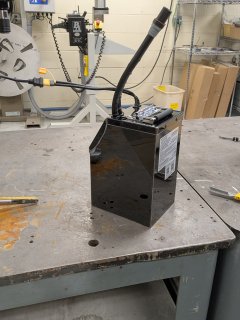
PXL_20260324_210208042.jpg
 
Hm, this is a chinese company too, you're saying you had no tarriff problems with them but you did with em3ev ( chinese ) ?
This is strange because em3ev has been using some kind of back-route to avoid tarrifs

Did em3ev tell you their tarriff situation changed, which is why you didn't order from them?
 
I've got nothing against Em3ev - they're great and worthy of the respect they get here. Their prices have gone up a lot since I ordered several batteries from them a few years ago. When I comparison-shopped their 862wh triangle battery (which is now unavailable) was priced at $568 before shipping, in January. The battery I bought from Amorge was also $568 and 1820wh with a 300A BMS. Shipping was $86 and it shipped out of Hong Kong via Taiwan. With quality and service being similar I felt I got a better deal. --( Personal opinion backed by actual numbers)
 
Hmm, i haven't noticed price increases on their site much

I looked at a recent listing and they seem to be giving decent bang/$ still
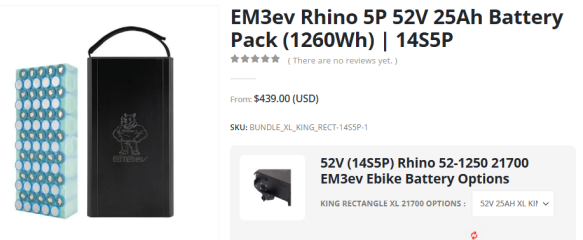
But they don't list the cell in the advertisement ( strangely, it's in the dropdown only ), and appear to have an AI produced ad text, which i usually see as suspect :cry:
1774905145245.png


So just to be clear; you didn't have a tarriff problem with them? you didn't attempt to make an order with them recently? It was more based on price?
 
No, it was purely a price comparison. I have to say those Rhino batteries were tempting but the form factor didn't fit my frame triangle and my Luna ludicrous controller needs 60A. Em3ev also doesn't quote shipping until checkout and I have paid over $150 to get a battery to the USA.
 
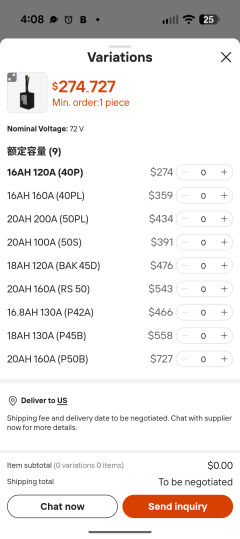
Amorge does seem cheaper. 72V 20Ah battery using Samsung 50S cells is $391:
Screenshot_20260330-160814.png

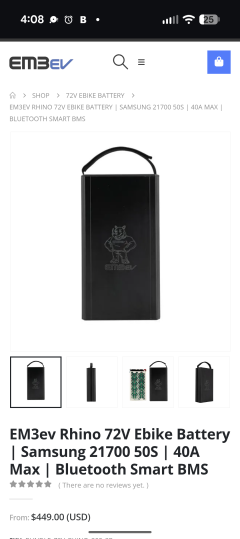
Meanwhile Em3ev 72V 15Ah battery using Samsung 50S cells is $449:
Screenshot_20260330-160801.png

So Amorge is giving more for less. Not sure about shipping and tariff differences, though. EM3ev seems to have more standard formats too.
 
So what's a fellow to do. Pay twice as much for a EM3EV battery that's not certified because of positive feedback, buy a newer UPP in hopes it's safe (they also have positive feedback), or give up and lie on the couch?
Buy from a reputable dealer, in person if possible. That's what I'm doing, driving down to the distributors shop and getting a fitting then buying, Panasonic cells. Depending on usage a decent battery will last what, 4 years, 8 years? The extra few hundred isn't much in the scheme of things over that time frame. Not for me anyway.
 
It broke my heart, being a "thrifty Yankee", but I took my two UPP004 batteries to be recycled, after 5 years of excellent performance. The thought of a single cell shorting leading to a catastrophic fire was causing me to lose sleep, so that tipped the scales.

I just ordered a 52V 19.xAh downtube battery from em3ev. The cell level fusing was the kicker for me. I'm hoping it won't fry the controller from my 2021 bafang 500W rear hub kit. I don't intend to fully charge it, so it may work out without buying a new controller. I figure it will be enough battery in case I upgrade to a 750W motor in the future.

Thanks for all the input on this. Apparently riding ebikes isn't for the feint of heart!
 
All lithium batteries can do this, some just more likely than others. The cheaper typically, the more likely.
Cell level fusing is nice to have but cell quality matters a lot more for safety.

I like em3ev because they go overboard; it's the right direction to err in :)
 
Nothing else can make up for poor source cells. Once you have those:
  • Don't smack it, Don't drop it. Don't pretend that you didn't drop it if you do.
  • Don't overcharge it.
  • Don't discharge it below 20% capacity.
  • Don't overheat it (sun, closed car, etc.)
  • Don't charge it when it's cold.
  • Don't let water get into it. Most plastic cases are designed so they keep water out if you don't turn it upside down. I have not had problems with this.
You best practice would be to work out the usual capacity you need, and then keep the charge between ~80-85% top and 20% bottom. The battery will last about 3x times as long and that will save you $$
The range of 80-20% will help a lot with cycle life, but doesn't always make sense to specifically spec around. Most modern high quality cells are rated to have 80% capacity at 1000 cycles at 100% depth of discharge. For most use cases, 1000+ cycles is 3+ years at least. Losing 40% of your capacity to make a 3 year battery last 10 years is not always worth it.

If you want a battery to last longer than 3 years but don't need 10 years- keeping between 10-90% might get you 6 years, and you don't lose as much capacity.

Note: modern cell chemistries often are designed to go down to 2.5V rather than 3.0V, and contain a significant amount of capacity in that region. Many devices and ebikes have the LVC at 3.0V for each cell, so you can simply make sure not to charge above 90% capacity.

As a general rule, don't look twice at a battery pack that doesn't specify what the cells inside it are, and if it does specify, then find the datasheet for that cell and check nominal capacity, continuous discharge rate, and cycle life.
Make sure the cell can do what the pack promises, in effect.
 
All lithium batteries can do this, some just more likely than others.:)
Fires, when I read posts like this I get the urge to go downstairs and push my ebike out into the backyard. I've never had a fire, and I have untold lipos here loose and in a variety of devices. I have taken old ones, individual cells and bashed them flat with hammers, not so much as a spark. I know the energy content plays a big part in the fires but what of the material itself? I have a few old ones downstairs and I'm going to fully charge a couple and put them in a drum on top of a small fire and see what happens. I'll burn a couple of flat sells too. Flat as in depleted, not physically flat.
 
Fires, when I read posts like this I get the urge to go downstairs and push my ebike out into the backyard. I've never had a fire, and I have untold lipos here loose and in a variety of devices. I have taken old ones, individual cells and bashed them flat with hammers, not so much as a spark. I know the energy content plays a big part in the fires but what of the material itself? I have a few old ones downstairs and I'm going to fully charge a couple and put them in a drum on top of a small fire and see what happens. I'll burn a couple of flat sells too. Flat as in depleted, not physically flat.
That's interesting, the bashing with hammer exercise. I had been led to believe that the seperator between anode and cathode was critical, and breaching it would lead to internal short, resulting in an exothermic reaction hot enough to cascade to adjacent cells, resulting in a fire hot enough to melt most metals and alloys.
 
I'm hoping it won't fry the controller from my 2021 bafang 500W rear hub kit.
The battery is not likely to fry the controller, unless its voltage is overspec for the controller input voltage.
 
That's interesting, the bashing with hammer exercise. I had been led to believe that the seperator between anode and cathode was critical, and breaching it would lead to internal short, resulting in an exothermic reaction hot enough to cascade to adjacent cells, resulting in a fire hot enough to melt most metals and alloys.
The batteries were flat, I'll try it again with a fully charged cell, 18650s. I have dozens of older ones, the cheap chinese ones that come with torches etc. I wanted to do the fire test because it's obvious the heat of the fires is triggering them.

There goes the neighborhood
 
It’s usually a combination of cell quality, BMS behavior, and how the system is integrated (charging profile, inverter compatibility, thermal management)

Several years back before retirement when I was riding my ebike to work and the subject came up I posted the concerns and safety guidelines I've learned and have echoed here onto our company's private Slack workspace after a local news item about battery fires.

A coworker who is also an SES (State Emergency Services) volunteer then commented that he had lost count of the number of house fires he had attended that had been started by leaving a battery on a charger all the time - mostly portable power tools.

So, I consider my concerns validated. I pay for batteries that the seller guarantees are made with name-brand cells and proper BMS electronics, etc. Li-ion batteries are not nitroglycerin, but I largely treat them as if they are anyway.

And I sleep well at night, and I wake up the next morning. For me, that's money well spent.
 
It's rare to see lithium cells leak. At least i have not seen/experienced it or heard of it.

Just an FYI - They do leak. I've seen it several times and once on one of my packs where I discussed it here -

 
Back
Top