• Hello ES! We could use some help to get us past the finish line on building the new knowledgebase for the forum.
    Can you donate? Please see our fundraising page. Thank you!

2011 Zero S Battery replacement?

jkrienert

⚡ Regular
Joined
Jun 13, 2021
Messages
292
Hello, I've found a Zero motorcycle (2011 S) for sale. The battery has some capacity left, yet it will likely need replacement in the near future.

To prepare for that if purchasing, I'm planing a replacement pack. So far the only dimensions I have found on the Internet for the 4.4kw (3.9kw useable) pack onboard is 19" length x 13" height x 9" width. I do not know if that's inside or outside, but presumably outside.

Does anyone have access to one of these packs or knowledge on the inside and outside dimensions?

Also, if anyone has helpful advice on making such a battery swap, namely how to handle possibly dodging the Zero BMS and utilizing one I have on hand (Orion 2 Jr.) to balance and maintain the pack? I am aware of the MBB and some other postings on the internet about how there is some challenges with that facet of substituting my own BMS and traction pack.

For the planned new pack, I have some cells that might fit (LFP prismatic BYD C13), though they will require a 16S design for an equivalent useable voltage range to the manuf. 14S NMC design. Anyone have experience on transitioning chemistry (NMC to LFP)?

Hopeful. Grateful.
 
Last edited:
namely how to handle possibly dodging the Zero BMS and utilizing one I have on hand (Orion 2 Jr.) to balance and maintain the pack?
Iirc the Orion 2 jr. is a 16s Bms and the zero S battery is 28s4p so doubtful it would work. You could split the pack in two and charge one half at a time.
What model of zero is it?
Later floyd
 
I don't think it will be 28s on this early model, my 2011DS has a 14s battery. I think I found a wiring diagram for 2011DS on electricmotorcycleforum, but I can't access the forum now. I can't access the unofficial zero manual site either 🙁

I have seen that people say they can bypass the bms on these early bikes rather easy, like connect two wires or something. But not actually wich wires you need to connect..
 
@floydr It is a 2011 Zero S. Its original traction pack is a 14s12p NMC. So, I'm supposing that a 16s LFP (110Ah prismatic cells) should be a decent equivalent v range in terms of motor rating and controller programing?

@j bjork I also spent the last couple days trying to access those resources to no success. Access denied or sites are down...

I'd love to figure out which 2 wires can help me skip the onboard BMS... If and once I get the bike, I'll definitely be doing some internal exploring and share what I find here. Ultimately my hope is this frame will support an eventual migration to 3phase motor and controller. That might be a waaaays off tho...
 
Its original traction pack is a 14s12p NMC. So, I'm supposing that a 16s LFP (110Ah prismatic cells) should be a decent equivalent v range in terms of motor rating and controller programing?
Same basic voltage, a bit more capacity. It may work. But expect to do some reprograming of the motor controller
later floyd
edit:some of your questions might be answered in these threads Google search results
 
Last edited:
Wow... Long couple days here. I got out of work early on Monday and took the opportunity to pounce....

Travelled a few hundred miles to pickup, paid in full requested price, strapped to my vehicle hitch, and landed tired late last night. I couldn't go to sleep without some testing on back roads near my residence... And

Oh man, what a horse! The battery is in a way better state than I'd supposed being it was manufactured in 2011, though it only has 815 miles. Apparently the previous owner had wonderful battery maintenance practices, and never let it go completely dead.

I started to troubleshoot issues that were part of the voiced motivation of the seller to let it go. Including the lever activated brake light being finicky, the kickstand hal effect sensor having intermittent function, and others.

While working on those small bugs I measured the outside dimensions of the battery: 18.375" L x 8.875" W x 10.25" H with roughly 0.0625” T aluminum sheet. Inside dimensions can be inferred from those for estimating what cells to use for a replacement battery. Yet an exact measure of the interior will be needed before ordering any repair parts. That's on hold for now since the existing pack has life left.

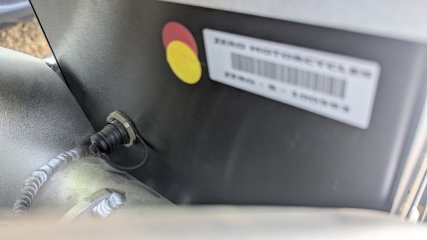
While measuring the battery I found something I've not (yet) found discussed anywhere online in forums or the original manual... There is a small round female comm port on the aft of the battery pack. Anyone know if there is a way to tap this for reading battery attributes?? I'm supposing it's a BMS comm, yet iirc the 2011 (gen 1?) packs didn't use CANBus? I'm considering contacting Zero direct, though I don't suppose they will be able to help much due to liability.
 
Last edited:
There should be a way, and I think I saw something about it in one of the previous mentioned forums that seems to have disappeared..
 
@j bjork I tried the waybacktimemachine for looking up some of the old pages with knowledge on this bike, to no success...

I'm have a bit of an upset stomach about the possibility this will be a very difficult horse to upkeep and maintain... However I keep reminding myself how good a deal they gave me on it and...
Plus, well it's such a blast to ride.

This is my first motorcycle after 30+ years of being a bicycle nut. The feeling, even at 20 or 30 mph, when your jacketed in the breeze and there are relatively no blind spots between you, the road, and the world...I imagine it's about as close to galloping on a horse was 200+ years ago... Aside from no manure . Lol.

There is some **** for me to deal with tho. After a long one at work yesterday I took the zero out. I had put it on the charger early that morning and left it there all day, well beyond the time needed for a full charge, with the hopes it would top balance balance the cells for the maximum range possible.

The route I took to test and practice my driving followed some hilly back roads. MANY little hills, each with laterally tight (over 50-200 yards between hill tops) gain/loss of 50 to 250 ft elevation. I maintained a speed of 30-45 mph most of the way, aside from some slower 10-20 mph tight turns.

On the way back with about 3 miles to go the last two bars on the battery started blinking letting me know I better find a plug... Though, on the homestretch 1/4 mile, just before my driveway I let it rip and got it up to 63 mph. Whoosh, I think I'd be alright just staying steady at 30-40 mph. Over 50 mph feels like light speed to me (fledgling motobiker). Remarkably It still had enough juice to make it up the drive and park without any dieing or v sag. All in all, the distance covered was about 18 miles.

That range is alright for in town travels, but I'm really striving for in between town travels (20-40 miles), so it's clear to me that I need to really consider battery refurbishment.

I have 16s BYD C13 cells ready left over from another project, yet they are slightly bigger in monolith than the original battery case. I reckon a new case could be built and it looks like it will fit in the frame. However my concerns continue to raise, as the more I look on the Internet for knowledge, the more I realize there really isn't much available information to go by.

While I am supposing there won't be much response, I might still take the time to write a letter to Zero and see what they might share or offer in terms of support given my situation. That and continue to tinker and seek knowledge here, which might be the more fruitful path down the trail anyhow....
 
I have a manual (what you got with the bike when new I suppose) and some instruktions and a program for the motor controller, but that is pretty much it I think. I should have saved all info I found online, but I didn't expect it to disappear :(
Especially that wiring diagram, but it wasn't easely printable from what I remember.

I remember thinking the range wasn't great with my newbuilt battery either, but I don't remember any numbers though.
It was 2 years ago that i rode the bike any distance.
 
Where do you suppose the range fell short? Was it the DC drive system? The MBB regulation of things?

If it's the DC system maybe I remind myself that someday I could swap that for an AC motor and controller to improve the range...

I went on another long 20 mile and emptied the tank yesterday. Honestly, one way to make that pretty limited distance a little better? Maybe I'll invest in another quiq charger, mount it to the chassis, and have a way to top off a bit quicker when landing places.

@j bjork Did you rebuild the battery with the same capacity as original, and still have that sense of underwhelming range?
 
I have something like 5,8kwh, but I don't remember what the range is on it. 20mile is something like 30km I think, I think I have more than that. Maybe double? I put a voltmeter on it so I can at least see what voltage range I can use, but I don't remember if I have tested it..
 
I just noticed another recent Zero post @j bjork about running beyond the end of the bars on the battery meter. I've never actually gone to none or beyond to check this, though I might soon to see if maybe the range is longer than the meter shows.

Does such a situation indicate the BMS needs to be reset? E.g. it's Columb counting is off and if there is memory supporting that it might need reset? No clue if that is even an option, though somewhere I saw a post discussing the more recent higher voltage Zero bikes having a BMS reset switch... Does the 2011 S?
 
I think it is interesting that it seems like for us both it started warning after about the same distance. At least in my case it is obvious that there is a lot of juce left when looking at the voltage, and I also have more kwh than the original battery had.
Maybe the meter it is based on used wh and not voltage?
But in that case it would stop before the meter shows empty when the battery ages :confused:
 
@j bjork Same chemistry cells as original?

My efforts are centered on migrating chemistry because it's what I have on hand. Either LFP (preferred) or LTO (less capacity/range). I have not yet determined how I'll navigate either chemistry having a different voltage range between Max and min with respect to the MMB and original BMS.

I've seen some discussions about this, but no real clear list or instructions on how to do that sustainably.

Any clues on such a reference? Is it best to bypass the MMB and BMS, and just use my BMS for the battery with the original controller?

Side note...
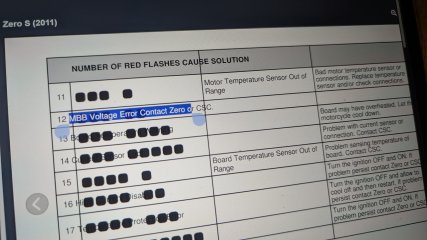
While on a longer ride yesterday I finally got a handle on the engine warning light code pattern that's been flashing. Some of the codes are mirrored depending on start and end pattern, which makes it tricky to pin point which one without some other diagnostic.

I believe the error code to be one of two signals as listed on the original manual I found online. Either dot dot pause dot dot dot (2 _ 3) or dot dot dot pause dot dot (3_2). The two photos attached have text highlighted for these errors.

Now, all functions on the bike seem nominal, so I don't have any explicit problem associated with this warning. Yet, for either of those order error codes, the manual listed action seems worthy of concern. Both say contact a zero technician...

Any thoughts? About diagnosing this error code?
 

Attachments

  • PXL_20260812_025244043.MP.jpg
    PXL_20260812_025244043.MP.jpg
    6.2 MB · Views: 6
  • PXL_20260812_025156045.MP.jpg
    PXL_20260812_025156045.MP.jpg
    8.8 MB · Views: 6
Last edited:
I'm surprised those old DC motors are still running. Don't they need new brushes? I've thrown out a lot of DC power tools as the brushes that transfer electricity wore out and I brought in bldc motor versions.

Those errors read more like battery/BMS issues, though. That's a good sign, I think, since it implies the bike will still let you ride if you drop in a new third party battery without the comm port and it will just flash those same errors about there not being CANBus signals and voltage reports from the battery management system.

I ride an ebike with a different system that requires a regular CANBus message from the battery board telling it the current maximum allowed discharge and regen amps or else it won't run 😭 Doesn't stop me from just powering the controller and motor with a different third party battery and just leaving the old battery sitting on the CANbus to send those messages, though, as long as I setup a common ground. 🤭
 
Looking to get replacement brushes if available or until those presently in use (864 miles on them) wear out and then convert to 3phase system...

Bodes promise if indeed as you mention maybe a battery swap will work though, that's supposing the same NMC chemistry?

Today I ordered a USB to TTL cable and male obd plug (bare wires and case for TTL end). That was after taking a trip on the wayback machine (website archival) only the oldest of the three archived websites worked, and it gave the wire guide to connect the USB rx and tx the female obd plug on the 2011 S subdash.

Maybe that will allow better trouble shooting the issues of the warning light, and general battery health. It might, with care and treading lightly, help facilitate the transfer to LFP battery (6.2kWh), by enabling the changing of appropriate settings... Maybe not? Anyone know about the level of settings access the MBB has?
 
Last edited:
not being CANBus signals and voltage reports from the battery management system
This leaves me mildly concerned. Is a lack of that reporting a danger when recharging these older batteries? There's not been any usage anomalies or power draw issue/sagging with the OEM pack. I just don't want to be recharging something that could go thermal runaway if it's sensors to notify and prevent reaching that threshold are compromised...
 
Here is the resource for making a USB to TTL connection with the 2011 Zero S MBB:
 

Attachments

  • DIY_usb_to_MBB.pdf
    510.8 KB · Views: 7
I saw somewhere that the oem cells are molicel IMR26700A, and this is what AI says about IMR vs NMC:


IMR (Lithium Manganese Oxide / LiMn2O4):

  • Power: Very low internal resistance allowing huge current spikes.
  • Safety: Highly stable chemistry with good thermal resistance.
  • Capacity: Generally lower energy storage capacity (shorter runtimes per charge).
  • Best Use: Power tools, heavy-duty electronics, and high-drain devices. [1, 2, 3, 4]
  • NMC / INR (Nickel Manganese Cobalt / LiNiMnCoO2):
    • Power: Moderate-to-high discharge capabilities, though pure multi-chem hybrids lean toward endurance.
    • Safety: Good thermal stability when managed properly.
    • Capacity: High energy density providing longer runtime.
    • Best Use: Electric vehicles (EVs), e-bikes, and consumer electronics. [1, 2, 3]
I didn't really care much about these differences. There are almost 10 years difference between them too, that probably can make more difference than the difference in chemistry.
I mean, as long as it is the same voltage range it shouldn't matter much to the bms I think.

But why do you want to go LFP or LTO? When I first saw you talk about LFP I thought you had a bunch of cells that you wanted to use.
If you are buying cells, why go for something less energy dense that will be harder to use? (doesn't work with the bms, and probably not the charger)
 
As someone with an LiMn manganese battery, I think the BMS does differ from standard modern lithium on my bike at least. They are self discharging, so no need for top balancing resistors, for example.

Some people go LFP for safety reasons. I agree the energy density is too poor for any battery I'd buy for a bike, though, personally.
 
LFP and/or LTO are partly for safety, but mainly for having them on hand. Though, I spent the last couple nights working on a case for the LTO so they are off the list.

The LFP are BYD C13 125Ah, with approx. 90-95% omf capacity. They will require case modifications.

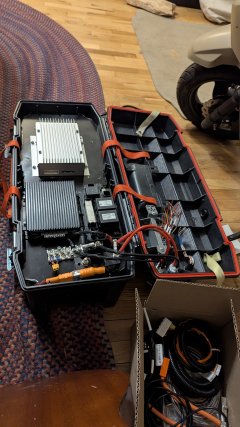
(Left photo) Case is the LTO traction pack, cells are below the phenolic firewall / isolation plate.

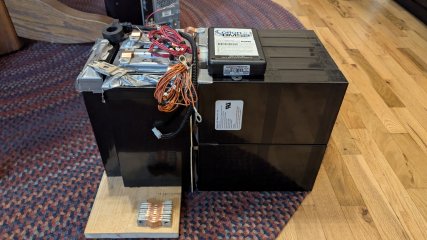
(Right photo) Uncased LFP with busses and Orion jr mockup.
 

Attachments

  • PXL_20260815_014145773.jpg
    PXL_20260815_014145773.jpg
    2.1 MB · Views: 6
  • PXL_20260810_002528991.jpg
    PXL_20260810_002528991.jpg
    2 MB · Views: 6
Last edited:
Back
Top