
• Hello ES! We could use some help to get us past the finish line on building the new knowledgebase for the forum.
    Can you donate? Please see our fundraising page. Thank you!

48v best way to wire lights in?

AC-EUV

⚡ Regular
Joined
Nov 17, 2010
Messages
101
I have a 48v quad/scooter I want to add a single headlight to the front of
How should I wire this in?
I have a flipsky 75100 Prov2 controller which doesn't have a dedicated "lights" plug like other controllers do.
It does have a 5v accessory line I could tap into

The light I have ordered works from 12-80v so my plan was to wire this straight into my battery with a simple on off switch inline on the positive cable. But found I cannot find any suitable switches that can handle 48v
(or more 54v fully charged) voltage

So I'm thinking of 2 options

Should I run a wire from my controllers 5v accessory line with a switch to a 48v relay which can then power the light (With an inline 10ap fuse on the 48v line)

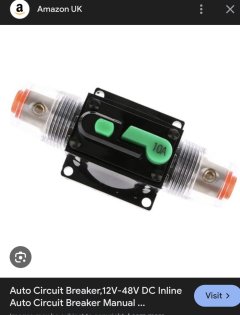
Or maybe an easier way I was thinking was to run a 48v cable directly from the battery to the light itself and get an inline 10amp circuit breaker (which has a resetting switch see pic attached) and use that as my light switch? (and fuse too)
Any reasons not to do this?

The flipsky controller also has its own small power on/off switch which I was thinking I could also tap into this wire to run a relay

So which way would be best
Relay from the controller somehow
Or inline circuit breaker direct to the light itself

Or am I missing an easier way to run a light for 48v system

Pics below of circuit breaker I was thinking about using and wiring diagram for the flipsky controller
 

Attachments

  • Screenshot_20251008-171808~2.jpg
    Screenshot_20251008-171808~2.jpg
    181.1 KB · Views: 8
  • Screenshot_20251008-171944~2.jpg
    Screenshot_20251008-171944~2.jpg
    431.4 KB · Views: 8
I use buck converter to lower voltage.Its cheap and simple to lower voltage
I did look into using a buck converter but decided against it as my thinking was it might drain unnecessary power from the battery
And so I found a light which works from 12v-80v to use directly from the battery
(Only after I ordered it I realised I couldn't then find switches ect for 48v systems)

Would a buck step down converter use much power from the battery?
 
“The best way” may be different fo different people. What I did was intercept the 48v + between the controller and display. I added a key switch there. The buck converter is added on the display side of the key switch. This way, I can turn the key and the display can now be turned on and the lights come on. When the key is removed, you can not run the bike or turn the lights on.
 
The light I have ordered works from 12-80v so my plan was to wire this straight into my battery with a simple on off switch inline on the positive cable. But found I cannot find any suitable switches that can handle 48v
(or more 54v fully charged) voltage
Any switch will work. I use a tiny toggle switch between my light and the 72V battery. The current used by the light is so low, and the voltage isn't enough to cause an arc, so I can't picture what kind of switch wouldn't be suitable.
 
I did look into using a buck converter but decided against it as my thinking was it might drain unnecessary power from the battery
And so I found a light which works from 12v-80v to use directly from the battery
if the light can run on that large range, it has a buck converter in it, so it does the same thing the separate one does, and drains the same "unnecessary" power.


how much current does the light take, worst case?

Many switches ahve both an AC and a DC rating. There are many switches available on Mouser, Digikey, etc., that have definite specificaitons (rather than lies or guesses or exaggerations on amazon/ebay/etc sales ads ;) ), that can handle up to hundreds of volts, so they would definiitely have some that can handle your battery's full charge voltage.

I always recommend using parts that are actually rated for the application, especially because many parts these days are made very cheaply and not even able to handle the ratings they are advertised for, and definitely not more (at least, not for long, and too often with catastrophic results).

Myself, I don't always follow my own advice, so I'm using an ancient 1960s tiny toggle switch (whose rating I don't know) out of the front panel of part of a roomsized computer to switch battery voltage (58v max) to my lighting system.

(it actually turns on battery power to an old 15vdc output wallwart adapter that then powers an automotive relay that connects my 4s lighting battery to the lighting and sound system on the SB Cruiser, so the switch only deals with a tiny current of a few hundred mA at most).

I am also using a "12v" battery cutoff from harbor fright as my main battery switch for the high current traction system. It has so far survived twice-daily power cycling for what must be approaching a decade now. I expected it to fail early on, but even though I have no precharge and it has to handel the full spark of controller cap charge, it still functions as it originally did.


That said--switches are rated for a voltgage because of the gap across them only being ablet o guarantee breaking current below that voltage. So using a swithc or breaker or fuse above its' rated voltage means it isnt' guaranteed to break the circuit, and might not be able to turn off. It will *probably* still work up to some point, but there will always be a point beyond which it won't work, eventually if not immediately.

A switch with sliding contacts inside (like many toggles and *some* rotary) will probably work at higher excesses than leverage-contacts (like most contactors, relays, and most pushbutton and rotary switches), beause the mechanical force sweeping the cotnacts across each other may be able to force-break the connection even if the contacts begin to weld, and may keep the contacts clean of spark-results and still wroking long after the the other types are no longer working.
(and how a switch mechanically looks like it's workign on the outside may be very different from how the contacts inside work).
 
Any switch will work. I use a tiny toggle switch between my light and the 72V battery. The current used by the light is so low, and the voltage isn't enough to cause an arc, so I can't picture what kind of switch wouldn't be suitable.
That is what I used to think too that a switch is a switch and will work at any voltage

But from what I've read recently you shouldn't just use any switch and that they have to be able to handle the voltage and also the amp draw
So ideally for 48v I would need at least a 58v switch
 
Last edited:
if the light can run on that large range, it has a buck converter in it, so it does the same thing the separate one does, and drains the same "unnecessary" power.


how much current does the light take, worst case?

Many switches ahve both an AC and a DC rating. There are many switches available on Mouser, Digikey, etc., that have definite specificaitons (rather than lies or guesses or exaggerations on amazon/ebay/etc sales ads ;) ), that can handle up to hundreds of volts, so they would definiitely have some that can handle your battery's full charge voltage.

I always recommend using parts that are actually rated for the application, especially because many parts these days are made very cheaply and not even able to handle the ratings they are advertised for, and definitely not more (at least, not for long, and too often with catastrophic results).

Myself, I don't always follow my own advice, so I'm using an ancient 1960s tiny toggle switch (whose rating I don't know) out of the front panel of part of a roomsized computer to switch battery voltage (58v max) to my lighting system.

(it actually turns on battery power to an old 15vdc output wallwart adapter that then powers an automotive relay that connects my 4s lighting battery to the lighting and sound system on the SB Cruiser, so the switch only deals with a tiny current of a few hundred mA at most).

I am also using a "12v" battery cutoff from harbor fright as my main battery switch for the high current traction system. It has so far survived twice-daily power cycling for what must be approaching a decade now. I expected it to fail early on, but even though I have no precharge and it has to handel the full spark of controller cap charge, it still functions as it originally did.


That said--switches are rated for a voltgage because of the gap across them only being ablet o guarantee breaking current below that voltage. So using a swithc or breaker or fuse above its' rated voltage means it isnt' guaranteed to break the circuit, and might not be able to turn off. It will *probably* still work up to some point, but there will always be a point beyond which it won't work, eventually if not immediately.

A switch with sliding contacts inside (like many toggles and *some* rotary) will probably work at higher excesses than leverage-contacts (like most contactors, relays, and most pushbutton and rotary switches), beause the mechanical force sweeping the cotnacts across each other may be able to force-break the connection even if the contacts begin to weld, and may keep the contacts clean of spark-results and still wroking long after the the other types are no longer working.
(and how a switch mechanically looks like it's workign on the outside may be very different from how the contacts inside work).
Current wise specs say at 12v it uses 2.2amps
and at 24v uses 1.1amps

I thought it must have a step down converter inside it too hence why it can run on that range of voltage so I ordered it.
Only after I ordered I couldn't then easily find any switches or inline fuses ect for 48v

Maybe I should just run it direct from my 48v battery then if it has a step down built in? And find an inline fuse and switch at the right voltage

So far I've looked on Mouser and digikey ect and struggling to find a switch at 58v which can handle more than 5amps they are all 200milliamps or 0.5amps?
 
Last edited:
That is what I used to think too that a switch is a switch and will work at any voltage

But from what I've read recently you shouldn't just use any switch and that they have to be able to handle the voltage and also the amp draw
So ideally for 48v I would need at least a 58v switch
Did you ever actually experience an issue, or is this only based on reading?
 
Did you ever actually experience an issue, or is this only based on reading?
No I've not had any switch issues myself, I just saw a video on YouTube of someone explaining why you shouldn't do it and so I then read up about it which seemed to confirm what the guy in video said
 
No I've not had any switch issues myself, I just saw a video on YouTube of someone explaining why you shouldn't do it and so I then read up about it which seemed to confirm what the guy in video said
There's some value to making yourself feel safe. I'm too cheap to spend much on creating a huge safety buffer, but if it gives you more confidence, then that's one less thing to worry about.
Maybe you could use one of those super cheap handlebar mounted switches that are used to turn your controller on and off. They handle full pack voltage, or are supposed to. I use one for my controller and it's been actuated 4 or 5 thousand times. But don't take it apart, since it's cheap as crap inside and may erode your confidence. $5.
1760047006009.png
 
There's some value to making yourself feel safe. I'm too cheap to spend much on creating a huge safety buffer, but if it gives you more confidence, then that's one less thing to worry about.
Maybe you could use one of those super cheap handlebar mounted switches that are used to turn your controller on and off. They handle full pack voltage, or are supposed to. I use one for my controller and it's been actuated 4 or 5 thousand times. But don't take it apart, since it's cheap as crap inside and may erode your confidence. $5.
View attachment 378831
I love cheap stuff from aliexpress, but those cheap switches in my experience were next to useless. I'd spend a bit more and buy something that's actually reliable, especially if you want to pass the battery voltage through it. And definitely fuse this line.
 
For peace of mind I would rather have a switch rated for the volts and amps I am using.

However I am having no luck finding any switches rated for 48v (or 54v) and above 5amps only ones I can find are £80 plus which is way out of my price range for a little light switch

So I am now thinking of getting a buck step down converter to reduce the voltage down to 24v then use a readily available 24v switch
I have managed to find an inline fuse rated for 58v by the brand Littelfuse for the 48v side of things

So would it be ok to use a step down converter to 24v if the light itself also has a step down converter built inside of it? I'm guessing no harm but any reasons why not?
 
So I am now thinking of getting a buck step down converter to reduce the voltage down to 24v then use a readily available 24v switch
I have managed to find an inline fuse rated for 58v by the brand Littelfuse for the 48v side of things
So are you going to have a way to turn off the buck converter? If not, the parasitic load will be draining your battery when you're not riding.
 
So are you going to have a way to turn off the buck converter? If not, the parasitic load will be draining your battery when you're not riding.
The buck converter itself wouldn't be switched no

But if I'm not riding it then I generally always turn off the battery anyway (with the built in battery switch on the hailong battery)

So that should never be a problem
 
The buck converter itself wouldn't be switched no

But if I'm not riding it then I generally always turn off the battery anyway (with the built in battery switch on the hailong battery)

So that should never be a problem
Save yourself some money, and just have the light come on when you fire up the bike and toggle the battery on.
 
Save yourself some money, and just have the light come on when you fire up the bike and toggle the battery on.
I could have the light permanently live
Although fitting a 24v switch isn't a problem after the step down converter to turn the light on and off if needed I could do that


But would it be a problem to have a 48v step down converter to 24v if the light itself also has a step down converter built inside of it?
I'm guessing not??
 
Back
Top