• Hello ES! We could use some help to get us past the finish line on building the new knowledgebase for the forum.
    Can you donate? Please see our fundraising page. Thank you!

Hub mid-drive dual motor combos

But isn't this only because a comparable hub is a much larger motor?
A comparable hub has both more thermal mass and a more efficient path to ambient air. At the same time, it has the capacity to burst far more power, even on a pound for pound basis.
 
These dual hub bikes you're referring to are 750w a piece, right? So 1500w? I get almost that much power out of my bbs02, and I make double that with a single dd hub. My 48v dual motor bike made about 2600w total. You can probably get more than 1500w out of some (single) geared hubs.


You seem to be saying the mid drive pulls the hub up to a speed where the hub is more efficient, but I don't think that's what Chalo was referring to.
I realize a hub can take huge amps . Amps being equal the mid-drive plus hub beats dual hub motors
 

Too bad 36v only.

Also assuming the motor is 82% efficient motor watts with the supplied 36v 15 amp controller motor power would be 442 (re: 36v x 15 amps x .82 = 442 watts)

That is not too bad. However, I question how long it could output that 442 watts at the motor? As a comparison point a 4 kg MAC with .27mm laminations is only rated at 500w continuous at 200 rpm and 800w continuous at 300 rpm:


If max unloaded speed is 328 rpm then peak power is probably coming in around 250 rpm. A MAC at this same RPM would be rated at ~650 watts continous.
 
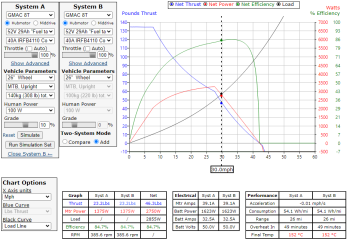
No motor will prevent you from running any voltage. Your limit is thermals. You want a high voltage and high RPM on the geared motor so it can help the DD hub across it's speed range, and since your load per RPM point on the geared hub is dropped, it'll be very happy to spin on a higher voltage for ya ( notice that both of these motors are producing good efficiency considering the climb )

In this scenario, we're just using the front geared motor part time for hill climbing. If you're not doing a very long mountain climb, the geared motor gets a lot of time to cool off between hills. You can take advantage of that and push that geared motor very hard intermittently.

This solution covers ~75% of what a mid drive can do. You're still out of luck for extreme grades.


Here's a scenario with dual MACs.

1723926354521.png

Beyond this point, you just need more and more hub motor, or even smaller wheels to make hill climbing work without releasing the magic smoke.

Ya gotta admit that a continuous 10% climb for 49 minutes till overheat is damn impressive.
 
Last edited:
Motors don't have a voltage. They only have an RPM per volt constant.

I'm only going by the supplied kit.

But lets say we use 48v to raise unloaded rpm from 328 to 437.

Assuming peak power occurs at the same percentage of unloaded speed when switching to 48v from 36v (a trend I noticed holds true when using the ebikes.ca motor simulator).....this means we would have peak power occur at 333 rpm for 48v if peak power occurred at 250 rpm for 36v.

333 rpm should yield a proportionally higher continuous power unless heat shedding starts becoming an issue.

Maybe that is why they are not offering a 48v option?
 
Last edited:
If you used that thing as a primary motor at 52v, you'd burn it out fast.
Motors are rated primarily on their thermal properties as a single motor configuration.
 
No motor will prevent you from running any voltage. Your limit is thermals. You want a high voltage and high RPM on the geared motor so it can help the DD hub across it's speed range, and since your load per RPM point on the geared hub is dropped, it'll be very happy to spin on a higher voltage for ya ( notice that both of these motors are producing good efficiency considering the climb )

In this scenario, we're just using the front geared motor part time for hill climbing. If you're not doing a very long mountain climb, the geared motor gets a lot of time to cool off between hills. You can take advantage of that and push that geared motor very hard intermittently.

This solution covers ~75% of what a mid drive can do. You're still out of luck for extreme grades.


Here's a scenario with dual MACs.

View attachment 358325

Beyond this point, you just need more and more hub motor, or even smaller wheels to make hill climbing work without releasing the magic smoke.

Ya gotta admit that a continuous 10% climb for 49 minutes till overheat is damn impressive.

Those hubs are pulling 40 amps each that's like dual 2000 watt motors.
 
..yet combined they weigh as much as a 2000w rated motor. :)

The only problem with such a setup is, a front suspension fork has a weak dropout compare, and you would really want front suspension at the speeds that setup would go,

That's why i'd say a smallish geared motor for the front is just the ticket for boosting a DD.
 
..yet combined they weigh as much as a 2000w rated motor. :)

The only problem with such a setup is, a front suspension fork has a weak dropout compare, and you would really want front suspension at the speeds that setup would go,

That's why i'd say a smallish geared motor for the front is just the ticket for boosting a DD.
I have seen a 750 watt front hub break the headtube off a frame, not a fan of front motors.
 
..yet combined they weigh as much as a 2000w rated motor. :)

The only problem with such a setup is, a front suspension fork has a weak dropout compare, and you would really want front suspension at the speeds that setup would go,

That's why i'd say a smallish geared motor for the front is just the ticket for boosting a DD.

One of the complaints I have read is that when a front hub motor accelerates hard it causes the forks to extend and pulls on the fork lowers in such a way that the stanchions are not used to. So the concern goes beyond just the drop out strength.

Going beyond the forks another thing to consider is the design of the head tube, top tube and down tube. In the normal operation of an analog bike a major force experienced by these parts comes from braking. This causes the down tube to undergo compression while the top tube undergoes tension as the braking force from the wheel tries to essentially steepen the head tube angle. When you add a front hub motor the force is reversed and now instead of the top tube undergoing tension it undergoes compression and instead of the down tube undergoing compression it undergoes tension.
 
Last edited:
I have seen a 750 watt front hub break the headtube off a frame, not a fan of front motors.

That's pretty exceptional, usually it's the fork or dropout that snaps first from the twisting force.

I would personally not run over 500w on a front motor. The only situation i'd run one, is a 2 motor configuration. I would also tune out the initial torque significantly, making the power band kind of flat.
 
Last edited:
That's pretty exceptional, usually it's the fork or dropout that snaps first from the twisting force.

I would personally not run over 500w on a front motor. The only situation i'd run one, is a 2 motor configuration. I would also tune out the initial torque significantly, making the power band kind of flat.

For a time, I used a 44V x 60A (so like 2kW mechanical output) QS212 hub motor on the front wheel of one of my bikes. Eventually I did ruin the fork, but not from motor related forces. The disc brake ejected one side of the front axle (the other side remaining attached by the Grin torque arm). Because I'd had to file away the lawyer lips from the fork tips to accommodate the 16mm axle, there's was nothing standing in the way when braking reaction force exceeded axle nut clamping force.

That bike would easily skid the front wheel on startup if I got too exuberant with the throttle. Otherwise it was very manageable.
 
I would personally not run over 500w on a front motor. The only situation i'd run one, is a 2 motor configuration. I would also tune out the initial torque significantly, making the power band kind of flat.

Unfortunately that will negate some of the value proposition of a hub motor helping a mid drive which is to 1.) soften the effect of mid drive's torque on the pedal drive train and 2.) make shifting (when a hill begins to steepen and/or a headwind comes during a climb) to a larger rear cog easier.
 
For a time, I used a 44V x 60A (so like 2kW mechanical output) QS212 hub motor on the front wheel of one of my bikes. Eventually I did ruin the fork, but not from motor related forces. The disc brake ejected one side of the front axle (the other side remaining attached by the Grin torque arm). Because I'd had to file away the lawyer lips from the fork tips to accommodate the 16mm axle, there's was nothing standing in the way when braking reaction force exceeded axle nut clamping force.

That bike would easily skid the front wheel on startup if I got too exuberant with the throttle. Otherwise it was very manageable.

I'm imagining this is a steel fork, no?
Man that's a weird failure!

To be clear, i was referring more to suspension forks, which usually come with aluminum or magnesium lowers, which just aren't fatigue resistant enough. The steel suspension fork is an unfortunate rarity..
 
I'm imagining this is a steel fork, no?
Man that's a weird failure!

It was one of these:

The listing then and now says high tensile steel, but the packaging claimed chromoly. Either way, it was substantial enough to work as intended. It was even substantial enough to let me come to a controlled stop with only one end of the front axle still attached to the fork!
The steel suspension fork is an unfortunate rarity..

Too true. They're either hideously cheap and awful telescopic models intended for department store/mail-order BSOs, or hideously cheap and awful vintage style springers for "customizers".
 
I'm imagining this is a steel fork, no?
Man that's a weird failure!

To be clear, i was referring more to suspension forks, which usually come with aluminum or magnesium lowers, which just aren't fatigue resistant enough. The steel suspension fork is an unfortunate rarity..

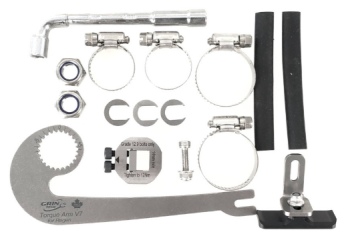
Wouldn't dual torque arms like the Grin v7s be the answer for lack of drop out strength in the suspension lowers?
 
Wouldn't dual torque arms like the Grin v7s be the answer for lack of drop out strength in the suspension lowers?

I think these recent ones would do a good job. The clamping dropout provides a very tight fit, and some decent % of the dropout motor holding strength gets moved closer to the bridge and seals, which both help resist twisting.

1724012284774.png

I might do 750w peak with a pair of these, 1000w on a heavy suspension fork with massive stanchions ( 40mm+ ).

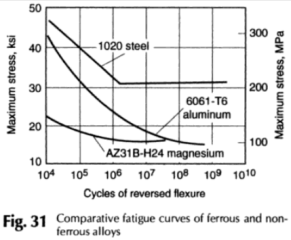
I'm still worried about fatiguing the metal of a suspension fork. If you can get aluminum lowers with steel stanchions, i think that's your best case:

1724013314715.png
Reference: Google Scholar
 
How do these $1200 dual hub bike's hold up . Can't imagine a great amount of engineering went into designing them.

If you are referring to one of the many dual motor fat bikes in that price range without a shadow of a doubt it will have a Chinese fork like this one from Bolany:


Reason: Only the chinese make suspension forks in 135mm front spacing.

Despite Seth being impressed by the performance of the Bolany fork he is concerned about this happening:


Though AFAIK he didn't test it until a sudden failure happened. I believe the statement about the sudden failure is what he speculates will happen.

However, here is what happened during real world trail usage with a Bolany fork at 6 months:


So Seth's speculation was accurate.
 
Last edited:
If you are referring to one of the many dual motor fat bikes in that price range without a shadow of a doubt it will have a Chinese fork like this one from Bolany:


Reason: Only the chinese make suspension forks in 135mm front spacing.

Despite Seth being impressed by the performance of the Bolany fork he is concerned about this happening:


Though AFAIK he didn't test it until a sudden failure happened. I believe the statement about the sudden failure is what he speculates will happen.

However, here is what happened during real world trail usage with a Bolany fork at 6 months:


So Seth's speculation was accurate.
I don't think they're putting air forks on these just a super cheap steel springer might be better for a front motor but still not engineered for that application.
 
I don't think they're putting air forks on these just a super cheap steel springer might be better for a front motor but still not engineered for that application.

The parent company that makes Bolany is called Bucklos.....and Bucklos also makes a bunch of other brands of forks like ZTZ and Lutu:


In fact, as the video points out these various forks all come in the same Bucklos box:


Anyway, this company named Bucklos also makes coil spring forks as well:

 
Last edited:
For hill climbing you can get a 3000w 60a controller for the BBS02 or BBSHD. I imagine the extra torque would climb the hill fast.

I’m currently considering Leafbike 1500w or BBSHD torque sensing. As Chalo mentioned probably a more powerful hub would also achieve the hill climbing performance you’re after. I’m more after top speed and efficiency for hills… so that’s another use case for your proposed setup. Hub has a bit more speed probably, and mid drive more efficiency for the hills. That’s my guess anyway. Can’t quite find the sweet spot to decide for me

(Edit: looking at all 48v or 52v for me, but with higher amp battery capability. Unfortunately the 60a BBSHD controller isn’t for the torque sensing version or that would be a good option)
 
I think these recent ones would do a good job. The clamping dropout provides a very tight fit, and some decent % of the dropout motor holding strength gets moved closer to the bridge and seals, which both help resist twisting.

View attachment 358362

I might do 750w peak with a pair of these, 1000w on a heavy suspension fork with massive stanchions ( 40mm+ ).

40mm stanchion forks would be very long travel (e.g. Fox 40 has 203mm travel) so any gain of stiffness from the larger diameter stanchion is offset by the larger bending force from the longer travel.

What you want is large diameter stanchions with a shorter travel.
 
For hill climbing you can get a 3000w 60a controller for the BBS02 or BBSHD. I imagine the extra torque would climb the hill fast.

I’m currently considering Leafbike 1500w or BBSHD torque sensing. As Chalo mentioned probably a more powerful hub would also achieve the hill climbing performance you’re after. I’m more after top speed and efficiency for hills… so that’s another use case for your proposed setup. Hub has a bit more speed probably, and mid drive more efficiency for
For hill climbing you can get a 3000w 60a controller for the BBS02 or BBSHD. I imagine the extra torque would climb the hill fast.

I’m currently considering Leafbike 1500w or BBSHD torque sensing. As Chalo mentioned probably a more powerful hub would also achieve the hill climbing performance you’re after. I’m more after top speed and efficiency for hills… so that’s another use case for your proposed setup. Hub has a bit more speed probably, and mid drive more efficiency for the hills. That’s my guess anyway. Can’t quite find the sweet spot to decide for me

(Edit: looking at all 48v or 52v for me, but with higher amp battery capability. Unfortunately the 60a BBSHD controller isn’t for the torque sensing version or that would be a good option)

The sweet spot for climbs is best done with a DD hub and a mid drive once you get the gearing right neither motor over heat's and speed is up there with the high amp hub motor. A high powered mid-drive puts a lot of stress on a bicycle drive train the split between motors will make both last much longer.
 
Back
Top