• Hello ES! We could use some help to get us past the finish line on building the new knowledgebase for the forum.
    Can you donate? Please see our fundraising page. Thank you!

DIY Modular 90V battery

mateiuskey

🔌 New-ish
Joined
Jun 11, 2026
Messages
19
Location
EU
Hey guys, newbie here, I had a few questions about battery design:

I want to make a 72V modular battery out of M50L cells. I have 130 M50L cells, and could make a 72V 30Ah battery, but I want to use it both with my ATV and my ebike, and a 30Ah won't fit in the frame. Also, making this battery bigger with time does seem nice

I bought a JK-BD6A24S12P BMS, (which has about everything adjustable, and is more than I'll ever need for a battery) and I want to split the battery somehow. From what I researched, splitting it in 2 parallel packs (72V 15Ah) would be the safer option... But I am interested in splitting them in series, maybe 3 x 8S or 4x 6S modules, so I could run about every motor by using combinations of them (and under/overvolting), but I need to know what complications would arise from that.

Also, in the parallel scenario, are there any other considerations other than having to make sure each module gets the same amount of use ( capacity drop and internal resistance stuff) and when used in parallel to make sure they all have the same voltage down to 0.05V?

I have a few friends that have a bit of experience with making batteries, so I'm not going in blind, but they are not experts by any means, so I'd like to be sure I'm doing everything right 😅
 
There's several threads on placing packs in series, and a thread on lipo packs as well which covers similar subject matter.

IIRC the two most important things are:
1) use a single overall pack BMS (safest but requires connecting and disconnecting more wires), or
2a) if you must use separate ones, make sure the packs have individual common port BMS each with MOSFETs rated to be able to block the entire combined voltage of all packs, and 2b) put a reverse diode across the terminals of each of the packs.

It is possible to design a safe system. Makita has power tools designed to put packs in series sometimes, for example. Battery management chips designed for this typically have extra signaling implemented between each other, though.

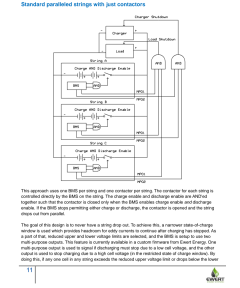
Similar to how in parallel topologies there's cases where you want to flip some overall contactor based on a signal from any individual pack BMS:
Screenshot_20260611-065345.png
Similarly some BMS manufacturers like DALY produce parallel pack balancing modules that can coordinate keeping parallel packs balanced:
 
... But I am interested in splitting them in series, maybe 3 x 8S or 4x 6S modules, so I could run about every motor by using combinations of them (and under/overvolting), but I need to know what complications would arise from that.
You’re using common port BMSs, so that’s best when configuring the packs in series or parallel. (y)

For me, the main challenges are:
  • Keeping the series packs in “balance” (at the group level so all cells of the modules are the same voltage).
  • A disciplined safe charging routine.

Cheap individual voltmeters (pretty dirt cheap on Amazon) and some simple math help to monitor each pack so you can easily see if the packs are balanced relative to each other when charging or discharging.
Charging to less than 100% and not discharging fully provides a safety buffer for small imbalances, especially if you bulk charge the whole setup.
If all cells being used are matched across all packs, they may never go out of balance, and its close to ideal. But, since it sounds like the actual usage may be of mixed configurations, all packs may not be cycled the same, so degradation may be an issue over time.

That said, I’ve used a mix of Lipos in series and parallel, in series with a lithium ion pack for several years. Obviously the cells aren’t matched, but are well matched within the lithium ion pack, and within the lipo packs. I bulk charge to 95%, and monitor the total pack voltages with cheap meters. A couple times a year I check for the voltage at the cell/group level, and I’ve never needed to balance, so for me, matched cells at the pack level is the most important thing to not make charging a big headache. I check the lipo balances more often since it’s easy using those little balance port meters, mainly because I have a healthy fear of them.
The second most important is the charge current rating of the cells. Since I charge attended, I want a fast bulk charging setup.
 
You’re using common port BMSs, so that’s best when configuring the packs in series or parallel. (y)

For me, the main challenges are:
  • Keeping the series packs in “balance” (at the group level so all cells of the modules are the same voltage).
  • A disciplined safe charging routine.

Cheap individual voltmeters (pretty dirt cheap on Amazon) and some simple math help to monitor each pack so you can easily see if the packs are balanced relative to each other when charging or discharging.
Charging to less than 100% and not discharging fully provides a safety buffer for small imbalances, especially if you bulk charge the whole setup.
If all cells being used are matched across all packs, they may never go out of balance, and its close to ideal. But, since it sounds like the actual usage may be of mixed configurations, all packs may not be cycled the same, so degradation may be an issue over time.

That said, I’ve used a mix of Lipos in series and parallel, in series with a lithium ion pack for several years. Obviously the cells aren’t matched, but are well matched within the lithium ion pack, and within the lipo packs. I bulk charge to 95%, and monitor the total pack voltages with cheap meters. A couple times a year I check for the voltage at the cell/group level, and I’ve never needed to balance, so for me, matched cells at the pack level is the most important thing to not make charging a big headache. I check the lipo balances more often since it’s easy using those little balance port meters, mainly because I have a healthy fear of them.
The second most important is the charge current rating of the cells. Since I charge attended, I want a fast bulk charging setup.
Could you give more details about your setup? When thinking about my design I thought I will need to use modules made out of the same cells (which tbh was going to be a hurdle since M50L seen to be replaced by the newer M50LT). Will using modules made out of different cells work decently? I assume it would be best if the modules have similar parameters overall. Also, how would one get around modules being newer or older? I assume that would cause some imbalances if not accounted for somehow...
 
Could you give more details about your setup? When thinking about my design I thought I will need to use modules made out of the same cells (which tbh was going to be a hurdle since M50L seen to be replaced by the newer M50LT). Will using modules made out of different cells work decently? I assume it would be best if the modules have similar parameters overall. Also, how would one get around modules being newer or older? I assume that would cause some imbalances if not accounted for somehow...
You should start with the same cells if you can. My setup meets my specific requirements while being the cheapest solution (since I’m cheap), plus I’m sufficiently paranoid, so not for most folks.

The 20S Frankenstein setup satisfies my relatively low power requirements and I wouldn’t recommend it unless you are OK with monitoring the full charging and discharging process. I charge at 8A so I only have to sit there for an hour for enough charge for my typical cruise around the neighborhood (20-25 miles). The setup has never seen a voltage below the nominal voltage (half charged) and only sees 90%-95% max charge in regular use.
I have two 6S 12Ah Turnigy Graphene lipos in parallel, that are placed in series with a 14S8P 27Ah Samsung 35E pack, but that pack has two series 7S 5Ah Turnigy Lipos (14S 5Ah) paralleled to it. Crazy.

The 35E cell pack can output 64A, but has a 45A BMS. Cell charge current for cycle life is 1A (8A for the pack). The voltage sag killing helper lipos are two 5Ah 60C rated lipos in series, then paralleled with the 14S pack to eliminate any voltage sag for that portion of the setup, and allows it to take the 8A charge rate with no stress. The graphenes already have no sag, rated at 15Cx2 continuos (720A) or 30Cx2 peak for discharge, and 3C charge current rating is pretty high. Of course I assume about half the stated ratings on any published lipo data, but I mainly use voltage sag as the measure of how the overall setup is able to perform under the loads it sees.
I don’t care about the discharge side much since I don’t run the setup to lower voltages. I charged everything to full capacity, connect it all, then bulk charge the whole thing to 90% to 95% after that, with meters on the 14S and 6S sub portions. After several hundreds of shallow discharge/charge cycles, I’ve separated the components and I’ve only seen around 0.01V-0.2V imbalance at the cell level on the lipos, and the 35E pack still takes a full charge without needing to balance.
My conclusion is matched cells within each pack is the most important thing to ensure, and not stressing any portion of Franken pack being second. I deal with the mismatches in capacity by ensuring everything is top balanced at the start with, and reducing that by 5%-10% for daily charging, which limits my paranoia; and never discharging below nominal so the pack lasts forever. This setup meets my requirements, which are fast charging, close to zero voltage sag under load, and long charge cycle life.

My mid drive is 14S4P of Molicel P45B, so it already can take something like a 28A charge, but I charge it at 8A as well. It had a tiny bit of sag under load, so I parallel the same 2x7S lipo setup to it to get rid of it all. Ya, it’s unnecessarily reckless, but I hate sag, plus it add a bit more capacity to the smallish pack. I may occasionally walk away for a few moments when charging, since I can monitor the charging and temps with the Bluetooth BMS (less paranoia), but not too long.
 
There's several threads on placing packs in series, and a thread on lipo packs as well which covers similar subject matter.

IIRC the two most important things are:
1) use a single overall pack BMS (safest but requires connecting and disconnecting more wires), or
2a) if you must use separate ones, make sure the packs have individual common port BMS each with MOSFETs rated to be able to block the entire combined voltage of all packs, and 2b) put a reverse diode across the terminals of each of the packs.

It is possible to design a safe system. Makita has power tools designed to put packs in series sometimes, for example. Battery management chips designed for this typically have extra signaling implemented between each other, though.

Similar to how in parallel topologies there's cases where you want to flip some overall contactor based on a signal from any individual pack BMS:
View attachment 389455
Similarly some BMS manufacturers like DALY produce parallel pack balancing modules that can coordinate keeping parallel packs balanced:
I have searched around but cannot find those threads, maybe I'm using the search function incorrectly, could you please link me some of most relevant ones? I'll only use Li-Ion cells for now, since from what I know LiPo's are pretty costly and wear out faster.
Also, are there any threads or good resources to learn how to optimally design a battery, tips and tricks, etc? I saw the knowledgebase is in the works but nothing on batteries for now
 
You should start with the same cells if you can. My setup meets my specific requirements while being the cheapest solution (since I’m cheap), plus I’m sufficiently paranoid, so not for most folks.

The 20S Frankenstein setup satisfies my relatively low power requirements and I wouldn’t recommend it unless you are OK with monitoring the full charging and discharging process. I charge at 8A so I only have to sit there for an hour for enough charge for my typical cruise around the neighborhood (20-25 miles). The setup has never seen a voltage below the nominal voltage (half charged) and only sees 90%-95% max charge in regular use.
I have two 6S 12Ah Turnigy Graphene lipos in parallel, that are placed in series with a 14S8P 27Ah Samsung 35E pack, but that pack has two series 7S 5Ah Turnigy Lipos (14S 5Ah) paralleled to it. Crazy.

The 35E cell pack can output 64A, but has a 45A BMS. Cell charge current for cycle life is 1A (8A for the pack). The voltage sag killing helper lipos are two 5Ah 60C rated lipos in series, then paralleled with the 14S pack to eliminate any voltage sag for that portion of the setup, and allows it to take the 8A charge rate with no stress. The graphenes already have no sag, rated at 15Cx2 continuos (720A) or 30Cx2 peak for discharge, and 3C charge current rating is pretty high. Of course I assume about half the stated ratings on any published lipo data, but I mainly use voltage sag as the measure of how the overall setup is able to perform under the loads it sees.
I don’t care about the discharge side much since I don’t run the setup to lower voltages. I charged everything to full capacity, connect it all, then bulk charge the whole thing to 90% to 95% after that, with meters on the 14S and 6S sub portions. After several hundreds of shallow discharge/charge cycles, I’ve separated the components and I’ve only seen around 0.01V-0.2V imbalance at the cell level on the lipos, and the 35E pack still takes a full charge without needing to balance.
My conclusion is matched cells within each pack is the most important thing to ensure, and not stressing any portion of Franken pack being second. I deal with the mismatches in capacity by ensuring everything is top balanced at the start with, and reducing that by 5%-10% for daily charging, which limits my paranoia; and never discharging below nominal so the pack lasts forever. This setup meets my requirements, which are fast charging, close to zero voltage sag under load, and long charge cycle life.

My mid drive is 14S4P of Molicel P45B, so it already can take something like a 28A charge, but I charge it at 8A as well. It had a tiny bit of sag under load, so I parallel the same 2x7S lipo setup to it to get rid of it all. Ya, it’s unnecessarily reckless, but I hate sag, plus it add a bit more capacity to the smallish pack. I may occasionally walk away for a few moments when charging, since I can monitor the charging and temps with the Bluetooth BMS (less paranoia), but not too long.
So let's say I build 3 packs of 8S 5P ( 120 M50L cells total), so I can have 16S and 24S capabilities. Then, in the future, if I want to make some other 8S 5P of similar cells, like the M50LT, and add them, (maybe in parallel, maybe also add in series to 32S if I can find a BMS for that) what should I have in mind?

Also, does it make that big of a difference to never discharge below nominal?

And I'm not sure how the lipo's reduce voltage sag when charging (I'm not actually familiar with LiPo's or good charging habits and I'd like to learn about that while I build my battery).,When does voltage sag occur in charging? I know a bit about it in discharging, but I'd like to be more informed about it in general.
 
Last edited:
I've killed three packs so far myself, each worth about $400. One was me prying apart super glued cells to try to remove a parallel group to decrease the pack voltage for use with a controller that couldn't handle the full charge. I likely opened a hole in the plastic wrap to the negative outside metal surface of the cell cans while doing it, causing a short the next time that touched something.

That cell quickly overheated and the cell's safety vents started venting boiling solvent, discoloring my garage walls. Glad I managed to get the pack out of my garage before that cell could set off the others in a chain reaction. Good packs use cell spacers instead of glue anyway, though. You do still sometimes have to remove spot welded metal strips, though, even then.

The other two packs I killed were all from just letting the voltage get too low. Upon dissection the cells had stared leaking afterward and had no voltage. Couldn't be charged either.

Search claims this is because the copper in the cell dissolves at low voltage, reforms with sharp tree like projections called dendrites, causes an internal short, which then leads to swelling and leakage. The popular puffy/swollen dead battery pack situation:
Lithium Ion chemistry batteries operate safely within their designed operating limits; however the cells become unstable if indavertently charged to a higher than specified voltage. Prolonged chaging above 4.3v on a cell designed for 4.2v will plate metallic Lithium on the anode. The cathode becomes an oxidizing agent, loses stability & produces Carbon Dioxide. The cell pressure rises & if the charge is permitted to continue, the internal cell pressure rises to the point that venting occurs – sometimes with flame.

Cell undercharge produces a similar instability in Lithium cells. Once the cell discharges below the minimum limit (around 2.7-3.0v for modern cells), the Copper current collector begins to corrode. Copper ions dissolved in the cell electrolyte can penetrate the cell separator causing internal short circuits. When the cell is recharged, these relatively low-resistance paths through the separator cause high internal currents to flow, heating up the cell. A severe enough short circuit can cause rupture of the cell as for overcharging, as above.
So making sure you never discharge too far helps avoid that. Technically the job of the BMS, but building a pack bigger than you need and never discharging very far does technically work.

Regarding voltage sag, every cell has a spec for maximum current charge and discharge it can handle ( in C which is a number you can multiply by the capacity ). Lipo cells are just chosen, or many cells are put in parallel to achieve, high allowed currents since they're often used for things like RC helicopters and airplanes. High current rating cells often have less capacity per cell, however.
 
So let's say I build 3 packs of 8S 5P ( 120 M50L cells total), so I can have 16S and 24S capabilities. Then, in the future, if I want to make some other 8S 5P of similar cells, like the M50LT, and add them, (maybe in parallel, maybe also add in series to 32S if I can find a BMS for that) what should I have in mind?

Also, does it make that big of a difference to never discharge below nominal?

And I'm not sure how the lipo's reduce voltage sag when charging (I'm not actually familiar with LiPo's or good charging habits and I'd like to learn about that while I build my battery).,When does voltage sag occur in charging? I know a bit about it in discharging, but I'd like to be more informed about it in general.
Not sure what you’re describing, but don’t mix cells within a pack, or even add newer cells of the same type.

I wouldn’t do it the same way today. You need to start out smaller with lipos to gain some experience with them. I took up a side hobby with RC cars, for a year just to them understand their behavior before using the big bombs strapped to my ebike. The charge and discharge curves differ from lithium ion, and the curve drops sharply at a point. I learned that with little lipos but luckily no fires. They were the solution at the time though.

Voltage sag happens when discharging, not charging. I hate it, because it equates to a delay in throttle response in the real world. I like the feeling of a direct connection between twisting the throttle and accelerating forward, and voltage sag does the opposite.

For cycle life on a lithium ion setup, people generally will go with 80-90% full, 20% remaining for empty. To meet my current requirements with cells made today, I’d just build a 20S5P pack of P50B cells. Back then, it would have been more expensive, and built with 18650 cell, and wouldn’t fit in my triangle anyway.

I described my setup as an example, but not a recommendation, of how I satisfied my own requirements, not yours, with what was available at the time, managing the risks enough to be able to sleep at night. My Specific recommendation for your case, if you didn’t already buy cells, would be to do more research and choose better cells since newer and better ones keep being developed. DIY ebike technology has been developing at a snails pace, while cell technology has been moving fast so even if my risky setup lasts forever, I’ll eventually swap it out for peace of mind by replacing it with a pack made with modern cells.

In my opinion, running packs in parallel is easy, running them in series is trickier and requires more monitoring.
 
Not sure what you’re describing, but don’t mix cells within a pack, or even add newer cells of the same type.

I wouldn’t do it the same way today. You need to start out smaller with lipos to gain some experience with them. I took up a side hobby with RC cars, for a year just to them understand their behavior before using the big bombs strapped to my ebike. The charge and discharge curves differ from lithium ion, and the curve drops sharply at a point. I learned that with little lipos but luckily no fires. They were the solution at the time though.

Voltage sag happens when discharging, not charging. I hate it, because it equates to a delay in throttle response in the real world. I like the feeling of a direct connection between twisting the throttle and accelerating forward, and voltage sag does the opposite.

For cycle life on a lithium ion setup, people generally will go with 80-90% full, 20% remaining for empty. To meet my current requirements with cells made today, I’d just build a 20S5P pack of P50B cells. Back then, it would have been more expensive, and built with 18650 cell, and wouldn’t fit in my triangle anyway.

I described my setup as an example, but not a recommendation, of how I satisfied my own requirements, not yours, with what was available at the time, managing the risks enough to be able to sleep at night. My Specific recommendation for your case, if you didn’t already buy cells, would be to do more research and choose better cells since newer and better ones keep being developed. DIY ebike technology has been developing at a snails pace, while cell technology has been moving fast so even if my risky setup lasts forever, I’ll eventually swap it out for peace of mind by replacing it with a pack made with modern cells.

In my opinion, running packs in parallel is easy, running them in series is trickier and requires more monitorin
So I already have 130 cells, I got them because they were what I could afford at this time. I want to make 3 smaller packs / modules, each of them being 8S 5P of 21700 M50L cells. The first 3 I'll make with the cells I have available. These will be connected in different configurations based on what I need on different small vehicles. But in the future, I'd like to add more modules to this battery, with newer and better cells probably. The reason I'm splitting the entire battery like that is because I want to use the same battery in different vehicles to save cost (since some of them I won't be running frequently)

Btw, all cells are Li-Ion. I have no intention of using LiPo. Just 21700 M50L cells for now, and in the future maybe 21700 M50LT or some Molicel stuff
 
So when I say parallel is easy, I mean using that configuration over the life of the packs, because all the cells are degrading at about the same time too. If you’re going to be changing configurations, where some packs are cycled more than others, it’s another thing to keep track of, especially if some are series configurations, where it’s easiest when the packs have the same capacity.
 
So when I say parallel is easy, I mean using that configuration over the life of the packs, because all the cells are degrading at about the same time too. If you’re going to be changing configurations, where some packs are cycled more than others, it’s another thing to keep track of, especially if some are series configurations, where it’s easiest when the packs have the same capacity.
So, what would happen if some are cycled more? Is it imperative that I make sure all modules are cycled equally? Or is there something I have to do when using these together with newer ones?
 
So, what would happen if some are cycled more? Is it imperative that I make sure all modules are cycled equally? Or is there something I have to do when using these together with newer ones?
Cycling equals degradation in capacity and current capability. If two identical packs are placed in series, they will both discharge at the same rate and be “Empty” at the same time and also degrade at an equal rate. If the packs have different capacities, then you will need to monitor their voltages more closely since one will hit empty faster. They may start out identical, but they won’t be if you cycle some packs more than others.
Like I said in my first post, just put a cheap meter on each pack, after figuring out ahead of time what voltage represents full and empty to you; and develop a consistent charging routine that you can live with.
 
Cycling equals degradation in capacity and current capability. If two identical packs are placed in series, they will both discharge at the same rate and be “Empty” at the same time and also degrade at an equal rate. If the packs have different capacities, then you will need to monitor their voltages more closely since one will hit empty faster. They may start out identical, but they won’t be if you cycle some packs more than others.
Like I said in my first post, just put a cheap meter on each pack, after figuring out ahead of time what voltage represents full and empty to you; and develop a consistent charging routine that you can live with.
Oh, that's not that bad, as you said, with some cheap meter on each module/pack and a bit of more headroom (maybe keeping them always over 30% instead of 20%) it seems decent. Other than that, what would be some robust charging habits?
 
If you only ever need the max discharge rating of a single pack, and only ever put them in parallel for extended range, there's battery blender modules you can buy out there as well. Allows safely connecting packs at different voltage.

Absolutely best charging practice is to charge outside. Not going to burn your house down that way. I use metal ammo cans. Second best is to always charge while present, don't sleep while charging.
 
If you only ever need the max discharge rating of a single pack, and only ever put them in parallel for extended range, there's battery blender modules you can buy out there as well. Allows safely connecting packs at different voltage.

Absolutely best charging practice is to charge outside. Not going to burn your house down that way. I use metal ammo cans. Second best is to always charge while present, don't sleep while charging.
Yeah, I have an interesting project just to charge and store those modules safely outside, it involves a 3 meter cylindrical root cellar that stays at an optimal temperature range, and is waterproof (I'd like to make the modules themselves waterproof for extra safety anyway)
 
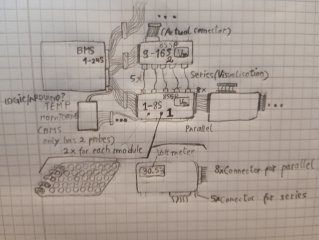
I've made some initial sketches of the whole battery arrangement, any feedback? I still have to calculate the ratings for the wires and connectors, but that comes later. Also, i think I placed the connectors suboptimally in the drawings for visualisation purposes.
 

Attachments

  • 17812816203761757132566734383381.jpg
    17812816203761757132566734383381.jpg
    2.6 MB · Views: 14
The 5x connectors between p-groups 1-8 and 9-16 in the serial arrangement could just be one thick, single connector couldn't it? Less work to connect.

It's true that Grin's modular batteries seemed to move from one pair of Anderson connectors for that:

To two XT60 connectors, though:

I suppose to run less current through a single connector. Or just because when one module ends up at the end you want two female XT60, one for charge and one for discharge. So the series connectors just ended up double because they sometimes end up at the end, and best practice for the external pack connectors is female because the pins can't short against something as easy.

Personally, every time I built something with XT60 I later wished I'd used XT90 so I could easily add an anti-spark resistor built into the connector.
 
The 5x connectors between p-groups 1-8 and 9-16 in the serial arrangement could just be one thick, single connector couldn't it? Less work to connect.

It's true that Grin's modular batteries seemed to move from one pair of Anderson connectors for that:

To two XT60 connectors, though:

I suppose to run less current through a single connector. Or just because when one module ends up at the end you want two female XT60, one for charge and one for discharge. So the series connectors just ended up double because they sometimes end up at the end, and best practice for the external pack connectors is female because the pins can't short against something as easy.

Personally, every time I built something with XT60 I later wished I'd used XT90 so I could easily add an anti-spark resistor built into the connector.
Yeah, why didn't I think of that ... thanks for the idea, I'll probably use the LiGo as reference for a few things. Can't wait to actually hop on in Onshape and cry myself to sleep designing the actual system :)) Are there any other stackable batteries from where I could learn a thing or two?
 
I wouldn't advise paralleling the packs with the balance wires unless the packs are the same age and cycles to keep the balancing currents low. Paralleling with the main wires is fine as long as the packs are plugged in together at the same voltage. And each pack would need its own BMS. How much battery can you fit on your ebike vs. your ATV? The motors only care about the voltage the controller is feeding them, so you could use the full voltage on each vehicle if you want. Your controllers would both need to be able to handle the full voltage though.
 
I've made some initial sketches of the whole battery arrangement, any feedback? I still have to calculate the ratings for the wires and connectors, but that comes later. Also, i think I placed the connectors suboptimally in the drawings for visualisation purposes.
I don’t know what I’m looking at. Is there a charge and discharge connector?
 
I wouldn't advise paralleling the packs with the balance wires unless the packs are the same age and cycles to keep the balancing currents low. Paralleling with the main wires is fine as long as the packs are plugged in together at the same voltage. And each pack would need its own BMS. How much battery can you fit on your ebike vs. your ATV? The motors only care about the voltage the controller is feeding them, so you could use the full voltage on each vehicle if you want. Your controllers would both need to be able to handle the full voltage though.
The balancing wires are 0.6A rated at least cuz it has active balancing, but if that's not enough, I could just use larger ones. My concern would be the BMS internals at that point. How different would the packs need to be cause problems?

Well, on the ebike, hopefully 2 packs, the ATV, well, 3- 9 maybe? There's a lot more room there that's for sure, and since the BMS can do 120A continuous, I intend to fill it :)) At this point I kinda want to try this because I like a good challenge.
 
I don’t know what I’m looking at. Is there a charge and discharge connector?
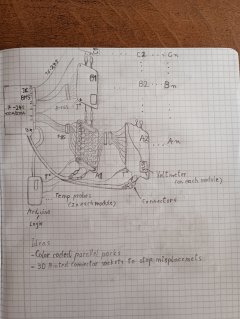
It's an unfinished sketch, so not really, here's an updated one, still has a few things missing but I'll add things as I go
 

Attachments

  • IMG_20260614_171839854_MFNR.jpg
    IMG_20260614_171839854_MFNR.jpg
    3.1 MB · Views: 8
Yeah, safe connection of packs of varying voltage seems the big limitation.

As long as each parallel pack has its own connection to the BMS B+ and P-/Controller- there will be a large current equalizing the bulk voltage on plugging in. This can be avoided with diodes, but that blocks regenerative braking and the controller feeding surges back into the cells. Also causes voltage drop unless you use ideal diodes (MOSFETs).

Similarly, when plugging the parallel connectors in, each p-group is going to equalize fast. For the Samsung INR2700-50G cells I use the maximum equalization voltage from max charge to min charge would 1.7V over 18.5 mΩ per cell generating 92A, I think. Even more current if many cells are in parallel reducing internal resistance. Meanwhile for 5P packs they could only handle 1.6A charging current x 5 = 8A.

Maybe you could connect the p-groups together with thermistors in the way. Even resistors might work. Sometimes builders use high resistance strips between cells in a p-group anyway to act as fuses. As long as each pack has its own discharge and bulk charge connectors there isn't supposed to be much equalization current between the p-group cells.

Not sure how that affects the BMS attempts to read the voltage of the p-groups and balance via discharge of p-groups during charging, though. Maybe each balance connector has to go to the BMS and not to the parallel pack next to it. That way if you add thermistors to limit inrush current, each parallel pack has the same amount of resistance shoved in front of the voltage measurements instead of that resistance multiplied by how many parallel connectors it goes through.

Definitely starting to make sense why the Daly parallel balance modules don't just have current limiting and a DC-DC converter built in to transfer voltage between parallel packs, but also communicate with the BMS on each pack to decide to turn on or off at all.
 
Back
Top