• Hello ES! We could use some help to get us past the finish line on building the new knowledgebase for the forum.
    Can you donate? Please see our fundraising page. Thank you!

Battery recommendation --> which new 5s battery should be connected in series with my 10s battery?

freddy89

New here
Joined
Dec 5, 2025
Messages
8
Location
Europe
Hello everyone,

I’m running an MTB with a BBS02b motor and two 10s4p batteries in parallel (12Ah each, so 24Ah total).

At the moment, my controller can handle a peak of 63V (thanks to a BBSHD controller with custom firmware. With the stock firmware, the cut-off voltage is 60V, which is why BBS bikes usually max out at 14s batteries.)

63V corresponds to 15s fully charged (4,2V).
I want to charge the batteries to around 4.1V per cell, which gives a total of 61.5V.
The controller draws a maximum of 33A.

I’d like to keep using my existing 10s batteries since they’re still in good condition.
My plan is to add a 5s battery in series (I’m familiar with the challenges of series-connecting batteries).
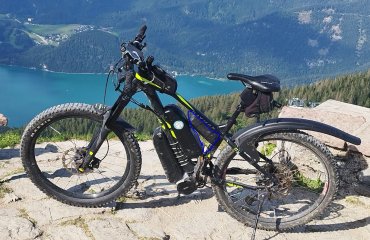
bike15s.JPG

The reason for this setup is that I want a mid-drive motor capable of very high RPMs when needed.
The bike is occasionally used for trial-like riding, and higher RPMs give me more peak power and reduce the need for shifting in difficult sections.


There’s some of space in the frame triangle (marked in blue in the attached image, instead of the bottle cage), and I’d use threaded inserts in the frame to mount the battery.


Here’s what I have in mind for the new 5s battery:
  • Nominal 18V (21V fully charged)
  • BMS capable of handling 33A for a few seconds, so a 40A BMS is recommended
  • At least 12Ah, ideally closer to 24Ah (it’s okay if the full 15s voltage is only available for short rides, but it’d be nicer if the 5s battery had almost the same capacity as the current 10s setup)

Since 5s batteries are not very common off-the-shelf for bicycle useage, I’d highly appreciate your recommendations and thoughts.


(Of course, the simpler and slightly less powerful alternative would be a large 14s battery. Downsides of that approach: higher cost, slightly lower voltage, less sustainable because I already have two good 10s batteries, and a slightly higher center of gravity (currently, one battery is mounted under the down tube).)
 
Hello everyone,

I’m running an MTB with a BBS02b motor and two 10s4p batteries in parallel (12Ah each, so 24Ah total).

At the moment, my controller can handle a peak of 63V (thanks to a BBSHD controller with custom firmware. With the stock firmware, the cut-off voltage is 60V, which is why BBS bikes usually max out at 14s batteries.)

63V corresponds to 15s fully charged (4,2V).
I want to charge the batteries to around 4.1V per cell, which gives a total of 61.5V.
The controller draws a maximum of 33A.

I’d like to keep using my existing 10s batteries since they’re still in good condition.
My plan is to add a 5s battery in series (I’m familiar with the challenges of series-connecting batteries).

View attachment 381686

The reason for this setup is that I want a mid-drive motor capable of very high RPMs when needed.
The bike is occasionally used for trial-like riding, and higher RPMs give me more peak power and reduce the need for shifting in difficult sections.


There’s some of space in the frame triangle (marked in blue in the attached image, instead of the bottle cage), and I’d use threaded inserts in the frame to mount the battery.


Here’s what I have in mind for the new 5s battery:
  • Nominal 18V (21V fully charged)
  • BMS capable of handling 33A for a few seconds, so a 40A BMS is recommended
  • At least 12Ah, ideally closer to 24Ah (it’s okay if the full 15s voltage is only available for short rides, but it’d be nicer if the 5s battery had almost the same capacity as the current 10s setup)

Since 5s batteries are not very common off-the-shelf for bicycle useage, I’d highly appreciate your recommendations and thoughts.


(Of course, the simpler and slightly less powerful alternative would be a large 14s battery. Downsides of that approach: higher cost, slightly lower voltage, less sustainable because I already have two good 10s batteries, and a slightly higher center of gravity (currently, one battery is mounted under the down tube).)
Do the two existing batteries use common port BMSs?

A 5S 24Ah battery will be as big as one of your existing batteries. Do you have room for that?.
 
Thanks for your feedback.
Both existing batteries have an individual BMS.

Regarding room/size of a 5s 24Ah: I would have to measure it for sure (as soon as I find a battery with the right specs). Might be possible with high capacity 21700 cells (depending on the ratio of the battery's dimensions in the three dimensions).


.
 
Thanks for your feedback.
Both existing batteries have an individual BMS.

Regarding room/size of a 5s 24Ah: I would have to measure it for sure (as soon as I find a battery with the right specs). Might be possible with high capacity 21700 cells (depending on the ratio of the battery's dimensions in the three dimensions).


.
Common port or multiport BMSs is the question, not whether they have a BMS. If you use the wrong type of BMSs when combining packs, your packs may be unprotected under scenarios when you have a trip. At that point you’ll have the opportunity to replaced the fried BMSs or put out the fire.

A 5S 24Ah pack will contain the same number of cells as a 10S 12Ah pack when using the same cells. Your 5S pack will need to have the current capability of the two existing packs combined, keep that in mind during cell selection.

Just one opinion, but going with 15s vs a common 14s makes very little sense. You could buy a couple of cheap lipo packs, 4S and 5S and do a short test ride to get a feel for the difference. I tested 14s through 22s that way, and a 1s increment difference isn’t much unless you butt meter is super sensitive.
 
Common port or multiport BMSs is the question, not whether they have a BMS.

Thanks for the warning.
Honestly I don't know but I will ask the battery dealer about it (the 10s batteries were assembled in Germany so it might have the safer multiport BMS).

I already made a short test run with two old/small 3Ah 18V Makita powertool batteries in series to the 36V batteries and I know that I like the higher reving 15s (but packaging and range of the setup with 2 additional Makita batteries is not ideal so I look for better solution).

What do you think about:
- Connecting the two 10s batteries in series (instead of parallel).
- So I would have 72V (20s).

Then I would be able to connect a step-down converter to the 72s and set the step-down-voltage to 62V - would this be a good option?
 
Thanks for the warning.
Honestly I don't know but I will ask the battery dealer about it (the 10s batteries were assembled in Germany so it might have the safer multiport BMS).

I already made a short test run with two old/small 3Ah 18V Makita powertool batteries in series to the 36V batteries and I know that I like the higher reving 15s.

What do you think about connecting the two 10s batteries in series (insteas of parallel).
So I would have 72V (20s).
Then I would be able to connect a step-down converter to the 72s and set the step-down-voltage to 62V - would this be a good option?
Multiport is “safer” if you’re running a single pack, and can be a liability when combining them.
The tool pack is a good test. I was going to suggest that for testing but not everyone has those lying around, so the lipos are a slightly cheaper option for testing. You’d need good butt memory to check the performance once the combined pack voltage drops by 3.7v to compare 15s vs “14s” voltages.
There are other folks here that have experience with using converters for your step down proposal, so hopefully they chime in.

For comparing 14S vs 15S, you could also just use the Grin Simulator to model the difference. The extra 3.7v has a pretty small impact on performance with only a 1.8Nm torque and 50W advantage over most of the range. I don't think most folk's butt meter can register that difference.

1764953281879.pngedit: I should have used 55.5v rather than 55.2v in the above example, although the resulting difference is minor.
 
Last edited:
Putting separate packs in series is not recommended, unless the BMS has some kind of special communication, or you have a balance board that will balance across the two packs.

Most BMSes are not designed to be put in series, and many will explicitly say not to put them in series, or not to go above 48v when putting them in series (common for LFP 12v packs, as 12v SLA is often 4 in series, and they are designed to be drop in replacements.)

Any step down from a 20s pack, to get a voltage range commensurate with 15s could work, but would probably be expensive for the rated amount of power, and would introduce a new source of heat and losses.

The safe option is simply to get a new battery that is 14-15s (14s is more common), and to either keep the lower voltage batteries for something else, or sell them to recoup some cost. If you're going to put them in series, you need to be very careful about their respective voltages, and in series they have to have the exact same capacity or you are effectively generating a pack with huge imbalance issues.
 
For comparing 14S vs 15S, you could also just use the Grin Simulator to model the difference. The extra 3.7v has a pretty small impact on performance with only a 1.8Nm torque and 50W advantage over most of the range. I don't think most folk's butt meter can register that difference.

View attachment 381687edit: I should have used 55.5v rather than 55.2v in the above example, although the resulting difference is minor.

Thanks for this comparison.
I agree, until 100rpm the difference is small between 14s and 15s.

But sometimes I ride like a sportive rider, I am young and like to spin my legs fast on some days.
I have short 150mm cranks for ground clearance which makes it even easier to maintain a high cadence like 110rpm - especially for a short duration during technical climbing when I want to support significantly with my human power.

Check this screenshot, at 110rpm (which is not very high for some people) the difference between 14s and 15s is already huge.
Typical climbing situation for me:

1765272334886.png

15s is 35% more powerful at 110rpm than 14s - and I really love to have 35% extra motor power :).

Simulator-Link:
 
Last edited:
Another simulation, typical 20% E-MTB climbing scenario in the alps.
Now A (14s) and B (15s) not set to the same RPM but same accelaration (0 kph/s - constant climbing speed).
15s is 7% faster at same wheel torque (= not more drivetrain wear wear despite being more powerful) and basically same final motor temperatur despite 10% more motor power.
1765274623927.png

Such practical ~7% performance improvements in an ordinary cadence (at least for some people) through voltage increase without more wear or durability issues can be nice for people who want to get the most out of their setup.

 
Another simulation, typical 20% E-MTB climbing scenario in the alps.
Now A (14s) and B (15s) not set to the same RPM but same accelaration (0 kph/s - constant climbing speed).
15s is 7% faster at same wheel torque (= not more drivetrain wear wear despite being more powerful) and basically same final motor temperatur despite 10% more motor power.
View attachment 381866

Such practical ~7% performance improvements in an ordinary cadence (at least for some people) through voltage increase without more wear or durability issues can be nice for people who want to get the most out of their setup.

Clearly you feel it’s worth the work of swapping out your existing BMSs and building the 24Ah 5S pack to get that additional performance, so you need to select cells next. If you can match the capacity and combined IR of the existing packs, that would be ideal.
 
Thanks for the insightful and respectful communication.

I am "designing" the 5s battery now.
I would commission a battery manufacturer to produce it (because I never did it so far and lack experience).

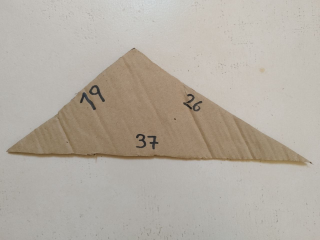
Available space:
1765284507937.png

Values of the triangle in centimeter.
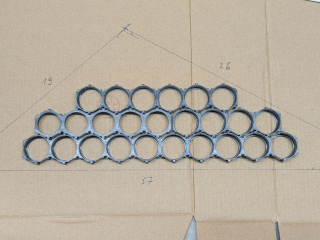
21700 cell holders (25pcs, most probably 5s5p with 5Ah (15A nominal) LG M50LT cells (25Ah):
1765284579965.png

Just for my better understanding:
What bad things can happen in practice if the 5s pack has more capacity and a lower IR compared to the existing 10s pack (series-connection) and I only use "standard"-BMS (without special communication or without a balance board that will balance across the two packs)?

I understand that there is a huge imbalance (e.g. 5s at 20% SOC and 10s at only 10% SOC, 10s has higher procentual voltage drop under load because of higher IR).
Worst thing I can imagine that either the 5s or 10s part will be completely empty (nearly 0% SOC) and the other part is still strong - and the controller demands high current.
(Nearly) empty packs hate high current (and the standard BMS won't react to it properly - no total shut-off in time) and cells might get damaged (or in worst case catch fire).
Correct?

As long as I keep an eye at the SOC of the 10s and 5s pack INDIVIDUALLY (to avoid that the 10s or 5s pack gets empty) is there still a high risk for such a series-connection?

Please send me a link that I can read (if you have one) to close my knowledge gap regarding the real world risks of series-connection of different packs (capacity- and IR-wise) which have still a good "standard"-BMS.
 

Attachments

  • 1765284533918.png
    1765284533918.png
    934.5 KB · Views: 1
Back
Top