• Hello ES! We could use some help to get us past the finish line on building the new knowledgebase for the forum.
    Can you donate? Please see our fundraising page. Thank you!

Charging Ebike directly from a solar panel with simple circuit.

Moretorque

Regular
Joined
Jun 20, 2025
Messages
379
Location
Florida
Using a 48 V solar panel to charge a 48 V battery directly how simple could you make this. My battery charges at 2 amps so a 400 watt solar panel directly would burn this up correct? Just curious and thanks.
 
The "simple" circuit you're looking for is a charge controller. There isn't a safe way to skip one.

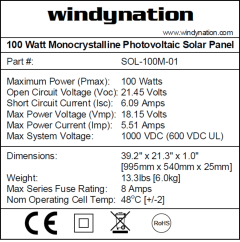
A solar panel's advertised voltage is nominal only, the same way that the nominal voltage rating for a battery is just a way to generally suggest its working voltage range. Take a look at the label on the back of an example 12v nominal solar panel:

1775260433449.png

A solar panel will attempt to deliver current and voltage. When its load (the thing that is taking power from the solar panel) increases, its voltage will drop. There is a point at which the solar panel can deliver an amount of current at a given voltage, which maximizes the wattage it is capable of producing. This is the Vmp on the rating, and the current it can produce at that voltage is the Imp. For this example panel, when you attempt to draw 5.51 Amps at 18.15 volts, you can draw a wattage of almost exactly 100 watts. Attempt to draw more current, and the voltage will drop sharply, drastically reducing the power output.

So why would we call this a 12v solar panel, when it can produce much higher than 12v? This is because what we call 12v systems and 12v batteries are also nominal terms we use to describe lead acid or lithium battery systems that have a working voltage range close to 12v, but can be more or less. We need to look at the highest charging voltage the battery can take. If we were using 12v lead acid batteries, max charge voltage is usually around 14v.

The charge controller is a circuit that typically takes the higher voltage of a solar panel and usually steps it down to the voltage that corresponds to a battery's max charge voltage. It does so in the case of lithium batteries using constant-current, constant-voltage (CCCV) output for safe battery charging. Usually this means that the voltage of the solar panel feeding into the charge controller must be higher than the max battery voltage by several volts. "Boost" charge controllers do exist, but they're less efficient and it's often easier or cheaper to use higher voltage solar input.

Therefore, your hypothetical 48v solar panel charging a 48v battery is going to incur a bit of research on your specific components. If you share those components, we can offer more specific suggestions.
 
I have a 100 watt 12v nominal solar panel that is good for 82 watts on a good day around noon.

I have hooked this directly to a constant current constant voltage booster, set to 42 volts, to charge my 10S battery, and I can dial up those 82 watts from the sun, but if I shadow the panel even slightly, briefly, then the max output falls to 52ish watts.

At that point I need to lower the current control trimpot to below this 52 ish watts, and then I can dial it back up to 82 watts.

I did not want to have to put a 12v battery and a solar charge controller in between.
It was only an experiment, and satisfied my curiosity.
 
state-of-charge-chart-for-48-volt-agm-battery-packs.png
 
So what do you think? can you build something that simple that will work well to be packed on the bike?
 
I have hooked this directly to a constant current constant voltage booster
but if I shadow the panel even slightly, briefly, then the max output falls to 52ish watts.

At that point I need to lower the current control trimpot to below this 52 ish watts,
I've also experimented with this, and this happens because the simple boost converter doesn't have the same "smarts" that a charge controller has, to ramp down current demand in decreased sunlight, and ramp it back up.

For what it's worth, a simple CCCV buck converter typically works okay as a charge controller, because stepping down voltage is easier than boosting and can dumbly responded to shade/sun/shade without having to reset current control.
 
Just curious and thanks.
This may not be what you are interested in, but it does exist. I have one, and I have used it to charge my nominal 48V 960Wh battery from Cap Rouge:
Solar 200 Watt Ebike Battery Charger - Sun200

It seems fairly simple, and I'm sure that means it has some drawbacks. I do not use it while riding. I do have other equipment I have accrued in order to build a solar roof for my trike, but I have not put that into practice yet, so I can't offer experience.
 
I think you need a mppt controller, its the safest way to charge your battery from a panel. If you plug a panel directly into a battery, it would only charge if the voltage was > then the battery...but not too high...a solar panel output is not stable. If you had the exact right panel and the exact right battery, you might get some charging but you might not. The MPPT controller adjusts the voltage and current from the panel so the battery can safely and efficiently charge. If your panel is less volts then your battery, get a boost controller. They aren't that expensive anymore. Search on Amazon for 48v MPPT boost controller. https://www.amazon.com/gp/aw/d/B0B4SL5C2X < $50
 
Thanks, I know I read the earlier post on why. Just wondering if somebody may have come up with some combo that works but is simpler. I need a small 48 V charge controller.
 
Using a 48 V solar panel to charge a 48 V battery directly how simple could you make this. My battery charges at 2 amps so a 400 watt solar panel directly would burn this up correct? Just curious and thanks.
I could rig something up, but it would not be kosher. Key is using my 0-60 minute mechanical timer. would need a fuse and a resistor or maybe diodes. would charge outside and watch it the first few charges. it would be like science class, an experiment or in an emergency. the timer keeps it from overcharging.
 
Not to be a downer, but won't the battery BMS mess with the unregulated charging input. I know the BMS's on my batteries dont even like other chargers of the same volt class and current. I had to color code them.
 
If your battery is 48v, I assume you want to charge it to 54.? volts. Using a Victron 75/15, you would need 60-70v pv input. If your panel is truly 48v then you need to boost it to > 54v to charge your battery. Feeding 48v to a 48v nominal battery will not charge it. If you want current to flow it has to be higher. A boost MPPT controller will take care of that.
 
So basically get a nice small Victron charge controller like a 75 15 ?
If your battery is 48v, I assume you want to charge it to 54.? volts. Using a Victron 75/15, you would need 60-70v pv input. If your panel is truly 48v then you need to boost it to > 54v to charge your battery. Feeding 48v to a 48v nominal battery will not charge it. If you want current to flow it has to be higher. A boost MPPT controller will take care of that.
The 75-15 Victron controller is for 24V nominal systems, not 48V. It'd be foolish to employ a 'booster' when you can simply use a Victron 100-20 instead (for 48V systems).
 
I've also experimented with this, and this happens because the simple boost converter doesn't have the same "smarts" that a charge controller has, to ramp down current demand in decreased sunlight, and ramp it back up.
I was gonna try putting a 5s1p li-ion between sub 21VOC panel and cccv booster, to keep input voltage from tanking when a shadow briefly passes over the sub 21ocv 12v nominal panel while cccv booster was trying to maintain constant amperage output.

If this works, I'd consider making a 5s1p 16340 or 14500 to keep the combo physically small but I guess it should also be able to handle 4 amp of charge current which likely eliminates 14500 or 16340's.

Obviously shading the panel for any length of time would have booster quickly deplete the 5s battery, but i am not keen on purchasing equipment like a dedicated mppt controller just to experiment.
If I were to need solar right now, today, to charge my 10s PEV away from home, I could totally do it. Id use solar to feed 12v nominal battery from a pwm solar charge controller and boost to 42v from that. If there were no risk of passing shadows I could just run booster directly from panel and eliminate charge controller and 12v battery.

I have other portable destination charging methods though.
I can put nearly 4 amp hours back into my 10ah 10s pack at upto an 8 amp initial rate, and also parallel esc feeds to plug in range extender batteries. My usual 8-10 mile range has been extended to 34 miles employing both strategies.
 
Not to be a downer, but won't the battery BMS mess with the unregulated charging input. I know the BMS's on my batteries dont even like other chargers of the same volt class and current. I had to color code them.
I've never needed a BMS, just a voltmeter on the handlebars. when a cell gets out of balance it will show a 3 volt drop alerting me to balance. this only happens on packs over 10 yrs old. I charge with an old 36v SLA charger all the time on my 40v pack, and have 2 old 24v car chargers wired in series for my 14s10p 2/4/7 amp rates. all use the timer, and I only shoot for 80-85% charge. another clue it needs to be balanced is that the final voltage is higher than history.
.
sternwake
if you use a diode to prevent backflow, you should be able to have it charge after a cloud or sunrise after night.
 
Last edited:
sternwake
if you use a diode to prevent backflow, you should be able to have it charge after a cloud or sunrise after night.
I have Two inline 'Ideal Diodes' I can easily use on either end of CCCV booster, or both.

I'll try them and report back.

Sun is down, so do not hold breath.
 
Back
Top