• Hello ES! We could use some help to get us past the finish line on building the new knowledgebase for the forum.
    Can you donate? Please see our fundraising page. Thank you!

Converting Yamaha SR 125 to electric (questions about motor and cells)

adsc

Established
Joined
Jul 25, 2025
Messages
137
Location
Switzerland
I can get a rolling chassis of a Yamaha SR 125 in good condition and was thinking about converting it to electric. The goal is to get a street legal commuter machine for A1 permission in Switzerland, so max 11 kW and it should be able to reach about 100 km/h top speed for occasional short highway segments. Range should be around 100km, but of course not at that speed, more like at 50 km/h.

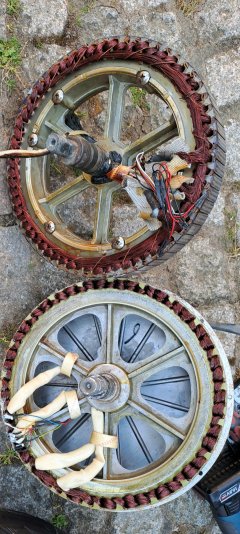
Since this is going to be my first conversion, I want it to be as simple as possible, so I was thinking about going with a hub motor, so that I don't have to mess around with motor fixation on the frame and sprockets and chains, and after some research, it seems a QS273 72V 5000W would fit the A1 limitation, but I have no idea if that would be able to reach the desired top speed of about 100 km/h or what kind of amps the battery would have to output to be able to do so.

I was also thinking about going with these cells: https://www.nkon.nl/en/eve-c40-40135-20ah-3-2v.html
Mainly, because the battery pack would be easy to assemble with them. But since they are quite large, it's probably going to be hard to get enough amps out of the pack. For 72V, we'd need 24s, then we could probably only do 5-6p, which would mean 100-120A max continous discharge (according to the datasheet). That would be 7.2 - 8.6 kW. Would that be enough to sustain 100 km/h for 20 - 30 min?
Of course, this would also create quite a massive and heavy pack, and I'm not sure if the relatively light frame of the SR 125 could support it, or if I could even fit it on there.

So what do you think, am I on a plausible track, or should I just go with a mid drive motor and a regular 18650 pack? The latter would probably allow me to just follow another build, as it seems mid drive motors are more popular when doing conversions.
 
You're going to be a little under your goals with your proposed cell selection. We're skipping over controller, wheel size, and total vehicle weight, so take this with all those variables assumed:

Would that be enough to sustain 100 km/h for 20 - 30 min?
You've probably be able to get to 100 km/h. You probably won't be able to hold it for 20-30 minutes. First, your 5000w-rated motor won't be terribly happy at 8000w for 20-30 minutes. QS motors are good, it'll be able to hit 8000w, just not for 30 minutes, consistently, every day, you know? Secondly, that higher speed is going to eat up exponentially more energy than if you were at a slower speed. So your pack might not last 30 minutes running full out.

On the other hand, if you actually are able to fit 24s6p of those cells into your frame, that's roughly going to be an 8.5kwh pack, which is a lot. You probably won't have a problem on range. Thought 144 of those cells would weight about 54 kilos, so it's gonna be a heavy one...

In general though, I'd say your goals are just about doable. If you were able to reduce your expected top speed or range by like 10-20%, I'd say it's very doable. Looking forward to hearing more!
 
Thanks a lot for your insight.

Yeah, the top speed and range is not fixed, I wouldn't be very disappointed if both were a bit lower, to be honest. Top speed is maybe harder to accept much lower, though, because I would really prefer to be faster than cargo trucks on the highway, otherwise it's going to suck a bit.

How can you judge that the specs would be able to reach 100 km/h? Is it just experience, or can you calculate it somehow from the specs? I would try to keep about the same wheel size, which I think is 16 or 17 inches. I can look up the motor max RPM, but I have no idea how to judge sustainable RPM given a certain power input.

Regarding the weight: empty weight of the bike is 103 kg in petrol form. It can take 2 riders, and the drivetrains are probably comparable in weight (if we exclude the battery). It should be fine with 10l petrol + an additional rider, which is at least 60 kg of additional weight, so a battery could probably also weigh around that much (although it is of course weighing on different parts of the frame). Balance during driving should be better than the petrol bike + second rider, because the weight is much lower to the ground.

I might just go for it anyway, because even if the cell theory does not work out in practice, I could still use them for a PV battery and just build a pack with regular 18650 cells.

A last point of concern is the motor, though, since hub motors tend to get hotter, and if you already think that it will be at its limit with a 100 km/h top speed, maybe it's not such a good idea after all due to heat?
 
A last point of concern is the motor, though, since hub motors tend to get hotter, and if you already think that it will be at its limit with a 100 km/h top speed, maybe it's not such a good idea after all due to heat?
I don't have direct experience with the QS273 5000W, I use the 8000w model. And speed isn't the limiting factor of the motor for either model, it's continuous building heat (as you are already aware). It's not that 100kmh is its limit, its that you'll be stressing it out if you don't that for the whole ride, every ride, day after day.

How can you judge that the specs would be able to reach 100 km/h? Is it just experience, or can you calculate it somehow from the specs?
It's not a judgement, it's an educated guess: I've build 3 different bikes at similar weights using 72v nominal, so they're guesses based on my experience. Meaning, they're not hard and fast judgements. You'll find several 72v builds if you keep digging on the internet, and many of them will probably say that they can reach 100-120kmh. Which I'm sure is true. Different controllers can play with flux weakening in different ways, maybe you will be able to as well. I would consider though, if you are only able to reach your top speed range by pushing both your motor and you battery, and you use that speed a lot, that means you're pushing some of your components to their limits on a regular basis. I would recommend overbuilding/overspeccing your build by 10-20%, so that's it's not running at maximum every time you use it. Does that make sense?

Hub motors are very dependent on voltage when it comes to top speed. If you want to go faster more reliably I would suggest perhaps going up to 96v nominal instead of 72v.
 
The problem with overbuilding is the 11kW limit for A1 category. I think the 6000W is rated for 12kW, so I'm not sure if it would be legal to use even that one, no matter whether the rest of the drive train can even provide that much power to it. I would have to ask the authorities.

And yeah, the 100km/h for 20 - 30 mins wouldn't be a regular thing. It's just, when you want to ride the highway, and there are lots of cargo trucks around, it's annoying and even a bit dangerous if you are slower than them, because they tend to not slow down and instead want to overtake you. And there are almost always lots of cargo trucks in the right lane on our mostly 2 lane highways in Switzerland. But I think the speed limit for them is 80 km/h (although it seems to me most of them are actually faster), so 90 km/h would probably be enough.

But I could probably drop the A1 category requirement. I thought it might be easier to make it street legal again, if it stays in the same category, and also of course more people could ride it (a lot of people still have A1 from their regular car driving license).

Lots of parameters to think about.
 
Last edited:
FWIW, I would recommend using ex-EV packs to build your battery from. They're designed for the ability to drive traction motors at higher power, physically constructed well, and don't typically (with some exceptions) depend on a whole bunch of interconnects to correctly operate, as they're usually made from large-capacity pouch or prismatic cells.

The only requirement they have vs cylindrical cells is compression of the cell stack...and that means they will be large blocks rather than something you could custom-shape to more or less fit a space within a frame. This makes them unsuitable for some builds; you'd have to judge that. The compression is built into many of the modules already, so as long as they are used physically intact (even if rewired) they will do the necessary job.

I don't know what's available for used ex-EV modules from reputable suppliers over there, but there are places like GreenTecAuto, etc., that guarantee their stuff, *and* have good deals on some of the useful modules for this kind of thing.

You'd have to install your own BMS, as any they might come with probably isn't usable. But you'd have to do that anyway for any pack you build. :)
 
Regarding safety / speed: I would guess that acceleration to get out of the way is at least as important as actual top speed. If so, you usually need a system that is capable of significantly more speed than you ever actually use (even if you limit it electronically for whatever reason).

In this case you need a battery that is that much more capable of delivering current, at a high enough voltage to provide higher current all the way up to max speed required of the motor, with as little voltage sag as possible.

And a controller capable of handling that voltage, and providing enough phase current to the motor for this situation.

And a motor with the right kV to reach that speed, provide accleration even up at that speed.
 
Regarding figuring out what it will take to reach these speeds, you can experiment with the trip and motor simulators at ebikes.ca to find out how many watts w it takes for your specific riding conditions and usage, and then use that to figure out how many watt-hours wh it takes to do what you want for hte range you require.
 
The problem with overbuilding is the 11kW limit for A1 category
That limit is different for electric vehicles. 80HP Varg is licenced A1 in many European countries (including Switzerland) because of how peak vs "continuous" power is calculated. I recommend diving a bit deeper into the regulations where you live.
 
FWIW, I would recommend using ex-EV packs to build your battery from.
Boring :)

In this case you need a battery that is that much more capable of delivering current, at a high enough voltage to provide higher current all the way up to max speed required of the motor, with as little voltage sag as possible.
Hmmm, will probably not be doable with the cells I planned to use. Thanks for the advice.

Regarding figuring out what it will take to reach these speeds, you can experiment with the trip and motor simulators at ebikes.ca
I would, but I don't find all the values for this motor. Lmotor and Rmotor are empty in the datasheets (Ohm and mH). And I don't know what a0 and a1 are, are these rated torque and max torque?

That limit is different for electric vehicles. 80HP Varg is licenced A1 in many European countries (including Switzerland) because of how peak vs "continuous" power is calculated.
Interesting, thanks for this hint. It does seem you'd have to electronically limit continuous power to 11 kW somehow. What does this mean? Does the controller allow higher power, but reduces it back down to 11 kW after a short while?
 
Interesting, thanks for this hint. It does seem you'd have to electronically limit continuous power to 11 kW somehow. What does this mean? Does the controller allow higher power, but reduces it back down to 11 kW after a short while?
Since you're asking about regulations specific to your country, it's going to be hard for others on the forum to answer. What I would be interested in though, is if you are able to find out some rules for Swiss law regarding homemade EVs, please do share them here.

Are you able to speak directly with city/government officials to ask specific clarifying questions?
 
I would, but I don't find all the values for this motor. Lmotor and Rmotor are empty in the datasheets (Ohm and mH). And I don't know what a0 and a1 are, are these rated torque and max torque?
You don'thave to use a specific motor to get the general idea of the power required tod o what you want under your riding conditions. ;)

If you want to simulate that specific motor, then you could check with QSmotor either thru their thread on this forum for sale section, or their website, to see if they can provide the other specs you need.
 
You don'thave to use a specific motor to get the general idea of the power required tod o what you want under your riding conditions.
Yeah, but it should be similar, right? And I have no idea what similar values would look like. I'm gonna try to find a spec sheet of a similar motor that maybe has those values.

Since you're asking about regulations specific to your country, it's going to be hard for others on the forum to answer.
I didn't ask about country specific things, I asked a technical question about how the controller would implement this "continous power" setting. But yeah, I'll write an email to the cantonal office and will post here if/when I get an answer.
 
I didn't ask about country specific things, I asked a technical question about how the controller would implement this "continous power" setting.
What I meant was, you'll have to ask whether the controller electronically limiting power is enough to satisfy the legal requirement.
 
With the QS 5kW Motor you can reach 100kph. You need 7-8kW to stay at 100kph.
The motor gets a little warmer than most here do recommend, but it is still fine.
Electric motors can run at 100C all day long. Mine stayed at 70-80C during 50km rides
I pushed my 5kW QS to 115kph with a little field weakening added, without it was 109kph (GPS verified)
I did 130km rides on the motorway, without fearing trucks.
You do not need to run 100km for not fearing trucks.
If I am on the motorway I stay behind the first truck I see to save energy and if there is a faster one overtaking, then I switch to the faster one.

If you can get a 5p pack in the frame, that would be enough for 30min 100km/h.

My 190kg heavy scooter has installed a 7,7kwh battery and that gets me with my driving style to 130km on the motorway. Behind a truck you need only 5kW for 97kph.

Last year I upgraded to a QS273 10kw Motor with a faster winding getting me to 125kph without field weakening.
This motor runs much cooler and has much more tourque but needs a bigger controller.
This motor has also a higher efficiency , I did a 150km motorway travel and at the end of it I still could easily stay behind the 97kph truck.

An 8kw motor will shure be enough, but I wanted my scooter to accelerate like a 400ccm motorbike.

For your needs I would go for an 6-8kW motor and at least for a Fardriver ND72680, if money allows go for the bigger motor and a Fardriver ND721000 and you shure will not be dissapointed.

The Fardriver controller has a time depended boost setting, where you can say 30 seconds 20kW and then get back to the normal 8kw.
 
With the QS 5kW Motor you can reach 100kph. You need 7-8kW to stay at 100kph.
The motor gets a little warmer than most here do recommend, but it is still fine.
Electric motors can run at 100C all day long. Mine stayed at 70-80C during 50km rides
I pushed my 5kW QS to 115kph with a little field weakening added, without it was 109kph (GPS verified)
I did 130km rides on the motorway, without fearing trucks.
You do not need to run 100km for not fearing trucks.
If I am on the motorway I stay behind the first truck I see to save energy and if there is a faster one overtaking, then I switch to the faster one.

If you can get a 5p pack in the frame, that would be enough for 30min 100km/h.

My 190kg heavy scooter has installed a 7,7kwh battery and that gets me with my driving style to 130km on the motorway. Behind a truck you need only 5kW for 97kph.

Last year I upgraded to a QS273 10kw Motor with a faster winding getting me to 125kph without field weakening.
This motor runs much cooler and has much more tourque but needs a bigger controller.
This motor has also a higher efficiency , I did a 150km motorway travel and at the end of it I still could easily stay behind the 97kph truck.

An 8kw motor will shure be enough, but I wanted my scooter to accelerate like a 400ccm motorbike.

For your needs I would go for an 6-8kW motor and at least for a Fardriver ND72680, if money allows go for the bigger motor and a Fardriver ND721000 and you shure will not be dissapointed.

The Fardriver controller has a time depended boost setting, where you can say 30 seconds 20kW and then get back to the normal 8kw.
Just wanted to say, this a lot of good real-world information, thanks for sharing, for OP, myself, and others on the forum interested in DIY e-motorcycles
 
I pushed my 5kW QS to 115kph with a little field weakening added, without it was 109kph (GPS verified)
I see that you are from Germany. Can you tell me where you got your Motor and controller from? It seems there are many different QS Motors websites, and I'm a bit hesitant to order from one of them.
 
The 5kW was installed in my first scooter with a max 5kW controller and stayed always cold. I swapped this motor over to the bigger chassis from the Masini Extremo and pushed it up to 22kW before i changed to the 10kW. The 8kW motor from the Masini Extremo looked weaker to me, later I found 5mm wider magnets and less copper in the Masini Motor.
The Masini motor was wound for 20% slower but it had more tourqe.
Screenshot_20230609_165102_Gallery.jpg


The 10kw was bought in Germany , someone ordered 3 pieces directly from Siaecosys and sold one of them on "Kleinanzeigen".

Before you buy anything you have to be shure what the MFK needs for getting it road legal. None of the chinese motor manufacturers does provide any documents for load capacity of the rim.
 
Last edited:
Yeah, no worries, I'm going to wait. I also see that you built a battery from pouch cells. Where did you get those from? It seems pouch cells are pretty hard to get, at least I haven't found any trustworthy sources yet.
 
My cells were scrapped after a few test cycles in the company I work. Cenat, the cell manufacturer, wanted to sell them only in complete sea Containers and that was to much for our business 5 years ago.
 
Very cool, and impressive build. I bet the nice aerodynamic form you made also helps with reaching that top speed.
 
I have a free 1965 Suzuki S32-2 that might make for an interesting conversion. It has 17" wheels and weighs ~ 250lbs, but was considered a fairly fast bike in it's era.
 
Back
Top