• Hello ES! We could use some help to get us past the finish line on building the new knowledgebase for the forum.
    Can you donate? Please see our fundraising page. Thank you!

Cylindrical battery pack?

TRS300

⚡ Regular
Joined
May 31, 2025
Messages
117
Location
Los Angles
So I'm asking for input on how to build a cylindrical battery pack. As you can imagine every time I Google this all I get is cells (not pack shape). I have thoughts on how to do this but it's always good to ask smart people here first.
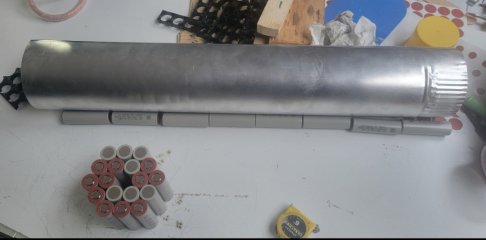
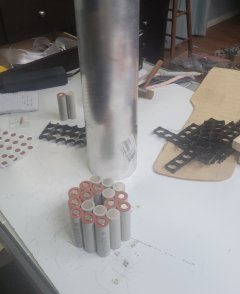
The concept is to have a battery pack built into a false exhaust pipe. I'm using 21700 cells organized in groups of 18. It seems it would be best if each cluster was a full block, but maybe there's a better arrangement option. I could fit probably 8 packs end to end in the tube which would limit my series to 16 I think.
Thoughts?
 

Attachments
  • Screenshot_20251231_140520_Gallery.jpg
    Screenshot_20251231_140520_Gallery.jpg
    151.6 KB · Views: 20
  • edited_20251231_143003.jpg
    edited_20251231_143003.jpg
    294.4 KB · Views: 20
Last edited:
Maybe try searching for a tear down video of a frame/seat tube battery?
 
I've bought them and also made my own cylinder batteries. I use them mainly for styling and stealth. I put them inside metal water bottles. I think it gets too hard to build bigger packs in cylinders

The first concern is finding a pattern that fits inside your container. I also like to use the plastic hex cell holders, but there's often not enough room for them. I believe gluing them is unsafe, with the risk of the cells shorting out. I've worked around it with a layer of battery "fish" paper around each cell plus a second shrink wrap over that, Then I use construction adhesive to hold the cells together,

The next concern is when a series group spans two stack levels. It makes for interesting interconnects, It looks unwieldy, but if you ever looked at commercial batteries, there's no other way to do it without having long wires/strips that are two cell lengths long. You also have to keep track of the BMS wires.

Finally, how to connect one stack to the next? . It's pretty tough to do a ring of cells and spot weld it to the next ring, If you are spanning a series group. there's the extra spot welds plus keeping track of all the wiring. One can use tabs that are spot welded. Another way is to do build the battery in one long laer from end to emd, turn around and come back with the next layer. Then you're not using the modularity of a stacked battery,

Is that a 4" (102mm) cylinder in your picture, Your 18 cell array should be 108 mm at its widest point with 21700 cells, Does it fit?
.
 
... I think it gets too hard to build bigger packs in cylindersI
I can see this as well...
also like to use the plastic hex cell holders, but there's often not enough room for them. I believe gluing them is unsafe, with the risk of the cells shorting out. I've worked around it with a layer of battery "fish" paper around each cell plus a second shrink wrap over that, Then I use construction adhesive to hold the cells together,
I was just looking at this last night. On the 21700 cells I can add a ring of 3/4 ID marine grade shrink wrap at each end of the cell (no need to heat it as it's a snug fit) then glue the cells together. Love the idea of adhesive glue. Good idea...

The next concern is when a series group spans two stack levels. It makes for interesting interconnects, It looks unwieldy, but if you ever looked at commercial batteries, there's no other way to do it without having long wires/strips that are two cell lengths long. You also have to keep track of the BMS wires.
This is something I'm still trying to get my head around...
Finally, how to connect one stack to the next? . It's pretty tough to do a ring of cells and spot weld it to the next ring,...
My thought is that each cluster would be a single series group, and that all the block groups would be connected in parallel.. Hard to describe without a picture.
Is that a 4" (102mm) cylinder in your picture, Your 18 cell array should be 108 mm at its widest point with 21700 cells, Does it fit?
No... I would either need to go to a larger tube or use 18650 cells instead. I need to look into the options more.

I really appreciate you taking the time to type out your thoughts. Actually, I've not seen any examples of construction techniques. All the batteries I see for sale are already encased. If you happen to have any pics you can share that would be great. I understand things like this easier if I can see it. Thanks again.
 
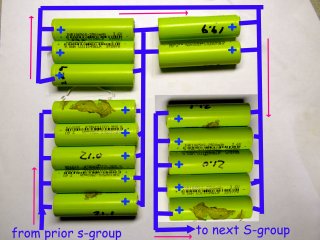
Here's an example. Suppose I had a circular stack of 8 cells. and I wanted to make it 5P. I can put 5 cells in one group, but will have to split 3 cells in this layer and two cells in the next one. Here's how it could be wired.
wirinf.jpg

The left side has shows one series group of five cells. Let;s call it #1, There are the three cells from the next group #2. The right side shows the two remaining cells for #2, Finally, five cells for series group #3.

The blue lines show how the wiring goes. Two lines come out of the left. Now there is room for a single cell from group #4 here, but I would skip it. Just repeat the sequence on series group #4. The conductors have to be well insulated.

--------------------------------------------------------------------------------------------------------
In real life, I've only done 2P cylindrical batteries and I do 7 cells in a ring. Three s-groups fit in a ring and only one cell spans to the next ring, I've seen commercial scooter packs. split a 3P group across three sections. That was a headache to figure out.

I didn't take pictures of my batteries, because you couldn't see the wiring. They're also ugly. It was tough to stack 4 rings of cells on top of each other and not have them go crooked.
 
This guy does a lot of batteries. I just watched this the other day.. it might not be exactly what ya need...but maybe give you ideas.

 
Here's an example. Suppose I had a circular stack of 8 cells. and I wanted to make it 5P. I can put 5 cells in one group, but will have to split 3 cells in this layer and two cells in the next one. Here's how it could be wired.
View attachment 382834

The left side has shows one series group of five cells. Let;s call it #1, There are the three cells from the next group #2. The right side shows the two remaining cells for #2, Finally, five cells for series group #3.

The blue lines show how the wiring goes. Two lines come out of the left. Now there is room for a single cell from group #4 here, but I would skip it. Just repeat the sequence on series group #4. The conductors have to be well insulated.

--------------------------------------------------------------------------------------------------------
In real life, I've only done 2P cylindrical batteries and I do 7 cells in a ring. Three s-groups fit in a ring and only one cell spans to the next ring, I've seen commercial scooter packs. split a 3P group across three sections. That was a headache to figure out.

I didn't take pictures of my batteries, because you couldn't see the wiring. They're also ugly. It was tough to stack 4 rings of cells on top of each other and not have them go crooked.
Thank you for the detailed response. Much appreciated. I have what I need to decide on how I'll proceed. Thank you again.
 
If you can structure the battery so you don't have to span a group across two or more layers, it's as easy as the in the Fiido video,

For smaller batteries, where you only have 6-8 cells in a later, it gets hard to make a battery that isn't really long,
 
Back
Top