• Hello ES! We could use some help to get us past the finish line on building the new knowledgebase for the forum.
    Can you donate? Please see our fundraising page. Thank you!

load testing cells with balance charger

derekderek

🔋 Established
Joined
Apr 16, 2025
Messages
92
Location
SW Florida
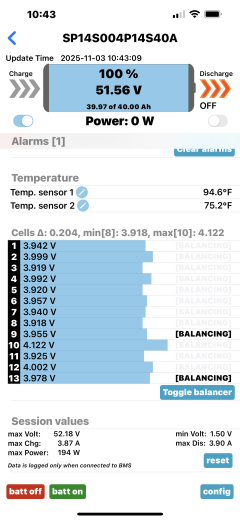
ok, got my Bluetooth BMS. replaced one dead parallel group. 13s 6p battery. got everything hooked up and had a bunch of imbalance. I sat down with my Amazon balance charger and brought these groups up and discharged those groups down. got all 13 groups between 3.85 and 3.9 volts. put on 54v charger. most groups climbed around 100mv so the whole battery is now at 3.92 to 4.00. except 1 set which ran up to 4.123 and shut the charging off. I am pretty sure charging faster than all the rest is same as discharging faster. and these 6 cells are gonna take at least 25% from battery capacity. so they are getting changed out. while using balance charger with alligator clips charging this set or group of sets I saw this set charging much faster than adjacent sets I was charging with. so I had a pretty good idea I was gonna see these results. I think most of these batteries have 1 or 2 sets that fail well ahead of the rest. and I think we can extend overall life with a spot welder and a couple dozen spare good cells. also this bad looking set was adjacent to the set that I replaced that dropped to 0 volts. so maybe if one finds one dead set it might make sense to dump the set or sets right next door to the dead set. is there anything wrong with my thought process?
 
So I pulled out my side cutters and I pulled the nickel strips off of the one side of that set of six cells. Surprise surprise. Two of the cells said 4.14 V. The other four cells said 0 V. I wouldn’t think it could do that. I would think the zero ones would drag the two live ones down. Now I’m torn between replacing the four that is zeroed out or replacing all six. I think I’m going to replace all six.
 
Zero volts doesn't necessarily mean a dead short. It means no voltage and you can have that happen with the cells still having a high enough resistance that they don't drag the remaining two cells down very far.

I figure you tested these replacement cells. Did you test them a long time ago? Maybe they were fast leakers. Or the CID's popped?In general, I guess working with used cells is full of surprises.
 
they were at 4.0 a couple of months ago when i got the battery. still at 4.0 today.repaired unit is now charging and they are going up in volts at same rate as the rest of the groups. I replaced all 6.
 
so I am thinking instead of changing 5 or 5 cells, maybe pull all the strips off 1 side of the battery and test each cell individually. if you have a zeroed out parallel set, you may well have a few more dead cells in some of the other stacks. cuz a couple of stacks charge higher and they seem to voltage drop more than the lower charge state sets when on the throttle.
 
If you get failures within a cell group, you should replace all the cells in that group. It's much better to have entirely matched cells in a battery pack, but at least you should have matched cells in each group of parallel cells.

If I was replacing it myself, I would probably add an active balancing board or switch to an active balancing BMS, because the new cells will be dragged down to the effective capacity of the worst remaining old group otherwise.
 
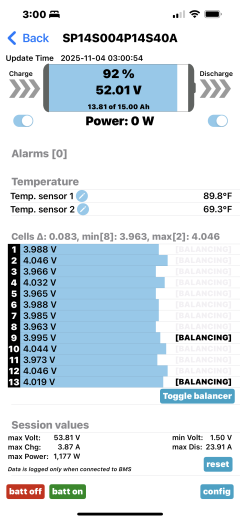
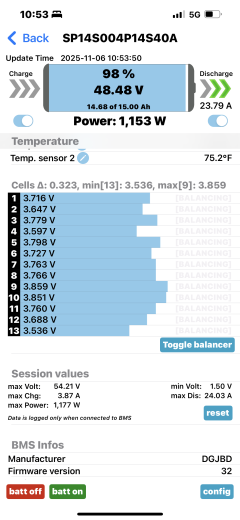
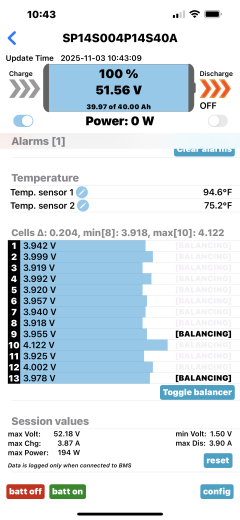
i just got a jbd sp14s 40 amp active Bluetooth balancer. post 2 is screenshot before I changed out stack 10 cells. 2 were 4 volts. other 4 were 0 or ,1 volts and now brief charging shows me stacks 2, 12 and 13 climb faster than the rest. so I am thinking I will find a couple of dead cells in those 3 sets.
 
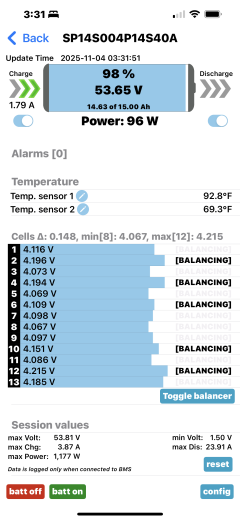
Here is batt with full charged with stack 10 only 2 of 6 cells showing volts. pic 2 is after changing out set 10 and some manual balance charging with alligator clips on this set or that one. pic 3 is after full charge showing sets 2, 4 and 12 climbing 3 times as much as the rest during charging. I think these 3 sets need looking at.
 

Attachments

  • IMG_9846.png
    IMG_9846.png
    616.1 KB · Views: 3
  • IMG_9847.png
    IMG_9847.png
    434.8 KB · Views: 3
  • IMG_9849.png
    IMG_9849.png
    460 KB · Views: 3
Last edited:
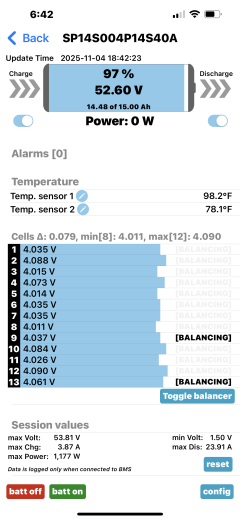
next pic is after 15 hours balancing and a 1 mile ride. showing balance delta dropping a lot. pic 2 is after balancing overnight. settling in well. pic 3 is after 5 minute charge. showing 2, 4 and 12 climbing 150 mv while the rest only went up around 30 mv. I am pretty sure this shows sets with dead cells in them. so gonna go back in and see what is up with them.
 

Attachments

  • IMG_9850.png
    IMG_9850.png
    429.7 KB · Views: 4
  • IMG_9852.png
    IMG_9852.png
    439.4 KB · Views: 4
  • IMG_9851.png
    IMG_9851.png
    695.7 KB · Views: 4
Last edited:
I also have a phone holder coming today. it is hard to hold a phone in one hand while hitting the throttle with the other to watch voltage drop under load. but it looked like 2 and 12 were dropping a lot. I will try to get screen shots if I can do so without flying over the handlebars...
 
You don't have to be riding around while watching the BMS, Charge the battery up to max. Drain the battery and take out some significant amp-hours, at least half. You can do this with a long ride or a load if you have a way to do it. Then look at all the group voltages. Anything really weak will be much lower.

I guess you're finding out what a pain it is to repair a battery, a few cells at a time. Most of the time with an older battery, when you see one or two bad cells, you will see others fail in the future.
 
You don't have to be riding around while watching the BMS, Charge the battery up to max. Drain the battery and take out some significant amp-hours, at least half. You can do this with a long ride or a load if you have a way to do it. Then look at all the group voltages. Anything really weak will be much lower.

I guess you're finding out what a pain it is to repair a battery, a few cells at a time. Most of the time with an older battery, when you see one or two bad cells, you will see others fail in the future.
Yeah, I basically never recommend it, because every time someone tries it becomes a whole adventure.

For the balancing BMS, if it is the JBD sp14s004 40a, it is passive balancing not active. It's probably faster to manually balance the new cell groups to the rest of the pack, as otherwise you will be waiting quite awhile. Ideally, balance the cells for the new group to the pack before putting them in, if you have an adjustable voltage charger or benchtop psu.


If the cells are not balanced to the pack, and already in the pack then here's an example of that:

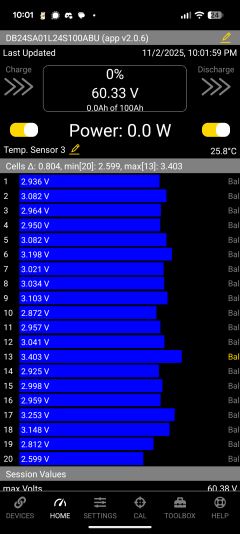
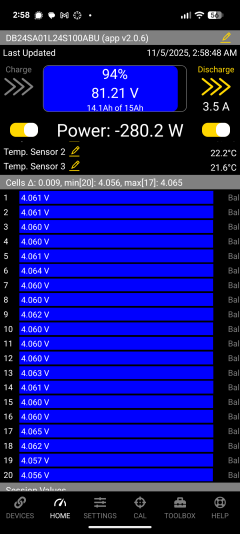
Example below only took about 24 hours of passive balancing +3 or so hours of manually balancing the worst groups. This isn't using the sp14s004, but another JBD bms with I believe the same balancing specification. At full charge or low charge, the difference in the cell groups will be most apparent, while at nominal voltage they will be closer together. I recommend setting the cell overvolt to 4150-4200mAh or so, and then charge until one group hits that, manually balance it down, and the. repeat. Passive balancing can be enabled the whole time.

Screenshot_20251102-220159.pngScreenshot_20251105-025848.png
 
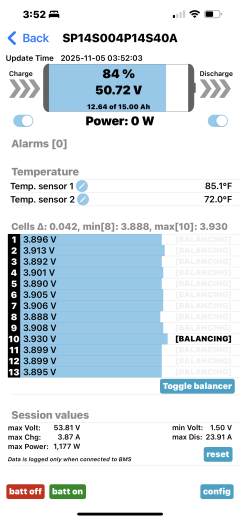
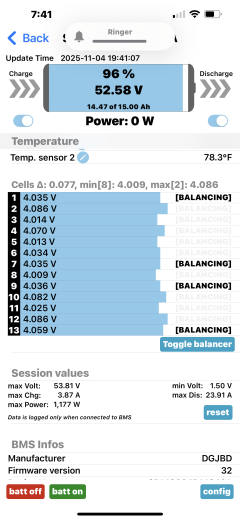
you have a couple of high sets and one very low set in first pic. those will have dead cells in them. and a high set will greatly reduce the battery's charge volume. as soon as 1 set hits 4.1 to 4.25-whatever it is set at, all sets receive no more juice. I think that pack is ready for it's pension. this bms is balancing the pack overnight while at 3.89 to 3.93 volts. reduced delta from .077 to .042 in 8 hours not connected to charger. you can set to balance only when charging or balance all the time.
 
Last edited:
2,4 and 12 seem to charge high. And also draw down more under load. But the pack is settling in somewhat with some moderate use.13 surprised me. is this too much voltage drop under load?
 

Attachments

  • IMG_9857.png
    IMG_9857.png
    597.7 KB · Views: 2
Last edited:
you have a couple of high sets and one very low set in first pic. those will have dead cells in them. and a high set will greatly reduce the battery's charge volume. as soon as 1 set hits 4.1 to 4.25-whatever it is set at, all sets receive no more juice. I think that pack is ready for it's pension. this bms is balancing the pack overnight while at 3.89 to 3.93 volts. reduced delta from .077 to .042 in 8 hours not connected to charger. you can set to balance only when charging or balance all the time.
Nah, all the cells are new but with self discharge issues. Having balanced it and charge cycled it twice, there is some variance but even at the top and bottom it stays around 30-40mv of delta. I wouldn't generally recommend using cells with any self discharge issues though.
 
this pack is settling in. but 2 sets still read around 100 mv high at top of charge cycle. I have a couple more of these BMS's coming. gonna install in this bike's other battery first to compare the 2. then put one in every battery we are using. without these all you can tell about your battery is volts shown out the discharge port and whether or not charger is charging. which is just not enough info.
 
Back
Top