• Hello ES! We could use some help to get us past the finish line on building the new knowledgebase for the forum.
    Can you donate? Please see our fundraising page. Thank you!

Nee-1009w BMS bypass B- to negative coming out of BMS going to main connector??

b0xlife

New here
Joined
Sep 27, 2025
Messages
7
Location
Milwaukee Wisconsin
Ive bypass the BMS on this battery pack and it's working great, but I have a question when I did the BMS bypass I soldered a wire directly from the battery negative straight to the black wire going to the discharge plug without cutting the original black BMS line coming out of the BMS.

It's still charges and works fine, but my question is, will I run into issues because I left the black wire connected coming out of the BMS negative?

Been watching certain YouTube videos I see people cut that wire coming out of the BMS negative (and others who do not cut the wire) and then wire directly to the plug which is what I did except I never cut the wire coming out of the BMS I just wired directly to it and everything works fine.

Should that wire coming out of the BMS negative be cut or is it fine being bypassed this way leaving everything connected with just a line going from the battery negative straight to the ground or negative coming out of the BMS which goes directly to the connection plug?

Or does the negative wire coming out of the BMS need to be cut while leaving my battery negative connection alone?

Battery works well charging it normally through the BMS works fine everything balances out great I was just wondering if leaving the stock negative coming out of the BMS installed as usual and running that wire and soldering directly to that wire coming out causes any issues in the long run that it should be cut coming out of the BMS negative or just leave it alone and leave it how it is.

Does any of this make sense?
 
I would recommend leaving it connected. If you are still using the BMS for charge protection it probably needs that to power the circuit.
If you aren’t using the bms at all, disconnect all the wires going to it to prevent slowly draining the battery.
 
Thank you so much for replying.

Makes sense to me.
Will leave as is.
This is how I've done it on other batteries as well but I really wanted to ask to make sure.
 
Was the BMS bypassed because the pack stopped working? If it stopped the pack from working, that is almost always because it detected a problem with the cells.

If you bypass a BMS, you bypass it's protection, leaving the cells vulnerable to damage from overdischarge / overcharge, and that damage can lead to a fire.

You won't know that this damage has occured until the fire starts.

So please don't ever leave the battery unattended (whether it is being charged, discharged, or just sitting there unused, as the fire can happen at any moment once the damage occurs), and preferably don't have it anywhere near other living beings, people, animals, etc., or their dwellings, so that no one else is hurt or killed by the fire when it happens.
 
Was the BMS bypassed because the pack stopped working? If it stopped the pack from working, that is almost always because it detected a problem with the cells.

If you bypass a BMS, you bypass it's protection, leaving the cells vulnerable to damage from overdischarge / overcharge, and that damage can lead to a fire.

You won't know that this damage has occured until the fire starts.

So please don't ever leave the battery unattended (whether it is being charged, discharged, or just sitting there unused, as the fire can happen at any moment once the damage occurs), and preferably don't have it anywhere near other living beings, people, animals, etc., or their dwellings, so that no one else is hurt or killed by the fire when it happens.
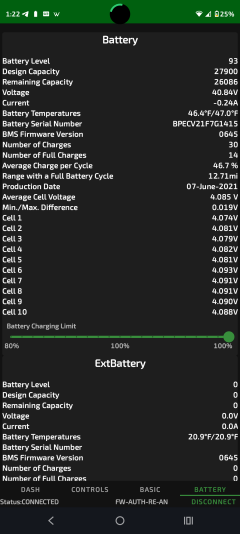
The BMS was bypassed because the battery came from a rental scooter and there's no firmware available on the internet that can flash it correctly. So for me to be able to use it without sending code to it to keep it awake the bypass needed to be completed. (BMS is locked and will cut off after 10 seconds of load without bypass and without firmware flashing, since this is not a retail unit there is no firmware available on the internet for it)The battery is from early 2022 in its information it says it's at under 20 complete full charges and over 30 half charges. Out of the 2700 mAh it says 26400 is available when fully charged.

The BMS itself is not disconnected whatsoever instead I left everything connected and installed a wire soldered onto the battery negative terminal at the end of the pack and ran that wire all the way to the wire that comes out of the BMS and goes directly to the discharge cable and connected it there.

So everything is still connected as it would be stock and it's still charges from the original charge connector on the pack with the original charger.

Here's info from the BMS on the cells and everything, ignore the range it's more like 40 miles+I was playing with BMS emulation in the app and I goofed up a setting so the mileage on the range is wrong in the picture.
 

Attachments

  • Screenshot_20251001-012240.XiaoDash.png
    Screenshot_20251001-012240.XiaoDash.png
    280.8 KB · Views: 6
Last edited:
The BMS itself is not disconnected whatsoever instead I left everything connected and installed a wire soldered onto the battery negative terminal at the end of the pack and ran that wire all the way to the wire that comes out of the BMS and goes directly to the discharge cable and connected it there.
Hopefully you are already aware, but in case you are not: Doing the above bypasses the BMS's ability to stop discharge if there is a cell problem. This is effectively the same as removing it entirely, as far as it's ability to protect the cells against damage goes.

The BMS in this situation has no way to do anything about such a problem--so you could have a situation where there is one cell that is enough lower capability than the ohter ones that as it discharges, it drops below the safe voltage for that cell. The BMS would have stopped it, but it can't now, so the cell continues to drop further, to the point of cell damage (which is externally invisible), and can even be driven negative in voltage.

If the cell drops far enough, the BMS would normally refuse to charge it next time. (Some BMS are not able to determine that a cell is actually negative voltage, and wont' prevent recharging it, even though it is probably damaged).

If the BMS is bypassed, it can't stop charging either (unless it has separate charging FETs, or is built in such a way that the charging port is not bypassed by the rewiring for the discharge port---in this event, assuming it's able to detect the problem, at least it won't recharge after being discharged too far, so as long as you don't try to recharge it after this, and dispose of it properly, or diagnose and replace any even potentially-damaged cells, it wouldn't be a fire hazard after the damage).


Since at least you can see the cell voltages, you can monitor for the problem, especially if this is something you can watch while you ride (since the problem usually is easier to see while the most load is present).

Hopefully it will never happen, and all cells will remain equal capability...but this isn't all that likely, given the way many places build batteries.
 
Hopefully you are already aware, but in case you are not: Doing the above bypasses the BMS's ability to stop discharge if there is a cell problem. This is effectively the same as removing it entirely, as far as it's ability to protect the cells against damage goes.

The BMS in this situation has no way to do anything about such a problem--so you could have a situation where there is one cell that is enough lower capability than the ohter ones that as it discharges, it drops below the safe voltage for that cell. The BMS would have stopped it, but it can't now, so the cell continues to drop further, to the point of cell damage (which is externally invisible), and can even be driven negative in voltage.

If the cell drops far enough, the BMS would normally refuse to charge it next time. (Some BMS are not able to determine that a cell is actually negative voltage, and wont' prevent recharging it, even though it is probably damaged).

If the BMS is bypassed, it can't stop charging either (unless it has separate charging FETs, or is built in such a way that the charging port is not bypassed by the rewiring for the discharge port---in this event, assuming it's able to detect the problem, at least it won't recharge after being discharged too far, so as long as you don't try to recharge it after this, and dispose of it properly, or diagnose and replace any even potentially-damaged cells, it wouldn't be a fire hazard after the damage).


Since at least you can see the cell voltages, you can monitor for the problem, especially if this is something you can watch while you ride (since the problem usually is easier to see while the most load is present).

Hopefully it will never happen, and all cells will remain equal capability...but this isn't all that likely, given the way many places build batteries.
Thanks for the heads up I'll definitely keep it closer eye on it, the charging is separate it's still charges normal through the BMS and it stops usually around 95-96% at 41.2 volts, every time, then afterwards it seems to spend a little bit of time balancing the cells and it seems to be doing a great job at balancing according to the readings.. I've ran batteries like this before and never had an issue in fact this is how most rental batteries end up getting used unless somebody just goes ahead and decides to buy a BMS and remove the old one/wire it up which is the safest way obviously. I never discharge under 60% either with my current riding.
. I learned this method from others that have done the same thing and told me that and showed this method keeps it as a charge only BMS and since everything else is connected it should keep doing what it's supposed to do.

But you are obviously more knowledgeable in this than I am so I will definitely keep watching and keep an eye on it all the time.

Thanks
 
Last edited:
The BMS was bypassed because the battery came from a rental scooter and there's no firmware available on the internet that can flash it correctly. So for me to be able to use it without sending code to it to keep it awake the bypass needed to be completed. (BMS is locked and will cut off after 10 seconds of load without bypass and without firmware flashing, since this is not a retail unit there is no firmware available on the internet for it)The battery is from early 2022 in its information it says it's at under 20 complete full charges and over 30 half charges. Out of the 2700 mAh it says 26400 is available when fully charged.

The BMS itself is not disconnected whatsoever instead I left everything connected and installed a wire soldered onto the battery negative terminal at the end of the pack and ran that wire all the way to the wire that comes out of the BMS and goes directly to the discharge cable and connected it there.

So everything is still connected as it would be stock and it's still charges from the original charge connector on the pack with the original charger.

Here's info from the BMS on the cells and everything, ignore the range it's more like 40 miles+I was playing with BMS emulation in the app and I goofed up a setting so the mileage on the range is wrong in the picture.
I have the same battery which i got it off the facebook marketplace, i am trying to use the battery for a robotics application

could you please share more information on the BMS emulation, how can i see those individual cell voltages and the remaining capacity, etc.,

i was trying to emulate the controller on an esp32 to read data out of the bms, but havent had any luck so far
 
Back
Top