• Hello ES! We could use some help to get us past the finish line on building the new knowledgebase for the forum.
    Can you donate? Please see our fundraising page. Thank you!

Rebuild Bosch Powertube 625wh to 930wh with 21700 cells

Jatem

🔋 Established
Joined
Jun 3, 2019
Messages
51
Has anyone completely rebuilt a Bosch Powertube non-smart 625wh or 500wh with bigger 21700 cells, a new custom battery housing/tube, and the original Bosch BMS?

I’d like to have 50% more capacity by moving to high capacity 5800mah 21700 cells. I plan to 3d print battery spacers, and wrap it all in a light carbon fibre shell, with the original battery end plates.

The question is whether it is possible to power down a Bosch powertube BMS, connect it to a bigger capacity pack, and have the Bosch computer learn the bigger runtime/range?

Another question, has anyone tried using the bms and socket from a powerpack 500 in a powertube equipped bike? It seems easier to find a used powerpack bms to buy. Can anyone suggest where to buy a working used powertube bms?
 
Last edited:
How do you plan to achieve 50% more capacity?
Whats the capacity of the original cells?
By your calculation its 5800/2 = 2900mAh which I doubt its that low
 
Capacity doesn’t always match the rated Ah x nominal voltage, and your calculation would actually be double the Ah. I’ll be looking at using 50 x 21700 cells, in a pack that used 50 x 18650 cells.

Anyway, here are the questions I have about Bosch non-smart system BMS…

Can you fully depower a powertube BMS (batt +ve removed first) and connect it to a different cell pack? It might be possible that Bosch are disabling their bms when they lose power, but it’s also possible that people trying to reuse dead BMSes with schottky failure.

Will a bosch non-smart 625wh powertube BMS allow for 900+wh of capacity to be used / calculated for range, or will it cut power after 625wh is used?

Would I be better off using a powerpack bms for my custom battery, presuming my trek rail will be able to connect/use a powerpack (I’ll be custom mounting the case anway)?
 
If you think there's a chance of the BMS bricking when disconnecting....don't disconnect it. ;)

Instead, ensure both new and old cells are at the same voltage. Wire the new ones up in parallel with the old ones. *then* disconnect the old ones. If the BMS sees no change it shouldn't react....
 
Regarding non smart battery, like powerpack yes you can disconnect the BMS completely. Best to do it following the right steps for which wire, connector to disconnect first . I think it was first disconnect positive coming from cells. Then balance connector small, then balance connector bigger (has temp sens wires in it too) and finally the negative coming from the cells.
Connecting back together it's the opposite order.

If you don't follow this order then if i remember well you can get afterwards a temp sensor error and battery possible can shut down output. That error needs to be cleared with diagnostic software.

In German forum "pedelec forum" you find thread about reading data. Or with esp32 showing known data and set output free for use as powerbank but depends on battery firmware version if output can be openend.

On Telegram you need group HardwareJunkie to find answers for your questions. But do not ask for the diagnostic stuff !!!
In that group are really knowledgeable people who repairing those B*sch BMS types and replacing cells etc.

It is long time ago i played with it but i used those BMS without cells (for safety) when playing with the board trying to set battery output open so it could be used as powerbank. (it does work but i never used it as powerbank, it was just for the fun of it).
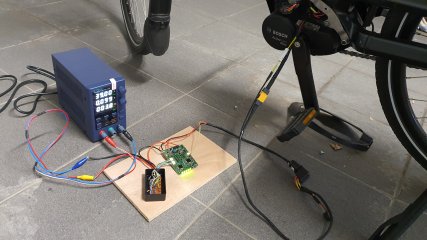
The picture below is a Powerpack rack 400 BMS without cells (powered by power supply) connected to my bike, which had no problem starting from this old 400 BMS while my original battery (disconnected) in the frame is powertube 500.

Powerpack 400 rack feeding bike.jpg
 
Back
Top