Tabless design cylindrical cells tests

I experimented an AwithZ 14.4kW P20B welder last week.

I needed to use gear 690, 15ms preheat, 3ms interval double pulse to weld 0.15copper, 0.15 nickel plated steel sandwich.

I could not properly weld 0.15mm copper with 0.15mm pure nickel sandwich at gear 990. One of the two welds was solid but the other weak to non existent.

The poor weld was always on the + welding pen. I switched pens, made sure the replaceable tips were tight, same size shape and cleanliness and used same pressure. Bumped preheating to 50 ms, triple pulse, more amd.less pressure.on + pen, It just wasnt happening.

However, I could then weld dual layers of 0.1mm copper, with 0.1 nickel plated steel sandwich with gear 990, both welds solid and pleasing.

This was without the welding 'flux'.

I have no idea how much 0.15 pure nickel would reduce resistance, over 0.15mm nickel plated steel when welded atop 0.15mm copper. Not enough to make any significant difference in my application.

I dont know the thickness of the WellGo busbars OrKaN uses, the thicker copper bar itself, nor the thinner part one welds. Looks like they will customize all those parameters.

DIY500AMP bussbars are designed differently than the WellGo.
He is welding the custom laser cut copper bussbar directly to the cell, both with and without nickel atop. Not sure the thickness of the nickel cap, or whether he uses nickel plated steel or pure nickel.
 
A conventional spot welder can't even weld 1 mm of copper. Therefore, the positive or negative terminal you weld consists of 0.15 mm copper + 0.15 mm nickel sandwich plates. If you have little knowledge, I would advise against it. DIY500AMP does excellent work and knows what he's doing. Talk to him, he'll build you a custom battery pack.
I am confused what thickness busbars you used. In your post #478 you wrote "I've finished the first 32S8P battery pack with RS50 cells and a 1 mm copper busbar"

Can you describe how you welded the busbar with 3 holes? Thickness and materials used, spot welder and settings, whether you used the special flux.

 
Oh yeah, if you want to
I experimented an AwithZ 14.4kW P20B welder last week.

I needed to use gear 690, 15ms preheat, 3ms interval double pulse to weld 0.15copper, 0.15 nickel plated steel sandwich.

I could not properly weld 0.15mm copper with 0.15mm pure nickel sandwich at gear 990. One of the two welds was solid but the other weak to non existent.

The poor weld was always on the + welding pen. I switched pens, made sure the replaceable tips were tight, same size shape and cleanliness and used same pressure. Bumped preheating to 50 ms, triple pulse, more amd.less pressure.on + pen, It just wasnt happening.

However, I could then weld dual layers of 0.1mm copper, with 0.1 nickel plated steel sandwich with gear 990, both welds solid and pleasing.

This was without the welding 'flux'.

I have no idea how much 0.15 pure nickel would reduce resistance, over 0.15mm nickel plated steel when welded atop 0.15mm copper. Not enough to make any significant difference in my application.

I dont know the thickness of the WellGo busbars OrKaN uses, the thicker copper bar itself, nor the thinner part one welds. Looks like they will customize all those parameters.

DIY500AMP bussbars are designed differently than the WellGo.
He is welding the custom laser cut copper bussbar directly to the cell, both with and without nickel atop. Not sure the thickness of the nickel cap, or whether he uses nickel plated steel or pure nickel.
If you want to do something ballsy, try 0.2mm copper + 0.1mm stainless steel.

Even on my "DIY" supercap welder, it's a breeze.

Heck, my friend with a Glitter 801H managed to weld 0.3mm copper as long as they used a SS strip for the sandwich.
 
I never considered SS before now.
I'd like to not have to max out the welder to use 0.2mm copper.

Is it 'ballsy', because of the extra sparks?
Yes, absolutely :p

Stainless steel will spark nicely if your tips aren't in... tip top shape.

But yeah, I use them for my 0.2mm builds since with 2% IACS conductivity, vs 10% for normal steel, it just welds so damn well.

It's why I hope my EVE 50PL groupbuy goes through; I finally get to flex my interconnects with something that can stress them :)
 
Ich bin verwirrt, welche Dicke der Sammelschienen Sie verwendet haben. In Ihrem Beitrag Nr. 478 schrieben Sie: „Ich habe den ersten 32S8P-Akkupack mit RS50-Zellen und einer 1-mm-Kupfersammelschiene fertiggestellt.“

Können Sie beschreiben, wie Sie die Sammelschiene mit 3 Löchern geschweißt haben? Dicke und verwendete Materialien, Punktschweißgerät und Einstellungen, ob Sie das spezielle Flussmittel verwendet haben.

https://endless-sphere.com/sphere/attachments/img-20250721-wa0000-jpeg.373789/
 
Yes, absolutely :p

Stainless steel will spark nicely if your tips aren't in... tip top shape.

But yeah, I use them for my 0.2mm builds since with 2% IACS conductivity, vs 10% for normal steel, it just welds so damn well.

It's why I hope my EVE 50PL groupbuy goes through; I finally get to flex my interconnects with something that can stress them :)
So the stainless steel increases the resistance at the points of the welds and get the copper below it hot enough and form a successful weld?

Found this IACS (International Annealed Copper Standard) chart. It has stainless steel and low alloy steel listed but not Ni or Ni Plated steel.

TABLE OF IACS (International Annealed Copper Standard) CONDUCTIVITIES​

100% IACS is equivalent to a conductivity of 58.108 megasiemens per meter (MS/m) at 20°C or a resistivity of 1/58.108 ohm per meter for a wire one square millimeter in cross section.
IACS % = (172.41/resistivity) where resistivity, ρ,(ro) is in micro-ohms per centimeter.​
METAL TYPE​
IACS %​
High Copper Alloys
Electrolytic (ETP) 110
101​
Silver-bearing 113,107
101​
Oxygen-free (OF) 102
101​
Phosphorized (DLP) 120
98​
Free-cutting (S, Te or Pb) 187,147,145
90 to 98​
Chromium coppers
80 to 90​
Phosphorized (DHP) 122 etc
85​
Cadmium copper (1%)
80 to 90​
Tellurium-nickel copper
50​
Aluminum Alloys
1100
59​
1350 (“EC-0”)
62​
2024
45.5/49​
6101
57​
6061-T6
43​
6005/6105
47/46​
Brass/Brass Alloys​
Free machining brass 360
26​
Brasses
25 to 50​
Phosphor bronze E
25 to 50​
Naval brass
25 to 50​
Admiralty
25 to 50​
Phosphor bronze A, C, D
10 to 20​
Aluminum bronze, 5%
10 to 20​
Silicon bronze B
10 to 20​
Beryllium copper
10 to 20​
Cupro-nickel, 30%
5 to 15​
Nickel silver
5 to 15​
Aluminum bronze (over 5% Al)
5 to 15​
Silicon bronze A
5 to 15​
Iron Alloys​
Low alloy steel, Iron
10-18​
Stainless Steel, high alloy steel
2.5-2.9​


edit: The table lists these copper alloys. Does anyone know which alloy is used for the Spot Welder Tips and why?
METAL TYPE​
IACS %​
High Copper Alloys
Electrolytic (ETP) 110
101​
Silver-bearing 113,107
101​
Oxygen-free (OF) 102
101​
Phosphorized (DLP) 120
98​
Free-cutting (S, Te or Pb) 187,147,145
90 to 98​
Chromium coppers
80 to 90​
Phosphorized (DHP) 122 etc
85​
Cadmium copper (1%)
80 to 90​
Tellurium-nickel copper
50​
 
Last edited:
Where the screw holes are, I mounted them with screws, not welded and additionally soldered
Thanks for clarifying you did not spot weld the 1 mm copper bus bar but used screws and solder to make the connections. I want to commend you on a neat job on your battery build.
 
I know it was talked about before but has anyone done more testing with a micro tig/jewelry welder?
 
If you have not seen this yet check it out Joe's E-bike build . He made his own spot welder using a car battery/Ford starter relay/capacitor timer circuit and built a battery with Molicel p42a's. The welds look very good. This shows you don't need expensive spot welders for copper (in his case .2mm copper and .15mm nickel plated steel).
 
@Pajda and @BatteryMooch I have official confirmation that CALB is now allowed to sell their "2nd gen tabless" 4680/46950 cells since one of my friends managed to get a hold of CALB 46950s that are higher performance than anything on the market (50-66% the IR of the EVE 46950, and with higher energy).

11.50 euros/cell + shipping for 100 cells.

Will try to get the datasheet as soon as possible.
 
Last edited:
Hey @Pajda, first of all thank you for your continued sharing!
It's great to hear that the RS50 cells arrived and that they are showing interesting initial results.
Queenbattery lists RS60 early production cells already. :mrgreen:
"Only" -30A/+15A though!
 
Hey @Pajda, first of all thank you for your continued sharing!
It's great to hear that the RS50 cells arrived and that they are showing interesting initial results.
Queenbattery lists RS60 early production cells already. :mrgreen:
"Only" -30A/+15A though!
130 pcs RS60 x 5.9 ea. + 519.4 shipping = $1286.40 . That's before tax. Anywhere to buy with more reasonable shipping?
 
Not bad at all for a 6ah cell, hopefully we will see more 6ah+ HP stuff this year!
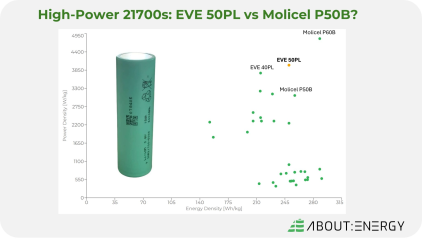
Molicel P60B hopefully will be out by EOY (about energy just made a post on linkedin today about receiving them at HQ for further testing so hopefully @BatteryMooch will get his very soon!). About energy also posted about it claiming it was the best performing 21700 they had tested, with it having the highest power density even beating out other cells they have testing like the JP40 & 50PL. But I also agree I want to see more especially with tabless design.1754342843642.png
 
130 pcs RS60 x 5.9 ea. + 519.4 shipping = $1286.40 . That's before tax. Anywhere to buy with more reasonable shipping?

Molicel P60B hopefully will be out by EOY (about energy just made a post on linkedin today about receiving them at HQ for further testing so hopefully @BatteryMooch will get his very soon!). About energy also posted about it claiming it was the best performing 21700 they had tested, with it having the highest power density even beating out other cells they have testing like the JP40 & 50PL. But I also agree I want to see more especially with tabless design.View attachment 374741
I'm still not convinced that the P60B has lower IR than the EVE 50PL or Reliance RS50.

Just the Molicel P60B datasheet tells us otherwise.
 
I'm still not convinced that the P60B has lower IR than the EVE 50PL or Reliance RS50.

Just the Molicel P60B datasheet tells us otherwise.
Isn’t lower IR not everything though? I mean didn’t the JP40 beat the 50PL in that regard
 
Isn’t lower IR not everything though? I mean didn’t the JP40 beat the 50PL in that regard
IR is rather important, yes. That's why if you want maximum power, the Ampace JP40 is still hard to beat, as it has a lower temperature rise than the EVE50PL at the same current, indicating either that the JP40 has a better thermal path, or that it's dissipating considerably less heat, increasing power density.

Still, I don't believe the EVE 50PL/Reliance RS50 get beat in pure power against the P60B; I guess we'll have to wait until Padja gets a, hopefully free, sample of the P60B to test it out.
 
IR is rather important, yes. That's why if you want maximum power, the Ampace JP40 is still hard to beat, as it has a lower temperature rise than the EVE50PL at the same current, indicating either that the JP40 has a better thermal path, or that it's dissipating considerably less heat, increasing power density.

Still, I don't believe the EVE 50PL/Reliance RS50 get beat in pure power against the P60B; I guess we'll have to wait until Padja gets a, hopefully free, sample of the P60B to test it out.
I do agree it's very important, I guess this is where Padja's testing is conflicting with Moochs as at the same current the 50PL had the same temperature rise while delivering more capacity. So if the capacity / run time was matched to the JP40 it should be a good bit lower in temps from my understanding.

I agree with you about the 50PL being beat by the P60B, but I don't know why they would be claiming this then. Yes I agree hopefully samples will be available very soon, I check this thread very often waiting for them :LOL:
 
I guess this is where Padja's testing is conflicting with Moochs as at the same current the 50PL had the same temperature rise while delivering more capacity. So if the capacity / run time was matched to the JP40 it should be a good bit lower in temps from my understanding.
We can‘t use max temps and/or a single IR number, AC or DC, to compare cells like that.

The DC IR is only the ohmic resistance at whatever temp it was measured at and doesn’t take into account the different other electro-chemical equivalent (AC) resistances that can have a huge effect at different temps.

The standard AC IR measured at 1kHz is just a small sample of, very roughly, the condition at that temp of the electrolyte. It will change in different ways for different cells at different times.

Neither resistance reading can be used to make any judgements or come to any detailed conclusions regarding different cells. Just compare the performance under different loads and the resulting cycle life.

To a degree, max temp doean’t mean much either as different cells have different levels of tolerance to higher temps and, in fact, may be designed to run a little hotter to increase electrochemical efficiency and reduce voltage sag a bit.

We all want this frustrating “it depends” stuff to be distilled down to one or two easy to measure and judge things (especially those who are testing!) but it’s often just not possible.
 
Back
Top