Many of the cells have good lower temperature charging, good for safe regen in cold weather:
Charge Temperature Range -20℃~ 60℃
Wonder what they are doing to allow below freezing charging on some of the cells?
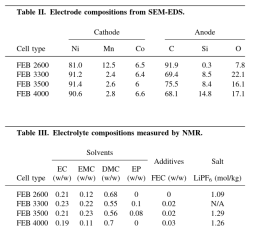
Well, the main way, and "simplest", is to improve electrolyte performance. If the electrolyte doesn't become as viscous or doesn't start to gel up at low temperatures, you keep high electrolyte conductivity at lower temperatures, which helps with preventing graphite anode overpotential during charging. The separator also matters, but this would make my reply too complex TBH.
Another way is to engineer the anode/cathode (both are important for cold charging performance, it's just that the anode is more sensitive during charging) to have more pathways for ions to intercalate/alloy with the anode. Even if the electrolyte gels up, more pathways mean more surface area, meaning better charge performance in the cold. There are many ways to do this, so I'll not discuss this.
Yet another way is to have anode/cathode coatings that have extremely low interfacial resistance with the electrolyte and low solvation energy, which then lowers anode overpotential, etc.
Then, you can also swap the anode material. Swap some of the graphite for some silicon, and because of its much higher voltage vs lithium compared to graphite (0.25-0.4V depending on the form vs graphite's <0.1V vs Li+), it means you have a lot more headroom to charge fast in the cold before delerious lithium plating starts.
Finally, material mechanical engineering can be used. For example, to maximize capacity, you can use an initial thin anode layer to maximize charge rates and as the electrolyte diffuses into the anode, you can start to use thicker and thicker coatings, etc.
Overall, if you charge a cell by itself, electrolyte, separator and electrode engineering is the name of the game. In general, any battery won't perform as well in the cold, even those with solid electrolytes, but the better you design a cell, the better it'll charge at any temperature.
UPDATE
I'd like to add that overall, increasing electrode surface area is the simplest solution, but that can come at the cost of energy density if done via just making coatings thinner. Rather, increasing ion pathways, coatings, super treatments, and multi-layer moncrystalline particles is the best bet.




 On the other hand, anything over 2,000 cycles seems unnecessary to me for many mobile applications. This is especially true for LEVs like e-bikes. I expect I’ll want to replace the battery because of the availability of higher energy density, rather than because I’ve worn it out.




 I do understand why though.


