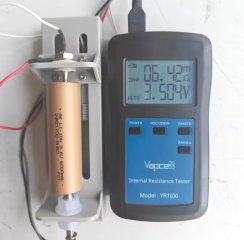
Tabless design cylindrical cells tests

The last time I tested original Tesla cells was in 2020. As for the Model 3, they were basically the equivalent of the NCR21700A and later the 21700T model, both with the 4800mAh minimal capacity. I didn’t look into what happened next.
 
The last time I tested original Tesla cells was in 2020. As for the Model 3, they were basically the equivalent of the NCR21700A and later the 21700T model, both with the 4800mAh minimal capacity. I didn’t look into what happened next.
Funny thing about initial Model 3 21700s: they only had 4500mAh of capacity in the beginning.

If I recall correctly, it didn't actually have the specified capacity on the original car.
 
Speaking of Reliance, three new cells have been added to their public product page:

– INR21700-RH70
– INR21700-RP75
– INR21700-RP80

If the RH60 -> RS60 cycle repeats itself and Reliance develops RH70 into a RS70, it will be very interesting to see multiple 7Ah road-mapped, including Tenpower's 70XG and Molicel's P70X.

First up, though: Reliance RS60, Molicel P60C, Tenpower 60XG, and (maybe a bit later?) BAK 60D. All very exciting!
Let's also see if EVE releases a 60PL by the time competitors start production of their power-oriented tabless 6Ah cells.
 
Many of the cells have good lower temperature charging, good for safe regen in cold weather:
Charge Temperature Range -20℃~ 60℃
Wonder what they are doing to allow below freezing charging on some of the cells?
 
Many of the cells have good lower temperature charging, good for safe regen in cold weather:
Charge Temperature Range -20℃~ 60℃
Wonder what they are doing to allow below freezing charging on some of the cells?
Well, the main way, and "simplest", is to improve electrolyte performance. If the electrolyte doesn't become as viscous or doesn't start to gel up at low temperatures, you keep high electrolyte conductivity at lower temperatures, which helps with preventing graphite anode overpotential during charging. The separator also matters, but this would make my reply too complex TBH.

Another way is to engineer the anode/cathode (both are important for cold charging performance, it's just that the anode is more sensitive during charging) to have more pathways for ions to intercalate/alloy with the anode. Even if the electrolyte gels up, more pathways mean more surface area, meaning better charge performance in the cold. There are many ways to do this, so I'll not discuss this.

Yet another way is to have anode/cathode coatings that have extremely low interfacial resistance with the electrolyte and low solvation energy, which then lowers anode overpotential, etc.

Then, you can also swap the anode material. Swap some of the graphite for some silicon, and because of its much higher voltage vs lithium compared to graphite (0.25-0.4V depending on the form vs graphite's <0.1V vs Li+), it means you have a lot more headroom to charge fast in the cold before delerious lithium plating starts.

Finally, material mechanical engineering can be used. For example, to maximize capacity, you can use an initial thin anode layer to maximize charge rates and as the electrolyte diffuses into the anode, you can start to use thicker and thicker coatings, etc.

Overall, if you charge a cell by itself, electrolyte, separator and electrode engineering is the name of the game. In general, any battery won't perform as well in the cold, even those with solid electrolytes, but the better you design a cell, the better it'll charge at any temperature.

UPDATE
I'd like to add that overall, increasing electrode surface area is the simplest solution, but that can come at the cost of energy density if done via just making coatings thinner. Rather, increasing ion pathways, coatings, super treatments, and multi-layer moncrystalline particles is the best bet.
 
Last edited:
Overall, if you charge a cell by itself, electrolyte, separator and electrode engineering is the name of the game. In general, any battery won't perform as well in the cold, even those with solid electrolytes, but the better you design a cell, the better it'll charge at any temperature.
The funny thing is that the stuff that makes fast charging possible is also usually the same stuff that makes fast cold charging and improving cycle life in general.

For example, if you make your cell capable of 5C charging continously vs the previous generations 2C, that also means 2C runs cooler and lasts longer.

Heck, if you manage to increase energy density without compromising power output, that also increases your power density further.

It's why the Amprius SA112 impresses me somewhat: what if Amprius decided to go all out with it with say, the Amprius SA112-X? Higher condutivity electrolyte, more advanced electrode engineering, all-tab design instead of tabbed design, super-aluminium can, etc.

Right now, with so much battery research, the sky is the limit.

I wouldn't be surprised that once the previous research hits the field, cells like the P85 and Reliance RS85 will appear and eclipse previous cells both in terms of power density and specific energy.
 
@Pajda Reliance said to me that the RS50 should comfortably last to 3000 cycles.
Based on my results, I have no doubt about this claim. (y) On the other hand, anything over 2,000 cycles seems unnecessary to me for many mobile applications. This is especially true for LEVs like e-bikes. I expect I’ll want to replace the battery because of the availability of higher energy density, rather than because I’ve worn it out.
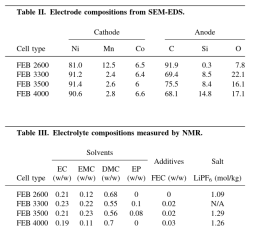
 
@Pajda @BatteryMooch

Screenshot_20260323_144646.png

Radware Bot Manager Captcha

This is incredibly interesting. In fact, while I think battery research articles are always very interesting in general, this is incredible thorough and is actually a full analysis of modern lithium-ion cells down to the bare material level.

It's also very funny to see how... suboptimal FEB's quality control for these cells are.
I think they either got B-grades or their higher energy cells aren't great in terms of consistency.
 
It's also very funny to see how... suboptimal FEB's quality control for these cells are.
I think they either got B-grades or their higher energy cells aren't great in terms of consistency.
I’m wondering if it might be that FEB (and others probably) just thinks that a certain minimum amount of electrolyte is all they have to worry about so inconsistent fills above that amount wasn’t a concern. Interesting stuff!
 
Last edited:
Hi there, do u guys know where to buy a bach of Tenpower 50XG from some site that is not Nkon here in Europe? I will need 600 cells :rolleyes:
 
Hi there, do u guys know where to buy a bach of Tenpower 50XG from some site that is not Nkon here in Europe? I will need 600 cells :rolleyes:
The only one I know about is Queen battery, they dont have any in stock either though.
 
So, I just thought, and found, about something interesting.

Regarding non-flammable non reactive electrolytes, I think I finally found what many bleeding edge manufacturers are trying to do.

I was talking to a friend earlier explaing to me how synthetic oils can utilize polymers and various other additives to thicken oils at higher temperatures. After my discussion with her, I thought about how something similar could be used to create an electrolyte mix that becomes dramatically less conductive to ions at high temperature (>90C) and even become completely solid at decomposition temperatures.

Boom! I then do a quick little research and I find this nice paper on this subject, which implements an additive that can form a polymerized cross linked compound that just blocks any dangerous side reactions when very high temperatures are encountered:

I think this might be how modern cells will approach much more demanding stringent regulations from federal regulations like the most recent CCC iteration: just add in an electrochemical fuse and you get rid of all those issues.
 
Last edited:
I think this might be how modern cells will approach much more demanding stringent regulations from federal regulations like the most recent CCC iteration: just add in an electrochemical fuse and you get rid of all those issues.
So frustrating when we hit a pay wall for a paper we want to read! 😂 I do understand why though.

IIRC these additives have been around for quite a while, at least twenty years. While it can be used in some situations it has some genuine issues to consider (like any additives). I haven’t read about it in a while but, IIRC, slowly activating in storage and activating during operation at high power levels (hotspots, etc), were concerns. There were others too.

I’ll always step back and consider why something that’s been around for a while isn’t being used in any cells. For me, that says there are issues that make using these additives not worth it yet (for general use at least). I’m sure there‘s a good fit somewhere, perhaps low power BESS…always in use and never getting hot unless there’s a problem?

Also, standard chemistry cells already have no problems passing all of the most stringent safety regulations (many have CCC certification). I can definitely see this being a factor when considering whether the years of research and millions of dollars needed to fully develop and validate these additives for mass production Is worth it. It’s such a crazy, brutally competitive business.

I think it’s a cool feature though! Would make for some great testing videos.
 
My first thought is that it would just make the electrolyte worse otherwise, and that trade off in discharge rate, capacity, IR, or whatever isn't worth it. I only skimmed the article though.
 
So frustrating when we hit a pay wall for a paper we want to read! 😂 I do understand why though.

IIRC these additives have been around for quite a while, at least twenty years. While it can be used in some situations it has some genuine issues to consider (like any additives). I haven’t read about it in a while but, IIRC, slowly activating in storage and activating during operation at high power levels (hotspots, etc), were concerns. There were others too.

I’ll always step back and consider why something that’s been around for a while isn’t being used in any cells. For me, that says there are issues that make using these additives not worth it yet (for general use at least). I’m sure there‘s a good fit somewhere, perhaps low power BESS…always in use and never getting hot unless there’s a problem?

Also, standard chemistry cells already have no problems passing all of the most stringent safety regulations (many have CCC certification). I can definitely see this being a factor when considering whether the years of research and millions of dollars needed to fully develop and validate these additives for mass production Is worth it. It’s such a crazy, brutally competitive business.

I think it’s a cool feature though! Would make for some great testing videos.
Luckily the paper is fairly easy to access. I really like the testing of the separator using what appears to be a lighter.
 
BAK's 65E cell was recently updated to -4C/+2C (from -2C/+1C) with a notably low internal resistance, potentially using a tabless structure.

Should we expect BAK's 71E cell to receive the same treatment and performance bump?

For broader context:
- BAK's 4680 and 4695 cells are currently rated around -4C/+4C (at ~27-28Ah and ~32Ah, respectively).
- EVE's G16 (4695, 32Ah) are reportedly used in BMW's iX3 and the upcoming i3, with roughly identical charge/discharge performance, and apparently no major cycle life penalty from repeated fast-charging.

~6Ah cylindrical tabless landscape (so far):
• Molicel P60C
• Reliance RH60, and upcoming RS60
• Tenpower's 60XG
• BAK's 60D
• V4Smart 5X

>6Ah cylindrical tabless:
• BAK 65E <- possibly not a tabless cell - TBD.
• Molicel-Tenpower M65A (also here) <- possibly not a tabless cell as well - TBD.
• Reliance RH70 (pre-announcement)
• BAK 71E (pre-announcement)

Things are looking good on the tabless front lately!

Some other notable tabless cells:
• Reliance 4695 (~32Ah)
• Samsung 4680 (~25Ah)
• LG H52A (~5Ah)
• Samsung 50U (~5Ah)
• Lishen 50PT (~5Ah)

P.S: Apologies to the purists for mentioning Ah's instead of Wh's.

edit:
- Charging transgression sign error fixed, keeping purists at bay.
- 65E & M65A "tabless" status updated, pending confirmation/invalidation. Thanks, @Pajda!
- 46mm EVE cell info updated, relative to cells used in recent BMW EVs. Thanks, @BlueSwordM!
 
Last edited:
For broader context:
- BAK's 4680 and 4695 cells are currently rated around +4C/-4C (at ~27-28Ah and ~32Ah, respectively).
- EVE's G16 (4695, 32Ah) are reportedly used in BMW's iX3 and the upcoming i3, with roughly identical charge/discharge performance, and apparently no major cycle life penalty from repeated fast-charging.
Actually, BMW doesn't even use the EVE G16 in their vehicles actually.

It's very confusing, but EVE Gen 1 cells are the EVE G13 30Ah and EVE G16 32Ah; the former is a higher power cell than the latter, but with lower energy contents.

However, there's also the newer EVE G11E, which is a Gen 1.1 cell, with similar power characteristics to the EVE G13, but with energy contents similar to the EVE G16 while only needing to charge at 4.20V vs the 4.25V of the EVE G16.

It's also a cheaper cell with much higher yields, which is why it's very interesting to see distributors trying to get rid of slightly older generations cells basically everywhere to non knowing buyers. Of course, they'll still sell the EVE G11E to you, just not advertise it as part of their catalogs :)
 
Back
Top