• Hello ES! We could use some help to get us past the finish line on building the new knowledgebase for the forum.
    Can you donate? Please see our fundraising page. Thank you!

Strange battery pack design?

Zambam

🚴‍♂️ Mega poster
Joined
Dec 17, 2021
Messages
1,659
Location
NYC
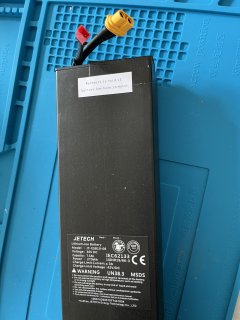
I've owned 3 or 4 factory ebikes before but this is my first iScooter i12 which has an unusual battery pack. It is a dual port with separate charge and output connectors. When the charger is plugged in, it cuts battery power output. If I turn the key on, the display LED does not light up. If I probe the battery output, it shows zero volts.

Is this only on scooters or only on certain brands? Is this unusual for a battery pack design?

Only when the charger LED turns green does it enable power output.

IMG_1460.jpeg
 
Sounds like a good safety feature. There were people doing unsafe stuff like daisy chaining batteries.
 
Probably cheaper to make too. A common port BMS has two sets of MOSFETs back to back so it can block either charging or discharging when needed (overcurrent, unbalanced cells, under voltage, etc.). MOSFETs act as a diode when unpowered, but there's a large voltage drop. So a good BMS would detect that everything is in order with the charging and enable both sets of MOSFETs to avoid the voltage drop if it doesn't currently need to block anything. Even though technically it could leave one set unpowered.
 
Probably cheaper to make too. A common port BMS has two sets of MOSFETs back to back so it can block either charging or discharging when needed (overcurrent, unbalanced cells, under voltage, etc.). MOSFETs act as a diode when unpowered, but there's a large voltage drop. So a good BMS would detect that everything is in order with the charging and enable both sets of MOSFETs to avoid the voltage drop if it doesn't currently need to block anything. Even though technically it could leave one set unpowered.
So a dual port BMS does not have two set of MOSFETS back to back, thus can only be charged via the charge port?

Do you see any problems wiring 2 of these dual port batteries in parallel? I.e. wire the 2 charge ports in parallel and then separately, wire the 2 discharge ports in parallel.
 
Do you see any problems wiring 2 of these dual port batteries in parallel? I.e. wire the 2 charge ports in parallel and then separately, wire the 2 discharge ports in parallel.
I've tried putting a 2-wire and a 3-wire together. Charged both from the charge port of the 3-wire BMS and the 2-wire pack never would fully charge.
 
I've tried putting a 2-wire and a 3-wire together. Charged both from the charge port of the 3-wire BMS and the 2-wire pack never would fully charge.
What is a 2-wire and a 3-wire? I have 2 identical batteries that are dual port with separate charge and discharge ports.
 
Probed charge port with DVM. No voltage present. Changed to ohms scale, got 43.4k and 50k (reversed probes). Is that a blocking diode in the circuit?
 
3-wire have the separate ports. 2-wire BMSs charge and discharge through the same port.
Found these 2 informative posts on 2 & 3 wire BMS.


Both packs are wired up in parallel (after charge to same voltage). Had to relocate the BMS from the side of the enclosure to the end. It was tight but fits fine. Motor runs. Have not test the charge port yet (need to run the battery down first).
 
With both packs (dual ports) wired in parallel, everything is working the same as before except it's taking twice as long (10 hrs instead of 5) for a full charge with the 1.5A charger. I ordered a 4A charger from aliexpress which should speed up charging time to 3.75 hrs.
 
With both packs (dual ports) wired in parallel, everything is working the same as before except it's taking twice as long (10 hrs instead of 5) for a full charge with the 1.5A charger. I ordered a 4A charger from aliexpress which should speed up charging time to 3.75 hrs.

When I travel (vanlife) I keep a Luna 3 amp charger and a 10 amp generic charger on board. My solar doesn't have enough to keep my ebike charged so I'll stop at a park or public area for an hour or two and bulk charge 10-20 amp hours with the generic but use the Luna running off of solar to finish later.
 
When I travel (vanlife) I keep a Luna 3 amp charger and a 10 amp generic charger on board. My solar doesn't have enough to keep my ebike charged so I'll stop at a park or public area for an hour or two and bulk charge 10-20 amp hours with the generic but use the Luna running off of solar to finish later.
I pretty much exclusively charge from 12vDC nominal with a campervan as the powersource mindset, even when I have 120vAC gridpower available.

I use a CCCV 40 amp max ( input) charger to charge my 10S li-ion batteries. I have and use smaller CCCV boosters/Step up converters too.

The actual max output varies depending on actual input voltage one is boosting from, but 10 amps charging of 10S Li-ion is doable with the ~25$ '1800 watt' CC/CV boosters.

When driving at speed, the alternator usually has a good amount of extra amperage available. It is when idling or driving slowly at low speed and low engine rpm(thus alternator rpm) that the alternator is in danger of overheating, if asked for more than 50% of its rating. A lot depends on the specific alternator and the underhood airflow of the specific vehicle. My CVan has two alternators (that I control manually with adjustable voltage control) of the same rating, but different design, and they behave quite differently in terms of their capability at different rpms, and the temperatures they achieve.

If you are using an inverter to power a dedicated charger, you are wasting a lot of energy as heat during the double conversion of DC to AC inverting 12vdc to 120vac and then 120vAC back to xx.x vDC. Boost ~12.8v to 42 or whatever DC voltage instead.

I consider most Red light green light AC/DC chargers to be an insult to the battery, and to propagate ignorance. At the minimum, know the voltage and the amperage that your charging source is delivering.
 
Last edited:
When I travel (vanlife) I keep a Luna 3 amp charger and a 10 amp generic charger on board. My solar doesn't have enough to keep my ebike charged so I'll stop at a park or public area for an hour or two and bulk charge 10-20 amp hours with the generic but use the Luna running off of solar to finish later.
Do parks or public areas usually have outlets for people to freely use? How long an extension cord do you carry? How much solar do you have on the van?
 
Do parks or public areas usually have outlets for people to freely use? How long an extension cord do you carry? How much solar do you have on the van?

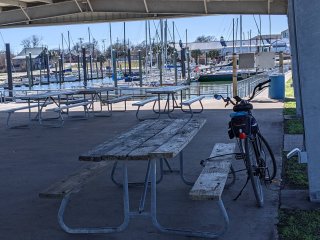
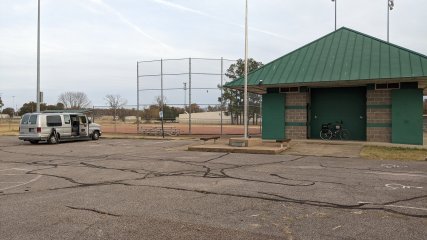
Most larger parks have electrical outlets in their picnic shelters or if they have a bandshell/stage or performing area there will always have electrical. (A few pics below of my ebike charging at various public places). I don't use an extension cord when charging the ebike and just strap the charger onto the trunk bag and ride up to an outlet. The van has a 50 ft. cord for when I plug into shore power. I used to only plug in when it would get cold as in the teens (15°F or colder) but do plug in a bit more often as I travel with a CPAP machine for the time being (I'm ancient). The van has 200 watts of solar nestled down in the roof rack for stealth and 150 ah of LiFeO2 house batteries. It has refrigerator, sink and running water and a 1,000 watt inverter for mains current. I've had bigger RVs but for just me this works well. Small and easy to turn around and get out of trouble faster than I got into it. (Too often I take no trespassing signs as suggestions instead of law.....) It's getting old and we've been looking for a replacement.

PXL_20250805_160347263 (1).jpgPXL_20230122_203332836.MP.jpgPXL_20231116_201942049.jpg
PXL_20231113_221900028.jpg
 
Can you post links?
I went into pretty good detail in this thread.

 
I went into pretty good detail in this thread.

Do you know what efficiencies you're getting from these boosters/converters? They need extra work to setup- voltage, power monitoring, trimpot adjustments etc.

I consider most Red light green light AC/DC chargers to be an insult to the battery, and to propagate ignorance. At the minimum, know the voltage and the amperage that your charging source is delivering.
I've read red/green LED chargers are around 85% efficient. Unlike boosters/converters, they have safety features built in. I double check mine with a volt meter and clamp on ammeter just to be sure they are within spec.
 
Do you know what efficiencies you're getting from these boosters/converters? They need extra work to setup- voltage, power monitoring, trimpot adjustments etc.


I've read red/green LED chargers are around 85% efficient. Unlike boosters/converters, they have safety features built in. I double check mine with a volt meter and clamp on ammeter just to be sure they are within spec.
The inline wattmeter I have going right now is claiming 74 watts in and the one on the output is saying 71 watts out charging from 13.34v lifepo4 to boost towards 41.8v at 2 amps output. The 10S receiving battery is still down in the 34.6v range and will require ~3.5 more hours before it is up in the mid 41v range. The Lifepo4 feeder battery will drop towards 12.6v by then and the lower the input voltage, the lower the efficiency in general.

The efficiency of the booster varies greatly on the input voltage and the output voltage and the amount of current flowing through the booster. I will estimate the range of efficiency varies from 94 to 82% depending on the huge amount of variables involved. I've not really concerned myself with the efficiency as I am not currently tilting solar panels for maximum harvest. If I am up at the booster's input amperage maximum I make sure the ones without fans, have excellent airflow over them.

Checking a charger output voltage open circuit/ unloaded is wise, but knowing what the battery voltage is when the red light turns green, and how much amperage was still flowing before red turned green, or if amperage IS still flowing AFTER the red turned green, is where I think most people's observations of their charger's ability falls well short.

The 2 Liion 7s and 1 10s chargers that came with equipment I got, were both overvolting the battery.
The red light turned green when 0.32 amps tapered to 0.31. But the amps did not stop flowing.
Amps would taper to zero and the 7s chargers would take the batttery well past 29.4v, upto 30.32v if left on the charger with its green light happily spewing BS.

The 10S charger would also happily take the battery to 42.6v, and rely on the BMS for high voltage disconnecting when any one cell reached 4.26v. That group regularly getting to 4.26v is going to age a lot faster than the onle only getting to 4.16 and the p groups will have different resistances and charge or discharge faster or slower than adjacent groups. Then one is really hoping the BMS has enough passive balance ability to keep them relatively close.

So happily trusting that a red light green light charger is actually doing proper by the battery, is not something I can condone.

I suspect many battery fires could be prevented if a Human did not simply just trust their red light green light charger.

With lots of observation as to how much the battery is accepting at a certain voltage both down low and up near full charge, they can get a much greater understanding of their battery's state of health.
If an observation of voltage or amperage flowing at that voltage reveals some parameter is way different than expected, then one can unplug the charger and investigate. Take a sniff for stank or a feel around for abnormal heat and move the equipment outside if either is noticed.

We live in an age where smartphone everything is supposed to do everything automatically and keep us safe while remaining ignorant, and coveting more material things, but Lithium battery fires are no joke, and I think more personal responsibility needs to be taken when one takes a pack of miniature potential jet engines into their living quarters.


I love my CCCV boosters as I can set the target voltage to 4.181v and max amps to 0.15. This allows my Dumb Daly BMS the time to actually balance my parallel groups, as it can only do so with 0.02amps maximum. I can also set voltage unloaded to 42.02v, connect it to the battery, and dial up 9.88 amps, and to stay under the 10 amp limit of my charge port and charge port fuse and charge as fast as is safely possible.

most of the time I am like, when is the next time i need to roll? Dheck my battery voltage, then dial 41.2 to 41.5v ( unloaded/ open circuit) and then plug into battery and then dial amperage only as high as needed to get there by then.

As slowly as possible, as quickly as needed.

Setting it to 41.5v instead of 42, if I forget and let it go after amps taper below 0.2 then i am not abusing the battery nearly as much as if i were holding it at 42v down to 0.00x amps.

The Only times I really dial in 42 volts, 4.2 volts per Parallel group, is right before a roll, and only when I expect to want the full available range.

The supposed saftey mechanisms of many dedicated li-ion chargers is simply to shut off when current tapers to a certain level, perhaps some use a timer after a certain amperage threshold is crossed, and this is usually 0.1 amps per cell in a p group at 4.2v, but does the charger know how many cells are in the battery's p group?
 
Back
Top