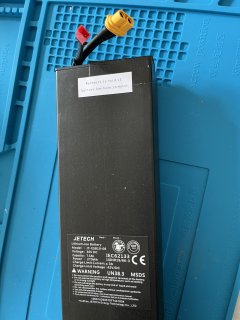
Do you know what efficiencies you're getting from these boosters/converters? They need extra work to setup- voltage, power monitoring, trimpot adjustments etc.
I've read red/green LED chargers are around 85% efficient. Unlike boosters/converters, they have safety features built in. I double check mine with a volt meter and clamp on ammeter just to be sure they are within spec.
The inline wattmeter I have going right now is claiming 74 watts in and the one on the output is saying 71 watts out charging from 13.34v lifepo4 to boost towards 41.8v at 2 amps output. The 10S receiving battery is still down in the 34.6v range and will require ~3.5 more hours before it is up in the mid 41v range. The Lifepo4 feeder battery will drop towards 12.6v by then and the lower the input voltage, the lower the efficiency in general.
The efficiency of the booster varies greatly on the input voltage and the output voltage and the amount of current flowing through the booster. I will estimate the range of efficiency varies from 94 to 82% depending on the huge amount of variables involved. I've not really concerned myself with the efficiency as I am not currently tilting solar panels for maximum harvest. If I am up at the booster's input amperage maximum I make sure the ones without fans, have excellent airflow over them.
Checking a charger output voltage open circuit/ unloaded is wise, but knowing what the battery voltage is when the red light turns green, and how much amperage was still flowing before red turned green, or if amperage IS still flowing AFTER the red turned green, is where I think most people's observations of their charger's ability falls well short.
The 2 Liion 7s and 1 10s chargers that came with equipment I got, were both overvolting the battery.
The red light turned green when 0.32 amps tapered to 0.31. But the amps did not stop flowing.
Amps would taper to zero and the 7s chargers would take the batttery well past 29.4v, upto 30.32v if left on the charger with its green light happily spewing BS.
The 10S charger would also happily take the battery to 42.6v, and rely on the BMS for high voltage disconnecting when any one cell reached 4.26v. That group regularly getting to 4.26v is going to age a lot faster than the onle only getting to 4.16 and the p groups will have different resistances and charge or discharge faster or slower than adjacent groups. Then one is really hoping the BMS has enough passive balance ability to keep them relatively close.
So happily trusting that a red light green light charger is actually doing proper by the battery, is not something I can condone.
I suspect many battery fires could be prevented if a Human did not simply just trust their red light green light charger.
With lots of observation as to how much the battery is accepting at a certain voltage both down low and up near full charge, they can get a much greater understanding of their battery's state of health.
If an observation of voltage or amperage flowing at that voltage reveals some parameter is way different than expected, then one can unplug the charger and investigate. Take a sniff for stank or a feel around for abnormal heat and move the equipment outside if either is noticed.
We live in an age where smartphone everything is supposed to do everything automatically and keep us safe while remaining ignorant, and coveting more material things, but Lithium battery fires are no joke, and I think more personal responsibility needs to be taken when one takes a pack of miniature potential jet engines into their living quarters.
I love my CCCV boosters as I can set the target voltage to 4.181v and max amps to 0.15. This allows my Dumb Daly BMS the time to actually balance my parallel groups, as it can only do so with 0.02amps maximum. I can also set voltage unloaded to 42.02v, connect it to the battery, and dial up 9.88 amps, and to stay under the 10 amp limit of my charge port and charge port fuse and charge as fast as is safely possible.
most of the time I am like, when is the next time i need to roll? Dheck my battery voltage, then dial 41.2 to 41.5v ( unloaded/ open circuit) and then plug into battery and then dial amperage only as high as needed to get there by then.
As slowly as possible, as quickly as needed.
Setting it to 41.5v instead of 42, if I forget and let it go after amps taper below 0.2 then i am not abusing the battery nearly as much as if i were holding it at 42v down to 0.00x amps.
The Only times I really dial in 42 volts, 4.2 volts per Parallel group, is right before a roll, and only when I expect to want the full available range.
The supposed saftey mechanisms of many dedicated li-ion chargers is simply to shut off when current tapers to a certain level, perhaps some use a timer after a certain amperage threshold is crossed, and this is usually 0.1 amps per cell in a p group at 4.2v, but does the charger know how many cells are in the battery's p group?