• Hello ES! We could use some help to get us past the finish line on building the new knowledgebase for the forum.
    Can you donate? Please see our fundraising page. Thank you!

Upcoming 3wheeler project

Pmkr

🧲 New user
Joined
Jun 24, 2026
Messages
14
Location
EU
In the not so far future I planning to start my EV projekt, an ultralight reversetrike. The structural construction won't be a problem, but I am totally green about the electric part.

Planning to use an e-moped, or e-motorbike hubmotor around 1500-2000 Watts (still in search for the right motor or donor vehicle). I am not going for the speed, but much more for range. A tipical el-scooter selling here with 20-30 Ah batteries and have 40-60 km drive with full battery. My plan is 2x200Ah battery. Is it realistic to count on 800-900 km with one charge, or minimum around 500 km? Or just not possible to calculate based on these parameters (with 48 v system)?

Another thing; 400 Ah total capacity will need about a full day (24 hours) charging time. I wanna be able to charge at home from normal domestic network, but also at public charging stations. Can I aim to any fast charging protocol, or Type 2 is the maximum what I can hope? The space for the batteries and charger(s) +the controll unit are really limeted so I would love to make everything as simple as possible (i mean really just „few” parts).

I much appreciate every information and help.
 
Last edited:
48v with 400ah is a capacity of 19.2kw and at least 100kg of battery cells alone, probably closer to 120kg once cases, bus bars etc are added. You are looking at a 200kg minimum vehicle. Allowing a moderate milage of 75wh/km your range would be about 250kms.
 
48v with 400ah is a capacity of 19.2kw and at least 100kg of battery cells alone, probably closer to 120kg once cases, bus bars etc are added. You are looking at a 200kg minimum vehicle. Allowing a moderate milage of 75wh/km your range would be about 250kms.

The elstimated weight of the batteries (lithium) about 25 kg each. The empty weight of the trike is about 100-120 kg (planned without the batteries). And it will be a 2 seater.
:)

But If I am really limeted to 250 km range, then the fastcharging will be a kind of necessity.
 
I am curious what batteries you are planning to use, if you can build a 10kwh that weights 25kg?
My 5kwh batteries weight somewhere around 25kg with modern 21700 cells.

And why should it take 24 hours to charge? With 11kw (normal 16A 3 phase) it should be done in less than 2 hours.
 
Fast charging for 48V batteries, lightest would be 3 Delta DPR3000B each 1,3kg and 3kW charging power, they can do up to 58V.
Downside is,noisy (each 55dB high reving 40mm fan), and no plug for connection available, you have to solder wires.
Less noisy is the high efficiency model DPR3000E, each 1,4kg.

Or if the battery is smaller, then 3 Vertiv R48-2000e3 1,13kg or 3 Eltek Flatpack S 48V 1800W 0,85kg could also do the job.
 
Thank you for you guys. I have to contact the manufacturer and clean up the weight specification. Maybe consider another voltage if that working better...
 
So I contacted the manufacturer and unfortunately I was wrong and you guys right. The weight of the batteries near to 50 kg each. :(
 
50kg of batteries for a trike sounds quite alright, but I guess it won't exactly fit the definition of ultralight anymore.

For DC fast charging on public stations, you'll need at minimum about 150V, but aiming for 200V would be a safer bet, since not all DC stations might be willing to go that low. Three-phase AC-to-DC charger would likely be more than enough for this capacity though.
 
50kg of batteries for a trike sounds quite alright, but I guess it won't exactly fit the definition of ultralight anymore.

For DC fast charging on public stations, you'll need at minimum about 150V, but aiming for 200V would be a safer bet, since not all DC stations might be willing to go that low. Three-phase AC-to-DC charger would likely be more than enough for this capacity though.

Unfortunately I can't afford that high weight, because, the special small size wheels limiting my maximum weight. And myself also a big disadvantage with my own weight ower 110 kg at the moment. :cool:
 
After all these information, what for I have to thank again, I decided to simpify my build. I will just use the cheapest available el-moped with the factory battery and sets for proof of the concept (making a working vehicle with any speed and range). And if that becoming a success, then I can change the drive, battery and controll to a commercially available longrange version, like the "NQi GT Big battery". This promissing about 140 km range, so if I double the battery then hopefully I can come around 200 km and I have to live with that. :)
 
Dear folks here!

My preparation for my project slowly rolling forward. About a week ago I bought my donor vehicle, what is an Ecooter E3. Not really what I planned (chaindrive insted of hub motor), but have a big bunch of advantages.

Unfortunately there is a very big disadvantage also and that is the 10 hours of charging time for the dual batteries. Because I planning to drive the vehicle in international (over 1000 km) travel, this isn't an acceptable alternative for me. There is few methode to get around and reduce the charging timer to 5 hours with using of a bouble charger system, but that have many technical difficulties.

But there is seems like a more simple solution, just I am a bit unsure if that is safe enough. The present charger what came with the scooter have a 64 V - 6,5 A output. There are few webshops which selling a stronger charger with 64 V - 14 A and listed as Ecooter E3/E5 charger and based on the images the charging connector indeed the specific Type 22 what my vehicle have. I tried to ask 2 different dealerships here in Scandinavia if this charger is safe to use to my scooter, but so far haven't got any answer from them.
Anyone here have a well-founded idea if I may use the stronger charger or I will fry my batteries?

Thanks for everyone who waste time on my worries. :)
 
a well-founded idea if I may use the stronger charger or I will fry my batteries?
Cells in the battery will have a maximum charging current rating. Figure out what cells you have, find the datasheet and that will tell you what's the safe charging current. It's not enough to approximate this from capacity; I have two batteries of almost exactly the same capacity - the 18650 one has 20 cells in parallel, and each can charge at 2.5A, giving 50A max. The other one has 1 cell in parallel, but can charge at 380A peak.
 
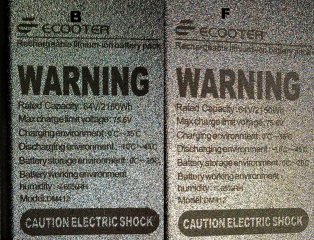
Thank you for your answer. I am not sure how much I can find out about the cells, because they are formed in a factory package, but I try to read after. Meanhwile I insert a pictre here from printed on datasheet of the 2 identical batteries. Maybe someone can sem and read what I can't identify and understand.

batteries2.jpg

Unfortunately printed lightgrey on a silver surface, but tried to make a bit more eradable.
 
This doesn't tell you anything about the charging current. Until you establish the exact cell model, the only safe option is to charge the battery at a very conservative (slow) rate.

The battery charging rate is often expressed in a unit C, 1C meaning "1 capacity per hour". For example, with a 2150Wh@64V, you have a ~33ah battery. This means that a charging rate of 1C for this battery is equal to 33A. 1C is actually on the higher side; a typical unknown li-ion cell can be assumed safe up to ~0.5C (*). This would give you 16.5A, meaning that the 14A charger is likely okay. To be completely sure, however, you need to learn about the actual battery specs.

*) Which would give you 2h charging time from empty to full. In practice, the current will quickly drop past ~80% when the charger reaches its maximum voltage and moves into the CV phase, meaning the actual charging time will be closer to 3-3.5h.
 
This doesn't tell you anything about the charging current. Until you establish the exact cell model, the only safe option is to charge the battery at a very conservative (slow) rate.

The battery charging rate is often expressed in a unit C, 1C meaning "1 capacity per hour". For example, with a 2150Wh@64V, you have a ~33ah battery. This means that a charging rate of 1C for this battery is equal to 33A. 1C is actually on the higher side; a typical unknown li-ion cell can be assumed safe up to ~0.5C (*). This would give you 16.5A, meaning that the 14A charger is likely okay. To be completely sure, however, you need to learn about the actual battery specs.

*) Which would give you 2h charging time from empty to full. In practice, the current will quickly drop past ~80% when the charger reaches its maximum voltage and moves into the CV phase, meaning the actual charging time will be closer to 3-3.5h.

Thank you so much for your help. :)
 
You have already purchased these cells? It seems you have a rebranded cell with the scooter/product brand printed on there.

If you could not get a cell data sheet, one option is try to get specs for a commercial product which uses this brand/model of cell, then back calculate from that spec. Even if you manage to do this, no guarantees you have the same batch/quality of cell. But its a starting point. You can use that scooter spec to start testing your cells.
 
You have already purchased these cells? It seems you have a rebranded cell with the scooter/product brand printed on there.

If you could not get a cell data sheet, one option is try to get specs for a commercial product which uses this brand/model of cell, then back calculate from that spec. Even if you manage to do this, no guarantees you have the same batch/quality of cell. But its a starting point. You can use that scooter spec to start testing your cells.

Thank for your help. I didn't bought any "cells", I bout the scooter with the 2 batteries in already, and a "shitty" slow charger. And now try to find solutions. :)
But luckily after some long waiting time, the danish dealership answered for me and the better charger is on the way to me. Maybe I will upgrade the batteries too by them.
 
Back
Top