• Hello ES! We could use some help to get us past the finish line on building the new knowledgebase for the forum.
    Can you donate? Please see our fundraising page. Thank you!

Аn angle of hall sensors

Why should I not trust the oscilloscope
You can trust it, but it is not relevant for your problem. The only thing that counts is, that the controller knows which hallstate belongs to which rotor position. Which controller are you using?

regards
stancecoke
 
I believe the solution may be much simpler than thought. :unsure:
I have come to the conclusion that the two main concepts being discussed in this thread, are actually 2 different, separate, and distinctive things.

The first being the hall sensors physical location (mechanical displacement) and representation of its associated electrical period. I.E. The difference between 60 and 120 degree locations. That can be easily identified between the two by comparing the off and on sequences of the three individual sensors compared against each other. As seen and discussed previously, including charts. And somewhat set in stone. (Or epoxy so to speak…) ;) These hall sensor transition sequences are known and commonly used by the industry and supported by the controller manufactures. Never hurts to verify before purchase that your particular degree is supported though…

And the second, that of the “hall shift angle” as presented in VOTOL EM50-4 software interface. In my mindset, a method of determining the most efficient start position or “advance” of the hall sensors operation. (Somewhat like the advancement of an automobile’s engine‘s spark advance and timing of its internal combustion engine ignition.) Which may vary a bit, and perhaps seen already in testing with the use of the different types of hall sensors. This seems to me to be obtained by comparing the hall sequencing to its associated phase wiring. As shown previously by oscilloscope/formula method, or controller’s self learning function.


Edited to add more content.
 
Last edited:
You can trust it, but it is not relevant for your problem. The only thing that counts is, that the controller knows which hallstate belongs to which rotor position. Which controller are you using?

regards
stancecoke
Votol EM50-4
 
I believe the solution may be much simpler than thought.
Yep! I think same.

I have come to the conclusion that the two main concepts being discussed in this thread, are actually 2 different, separate, and distinctive things.
Nope. We are not discussing physical location here. And we have no reason to discuss it.

I decided to find out why the motor has 60 deg. instead promised by seller 120 deg. and if it is possible to get 120 electrical (magnetic) deg. offset for the motor hall sensors.
 
Before purchasing the controller, I asked the seller if their Votol controller would fit my Suringmax motor.
The seller of the controller stated that there no problems, all DD motors work perfectly with Votol controller.
But after I bought the Votol EM50-4 and started setting it up, I got problems with the setup.

To this the seller of the controller tells me that only their QS motors and only motors with the angle 120 deg. of hall sensor are suitable for their Votol controllers.
I was very shocked by the lies of seller. In order to sell, he is ready to state anything.

It calmed me down to think that my motor at least has hall angle 120 deg. how stated seller of motor.
But the controller setting was not successful. The value of 120 degrees in the controller settings did not make the motor work correctly.

Thanks to auto-identification and oscilloscope measurements, I found out that the angle of the hall sensors is other.
I decided to replace them with new, working hall sensors.
And I asked the controller seller what kind of Hall sensors are in the QS motors.
The thing is that my Suringmax motor is a popular motor model that many manufacturers copy.
And QS also makes the same motor.
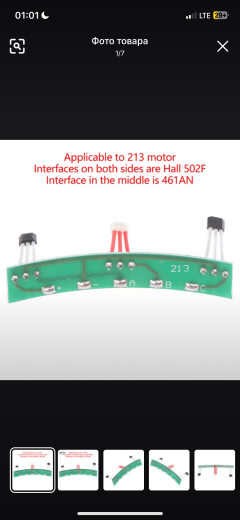
I found out and bought the whole board with three Hall sensors like in the QS motor.
 
One more thing.

By the way, to get 60 deg. instead of 120 by turning the central hall sensor, can use only the hall sensors without the board.
The thing is that there are tracks on the board and turning the sensor simply confuses the connection. And this will not work correctly at all.
For offset the angle hall sensors 60 deg. , needs the board for 60 deg.

For example the board for 120 deg. Turning the sensor the opposite way will result in the incorrect connection.
 

Attachments

  • IMG_1714.png
    IMG_1714.png
    1,008 KB · Views: 8
And this will not work correctly at all.
Of course you have to solder the pins correctly to +5v, GND and signal. Simply twist the connection legs of the center sensor, that the face of the body points to the reverse side. As the legs are fully insulated this should not be a problem, they are long enough. But of course, you can change the whole board or replace the center sensor by one with the reverse logic, also.
 
Last edited:
Back
Top