• Hello ES! We could use some help to get us past the finish line on building the new knowledgebase for the forum.
    Can you donate? Please see our fundraising page. Thank you!

First basic build - need assistance.

bkaushansky

🧲 New user
Joined
Apr 22, 2026
Messages
6
Location
United States
I’m mechanically and electronically fluent and need some assurance in completing a build. Have built racing drones in past so comfortable with basic programming, parameter adjustments.

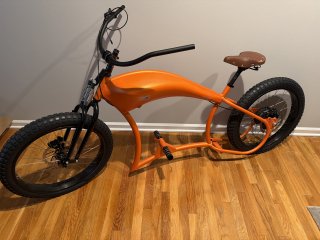
Long framed beach cruiser running without cycling setup, so throttle controls only. Running Bafang G061 750w motor on rear wheel only.

Looking for a simple solution for controller and recommendation on battery size. Targeting 25-30mph max on 24” fat tires (so effectively a 26”). Run time of 30 minutes min. Bike frame is quite heavy. And I do my own metal work so welding tabs and brackets on frame isn’t a problem.

Thanks for any assistance.
 

Attachments

  • image.jpg
    image.jpg
    2.9 MB · Views: 9
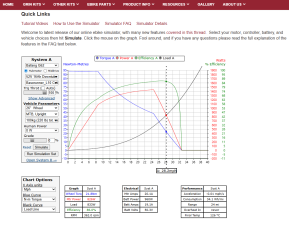
So at 30 minutes at 30 mph, you are looking for a range of 15 miles. You didn't say if there are any hills. If you are using 30 wh/mile, you will need a 450 wh battery. 25 wh/mile is common on flatish terrain with pedaling at around 20 mph. The force of the wind resistance is quite a bit higher at 30 mph and hills will also eat into your battery. The Grin Motor Simulator will give you a better idea: Motor Simulator - Web Tools - Resources
 
A 48v battery, 10ah or greater should get you going, but avoid bogging down too much while climbing hills without cranking assistance.
 
I played around with their simulator a bit. Interesting tool.

This is a 100% beach cruiser with no hills whatsoever so ever. All pavement.

Looks like 48 or 52V, ~20ah battery would do it.

Need controller that’s simple with little to no bells and whistles. Was actually looking at a grip throttle with battery state display. Very simple and perfect for my needs. Suggestions welcome.
 
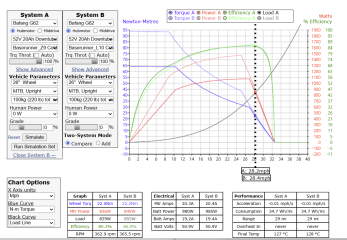
It looks like going with a 52V battery will get you about 1.4 mph more over a 48V battery. Changing the controller from 25A to 35A didn't make much difference, so 25A is probably good enough on flat ground. But you can play with the motor simulator to see what works best for you.

Motor3.png
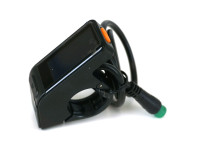
The Grin Baserunner controller is probably not as basic as you want, but you can get it with the Superharness kit and a mini-display and throttle. There are a lot of other cheap controllers on Amazon and eBay. I would advise not to go cheap on the battery though and get one from a reputable source that uses name brand cells to avoid fire risk.
https://ebikes.ca/ebike-parts/control-stuff/superharness/bundle-superharness-displ.html
dsp-sw102.jpg

Motor Simulator - Web Tools - Resources

Motor4.png
 
We talk about 48V packs and 52V packs, but the performance of the two overlap, so a fully charged 48V pack will outperform the 52V pack at it's nominal voltage (54.6V vs 51.8V), all else being equal.

When you state 30mph maximum speed, do you mean 30mph minimum for maximum speed, meaning at any charge level of the pack, you'd want to still be able to go 30mph?

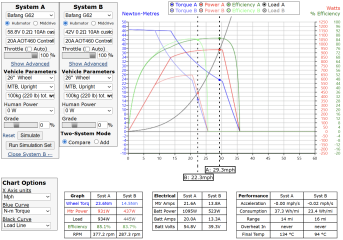
Below is an example of a fully charged "52V" pack and a nearly discharged "52V" pack. You can see there's an 8mph difference, 30mph vs 22mph over the course of discharging the pack. Really sucks near the end of the pack. 14Nm of torque at 22.3 mph for the near dead pack, vs 30Nm at the same speed the fully charged pack. You might be able to feel some acceleration at 30Nm if you twist the throttle. Acceleration from 14nM of torque wouldn't be much more than a big fart.

If it's a cruiser, you probably don't care about acceleration, but if you want to get to 30mph before the old lady with her walker, you'd want to build a bike that goes at least 35mph; just look at how the torque curve takes a nose dive as your speed increases.

1776893007163.png as
 
You gon' put whiskey in that tank?

Assuming pedal power is absent or ineffective, I would use 48V/25A in a reasonable motor speed range. That bike does not look super capable at over 25 mph.
 
You gon' put whiskey in that tank?

Assuming pedal power is absent or ineffective, I would use 48V/25A in a reasonable motor speed range. That bike does not look super capable at over 25 mph.
Whisky goes in me !!

Ive been building bikes for 40 years. Got it up to 20, down a hill, with a stupid gear just to see if it’s even feasible.

The 35mph target was for max speed, full battery, 100% throttle. Just a goal. Realistically 20mph for 30 miles of flat terrain.
 
In playing with the simulator... and please correct me if I'm wrong. Assuming all else equal, changing from Baserunner z9 to Baserunner L10, to Phaserunner allows for same torque output at decreasing level of throttle. Suggesting that if I want greater potential acceleration (at expense of battery) the Phaserunner can deliver it vs Baserunner Z9.

So what's the rationale (other than cost) for not running the Phaserunner?

Secondly, the greatest consumption of energy is during acceleration stage. So assuming I push all out till 20mph then hold steady at that speed, I can look at the range during acceleration to be 30 miles, then during steady state is 50 miles demonstrating that the motor no longer has to work as hard to accelerate.
 
In playing with the simulator... and please correct me if I'm wrong. Assuming all else equal, changing from Baserunner z9 to Baserunner L10, to Phaserunner allows for same torque output at decreasing level of throttle. Suggesting that if I want greater potential acceleration (at expense of battery) the Phaserunner can deliver it vs Baserunner Z9.

So what's the rationale (other than cost) for not running the Phaserunner?

Secondly, the greatest consumption of energy is during acceleration stage. So assuming I push all out till 20mph then hold steady at that speed, I can look at the range during acceleration to be 30 miles, then during steady state is 50 miles demonstrating that the motor no longer has to work as hard to accelerate.
So what kind of acceleration are you trying to achieve? That affects battery, controller, and motor choices. For what you have described, the phaserunner is spending a bunch on features you’ll never use, and maybe under powered due to phase amp restrictions, if you need stronger acceleration. Any other requirements?
 
In playing with the simulator... and please correct me if I'm wrong. Assuming all else equal, changing from Baserunner z9 to Baserunner L10, to Phaserunner allows for same torque output at decreasing level of throttle. Suggesting that if I want greater potential acceleration (at expense of battery) the Phaserunner can deliver it vs Baserunner Z9.

So what's the rationale (other than cost) for not running the Phaserunner?

Secondly, the greatest consumption of energy is during acceleration stage. So assuming I push all out till 20mph then hold steady at that speed, I can look at the range during acceleration to be 30 miles, then during steady state is 50 miles demonstrating that the motor no longer has to work as hard to accelerate.
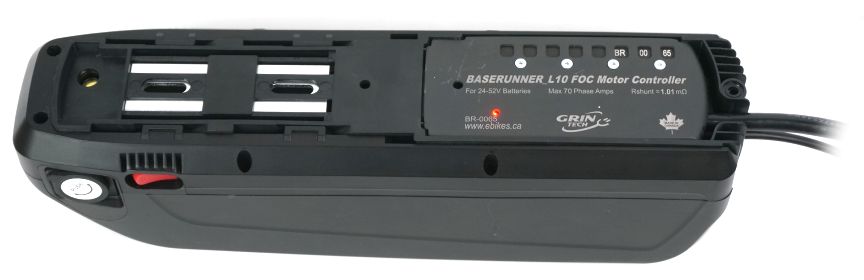
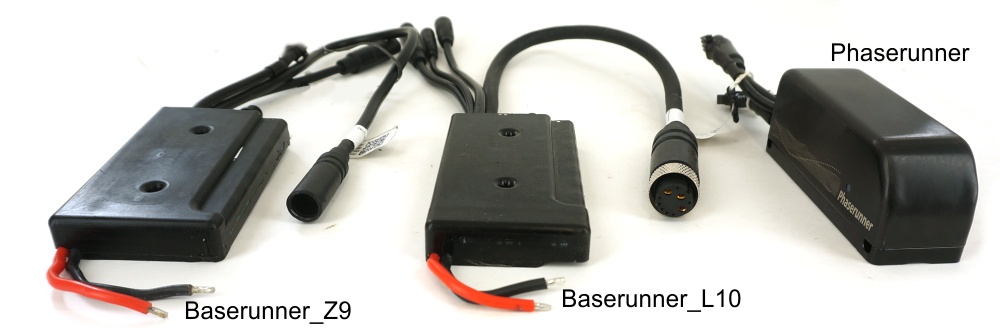
L10 and Z9 just refer to the connector used for the motor. The Phaserunner is larger and probably overkill for your build, but I use that controller and like it a lot. The Baserunner is physically smaller and can be integrated into some battery enclosures. The standalone Baserunner and the Phaserunner are fully potted for waterproofing. The regular Baserunner is not. The Phaserunner is still relatively small compared to other cheaper controllers.

BR_L10_In_Battery.jpg


Baserunners_Spread.jpg
 
Checked their site, looks like L10 vs Z9 are different. Max and continuous phase amps greater on L10 which explains torque curve.
I don't know and wasn't aware of it. You could send an email to Grin and ask them. I own an L10 Baserunner, but never used it as I ended up going with the Phaserunner. I bought the Baserunner when the Phaserunners were out of stock for a while, but procrastinated long enough on the project that the Phaserunners came back in stock before I finished the build. My GMAC motor has the L10 connector, so I didn't consider the Z9.

Honestly, the difference shown on the motor simulator isn't going to be noticeable while riding the bike if it even exists. It shouldn't be a factor in choosing a controller.
 
The FETs and size differ between the two baserunners:
Screenshot_20260423-121035.png
 
Back
Top