• Hello ES! We could use some help to get us past the finish line on building the new knowledgebase for the forum.
    Can you donate? Please see our fundraising page. Thank you!

Oil Shock Inflation

This business of phasing out petrol cars was always nonsense to me, you simply had to ask the basic question, what will they do with the 45% of the oil barrel they are no longer using?

Very good question. Part of the answer will be that they will simply do less cracking; right now they crack a large percentage of crude into short-chain hydrocarbons appropriate for motor fuels. Without that step it will be more like 20% of the oil barrel. But it will still be there, and will result in cheaper gas as EVs take more and more of the transportation market.

A larger answer that the industry will simply use less oil. And instead of cracking for short chain hydrocarbons (hexane, pentane, octane etc) we'll crack for the components we need for plastics, fertilizer, lubricants, clothing etc.

But there is no battery-electric (BEV) Toyota RAV4, just a petrol hybrid. So petrol cars sales have not declined at all.

I have a PHEV Toyota Prius. (The RAV4 has an almost identical power train.) And while technically a hybrid, I buy about a gallon of gas every two months. So while the car contains a gas engine, it drastically reduces demand for gasoline.

If we used that technology/process for all our cars we'd reduce our gasoline demand for road passenger vehicles by 99%. Which that "20% of a barrel" would MORE than cover.
 
I have a PHEV Toyota Prius. (The RAV4 has an almost identical power train.) And while technically a hybrid, I buy about a gallon of gas every two months. So while the car contains a gas engine, it drastically reduces demand for gasoline.

If we used that technology/process for all our cars we'd reduce our gasoline demand for road passenger vehicles by 99%. Which that "20% of a barrel" would MORE than cover.
Only if you restrict your journeys to local distances…
Despite the Rav4 PHEV having a relatively large 22 kWh battery, its EV range is still less than 50 mls
I averaged about 2.0 to 2.2 miles per kilowatt-hour in my all-electric driving. That's not great efficiency, but I have to note that this test occurred during some brutal, 24-but-feels-like-7-degree New York weather in January. My Kia EV6 pulls the same numbers in similar conditions. I did, however, manage about 37 mpg in mixed city and highway driving, which was not bad at all for a crossover this size.
so , “Joe Average“ , is more likely to see that 37mpg figure , which likely would represent somewhat less than a 99% fuel reduction ?
 
Last edited:
Alas a lot of mental energy has been invested in the great transition to electric cars for all mankind and it will take some time for it to unwind. But the board masses of the the people have clearly made their choice, as is reflected in global sales figures of pure ev. They don't want them. They don't HATE them, they just don't want them and all the baggage that comes with them. Why the simple rejection of a consumer product like a car must somehow equate to "HATRED" though is a psychological issue beyond the scope of this thread, though I suspect it's a form of thought-stopper.

If you brand someone or some group as 'haters' they are more likely to cease and desist criticizing whatever it is you are promoting. As far as my read of things go the only people who genuinely hate them are people who have bought them and been let down by workmanship, as well as ranges that are much lower than that told them when they bought. Simple things like the fact no one told them that using the cabin heater in Winter would reduce ranges by 20% and more. Caveat emptor :whistle:


“Joe Average“ is more likely to see that 37mpg figure , which likely would represent somewhat less than a 99% fuel reduction ?
The Prius plugin has a battery range of 40~50 miles. Perfect for the retired or elderly who don't ever drive far from home. But then you have to add in all the extra oil used to make them in the first place. Last time I checked the Tesla-S had a 6 year break even period before it became carbon negative. Lithium batteries are very expensive, a direct correlation to the amount of oil used to mine the minerals needed for them and the coal burnt in China to manufacture them.
 
I don't see people not wanting bev's. AI says
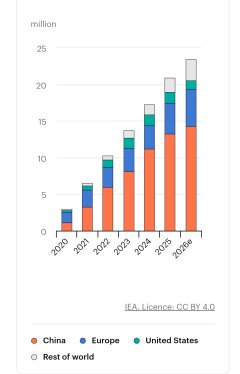
Global sales for all Battery Electric Vehicles (BEVs) reached approximately 20.7 million units across the passenger and light-duty sectors. Pure electrics represent a majority of plug-in vehicle sales (roughly 70% to 72%), with China capturing over 50% of the market share. [1, 2, 3]
 
I do a simple search: "percentage of cars on the road which are bev" And what do I get? Page after page of "Sales" figures. Well we know "Sales" figures collapsed back late last year, and we know that in April and May they went up, a knee jerk reaction to the oil price rises. So what does that tell us? Nothing basically. I have been reading about high single digit sales figures for years now, hearing about the great transition for years now, hearing about how ICE cars will be outlawed and the owners lined up and shot for years now. But all of a sudden, very quietly some months back, all the nations began repealing the 'deadlines' for ice sales. All the MAJOR manufacturers like Ford and VW began shutting down their EV divisions.

Hell even Elon Musk went silent, that should tell you something. He treats Tesla like the Hyperloop now, *crickets*
Ever hear of a place called Australia? A nothing little nation with less than 30 million people? Well it's the big tout for Tesla sales, there is more money than sense down here :LOL:

China was the biggest consumer of BEVs by far but their retail sector sales are down 11% YoY in April. They are making up for it by flooding the world with their cars at giveaway prices. Anyone who can't connect these dots is just plain hoodwinked. Like the small businessman watching his company collapse before his eyes and yet refuses to take the hint, hanging on to the very end until the sheriffs come and lock the gates. So what's the actual percentage of BEV on the roads? Finding that data is like looking for pearls on a beach now.

aftermarketmatters.com cites
May 11, 2026 The number of EVs in the U.S. has increased by 26.7%, growing from 3.56 million to over 4.5 million
AI says 4.7 million.
moneygeek.com adds in
The United States had 284.6 million registered vehicles in 2023. 100 mil are passenger cars and rest trucks mostly. But the truck figures also include SU, pickups and minivans. So lets say 200 million passenger vehicles, close enough for government work. 3.56 as a percentage of 200 = 1.78% That's the current adoption of BEV in the US and the US is one of the bigger adopters. You know, Tesla and all that. Less than 2%, and falling now the subsidies have been stopped. It's time to get off the bus while spare parts are still available folks, trust me.

22 Apr 2026 — Ford lost $4.8 billion on EVs in 2025. Ford closed 2025 by canceling the F-150 Lightning electric pickup truck

Apr 28, 2026,- General Motors committed heavily to battery-electric vehicles several years ago and now is suffering the financial pain of converting manufacturing capacity from internal-combustion vehicles to EVs as that market growth has slowed dramatically. It's been an expensive journey, as General Motors recorded a total of $7.6 billion in EV-related charges in the second half of 2025.

carbuzz.com/gm-loses-another-billion-on-evs/
carscoops.com/2026/05/mazda-ev-delay-hybrid-pivot/

 
I was interested in what you were saying until this happened:
hearing about how ICE cars will be outlawed and the owners lined up and shot for years now.
Quickly lost interest.

Anyway, my own personal observations are quite different. Despite all the sales figure numbers you shared, and the auto mfr. pronouncements:

I know many many owners of EVs (and I am in fact one, with an old EREV). They ALL are happy with their EVs, none are planning or even desiring to trade back to ICE vehicles. In fact, one recently was in a collision and their EV is at the repair shop. They are quite upset that their temporary rental vehicle is an ICE and hate it, wishing their rental could be an EV.

As usual, YMMV ;).
 
I was interested in what you were saying until this happened:

Quickly lost interest.

Anyway, my own personal observations are quite different. Despite all the sales figure numbers you shared, and the auto mfr. pronouncements:

I know many many owners of EVs (and I am in fact one, with an old EREV). They ALL are happy with their EVs, none are planning or even desiring to trade back to ICE vehicles. In fact, one recently was in a collision and their EV is at the repair shop. They are quite upset that their temporary rental vehicle is an ICE and hate it, wishing their rental could be an EV.

As usual, YMMV ;).
I think my opinion will swing toward EVs only when Solid State battery tech has matured enuff to handle the northern climate. I can personally tell you EVs SUCK currently in the Montana winter conditions.
 

Someone, who ignores this development must live in his own world. The U.S. needs to accept that it is no longer the center of the world and is simply falling behind in technological progress. 🤷‍♂️
Of course, it will still take twenty or thirty years before internal combustion engines disappear from the streets; after all, horse-drawn carriages didn’t vanish within a decade either.
And internal combustion engines will never disappear completely—after all, horse-drawn carriages still exist today. ;)
Of course, at the moment the political support of EVs has a significant impact on the sales figures. But the more people made their personal experience with EV the less political help will be needed.
It's really strange, that actually released EVs have ranges about 800km, that you will never need (who drives 800km without a break?!)
This very big batteries make the cars heavy and expensive. Totally stupid.

Screenshot_20260522-101709~2.jpg
 
Last edited:
It's really strange, that actually released EVs have ranges about 800km, that you will never need (who drives 800km without a break?!)
This very big batteries make the cars heavy and expensive. Totally stupid.
I don't know how it is where you are. American car drivers buy cars to express their fantasies about themselves, not to meet their day to day needs. Some long for cross country road trip range when all they do is drive to work and back. Some insist on huge towing capacity to pull something they wish to own one day. Some itch for 300 km/h speed capability they can only imagine using.
 
ICE cars get horrible mpg in the cold. It can take an hour at speed for the rear and trans to warm up fully. Even here in FL a short trip to the store would get me 8-10 mpg. The fuel does like to atomize when it is cold. Range is way down when it is cold out, or even on hot days for the 1st mile. I once used a 2 gal tank for precise testing. It was a real eye opener. Cold engines waste gas. I would even start it up with my foot on the clutch, in gear. Any warmup sitting still gives even worse mpg. So i'd pull out within 1 or 2 seconds. And shut it off for long red lights.
 
ICE cars get horrible mpg in the cold. It can take an hour at speed for the rear and trans to warm up fully. Even here in FL a short trip to the store would get me 8-10 mpg. The fuel does like to atomize when it is cold. Range is way down when it is cold out, or even on hot days for the 1st mile. I once used a 2 gal tank for precise testing. It was a real eye opener. Cold engines waste gas. I would even start it up with my foot on the clutch, in gear. Any warmup sitting still gives even worse mpg. So i'd pull out within 1 or 2 seconds. And shut it off for long red lights.
Florida? Cold?.......A Floridian talking about cold is like a Montanan like me talking about bikini supermodels on the beach.
 
There's ICE technology.
And there's fossil fuels.

Don't confuse them.

Consider an alternate time line wherein Diesel's original idea of using vegetable oil for his engines and perhaps at the same time also developing alcohol for a petrol equivalent plus the existing steam and electric solutions were used with plant based fuels. The amount of carbon in the biosphere would not have increased - it would have circulated unchanging as it had been since the current pause in the ice ages began and the climate stablised in the form that has permitted large scale agriculture in so much of the earth.

In opposition, we have what we did instead - major increases in carbon in the biosphere since then due to releasing fossilized carbon that had been trapped in the earth - out of the biosphere - destabilizing the climate we rely on to grow food. Mismatches between the weather and the food production cycles mean a month's delay translates to a year's missed food production, for instance - it's not something we can easily make up for. It isn't a matter of being a little late - a year is lost.

When people can't eat, they don't cooperate. Rhetoric is not effective. They will not continue to participate in the economy - they will seek a way to feed themselves and their children.

Any inflation that was a topic of this thread is only a small, temporary consequence of the events that will/are occurring - due to a short term of competition for food and other resources as they become scarce. It's not itself a concern that should loom large in anyone's perspective. The other aspects of the effects of treating our planet as an unlimited candy store instead of as the lifeboat it is dwarf any concerns about 'inflation'.

In a bicycle related chapter, Schwalbe did measurements that pioneered the use of 'balloon' tires, showing they are more efficient in part of the bicycle operating envelope despite this confounding the prevailing theories - the 'hard tires are more efficient' approach. It turns out the energy 'wasted' in deforming the tire patch in contact with the ground was much smaller than the energy 'wasted' lifting the rider up and down on all the tiny deformities in the roadway. We just weren't accounting for the 'lifting' component. And that points to the real problem.

We ignore what really happens and pretend. We fasten onto convenient explanations that suit our wishes and defend them. But everything that is real must be accounted for - we don't escape it.

Fossil fuels are a problem that dwarfs any consideration of ICE vs. electric or whatever, and any consideration of 'it will cost a lot to switch', etc. Not switching has, does, and will, cost the lives of many people, and also do expensive damage to much of our ability to maintain a coherent civilisation, and we will not avoid making the switch. The only choice is between making the switch consciously and preserving some semblance of civilisation, or thoughtlessly wait for the failure of crops, economics, trade, and the viability of life in many regions to force the switch on us. Pretending does not change this - all energy and effects have their consequences whether we admit it or not.

ICE can burn renewable fuels and otherwise might be acceptable. Who cares?

It's the fossil fuel part of the issue that matters and it matters so much more that 'inflation' and 'ICE' are negligible, although they may be minor hazards to navigate along the way, or minor parts of the solution to the actual problem. The problems we can't ignore are destabilising the climate, and our refusal - as individuals and groups - to admit measurable, consequential reality.

Reality bites.
 

Someone, who ignores this development must live in his own world.
... One in four new cars sold worldwide was electric in 2025
In particular, 2025 saw a boost for battery electric cars. The share of battery electric cars in total electric car sales increased to 65%, reversing the trend seen in the 2 years prior.

For those who have been living under a rock for the past year this refers to the rebranding of EV. EV no longer means Electric Powered vehicle, I means any any vehicle that has an electric component, ie: Gasoline powered hybrids included. BTW, a typical hybrid charges it's battery off the gasoline engine with a little regen added in, about as much as the cyclists here get. Very few plugin hybids are sold.

Ask yourself a simple question, if the BEV dream never collapsed, why did all the popup BEV makers collapse? It's only Tesla and Rivian left now, GM and Ford backed away. Does this sound like a booming industry about to replace the ICE car? Come on boys, put the marketing pitch aside and look at the real world. And when you google passenger car sales, remember SUV and trucks are excluded from that segment, even though everyone is driving them now.
 
ICE can burn renewable fuels and otherwise might be acceptable.
Yes, we can run all the petrol cars off ethanol, anyone old enough to remember that? Why rape sorry, molest the Earth for Lithium and Cobalt and rare earths for BEVs when we can run our passenger vehicles on naturally grown corn and sugar? Clean natural liquid fuels please, no toxic battery waste.
 
SUV and trucks are excluded from that segment, even though everyone is driving them now.
No one drives light trucks in Europe. They are absolutely not suited for the city here, much to small roads and much too small parking lots.
And for sure there are BEV SUVs. Even a few models that are capable of towing heavy loads...
Chinese BEV brands are flooding the world marked. US cars are simply not wanted on the world marked. Biggest US car exporter is BMW ;)
 
Last edited:
No one drives light trucks in Europe. They are absolutely not suited for the city here...
Chinese BEV brands are flooding the world marked

"BMW Group remained the largest automotive exporter by value in the United States in 2025, according to data from the US Department of Commerce. The company’s Spartanburg plant in South Carolina exported nearly 200,000 BMW X models"

The BMW X5 is available in plug-in hybrid, diesel and petrol powertrains.
The BMW X3 is available in electric (iX3), plug-in hybrid, diesel and petrol powertrains.
The BMW X1 is available in electric (iX1), plug-in hybrid and petrol powertrains.

I'm not sure I understand the relevance of your BMW story? Aside from the fact that petrol and diesel power trains are still in high demand. It's the same with the Chinese cars BTW.

As for light trucks in Europe, well I don't consider Europe much when looking at the trends in BEV anyway because most of those countries still have massive financial incentives in place distorting the market. When these were in place in the Chinese and US markets sales boomed too, but sales collapsed when they were withdrawn. Naturally I'm talking BEV, which used to be called just EV.
China sold 1.34 million electric vehicles and plug-in hybrids in April, marking renewed growth in demand both year-on-year and over the course of 2025 so far. Strong export figures continue to drive the increase, while Chinese manufacturers still face a challenging domestic market. electrive.com/2026/05/11/chinese-ev-sales-recover-as-exports-surge/
3 days ago — "Chinese Imports now account for over half of electric car sales in countries outside Europe and the United States.
Electric, which includes Gas-hybrids naturally.

I don't mind discussing sales figures but I wish people would do their research first before throwing out stores about increasing BEV sales. If on the other hand you, like the IEA, regard hybrids with ICE engines as electric cars too than what's the point of even discussing it? We're still burning oil in cars and nothing has really changed. Soon we'll have V8 and V12 hybrids because that's the way these things go. But as I said earlier, sales are irrelevant at this stage anyway, and actually always have been as far as the long term trend is concerned. If the BEV (no gasoline) uptake, ACTUAL cars on the road, exceeded 10 or 15% then it might have relevance but we are still in the infancy of this technology spreading. If the industry can't move past the beta testers and make a meaningful dent in overall cars onroad all this chatter about an EV future is just that, idle chatter driven by corporate marketing.

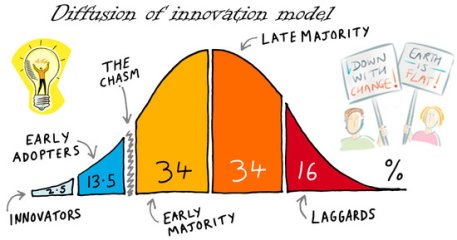
Aside from the tiny oil and gas rich nation of Norway, Pop 6 million, which has basically given the populace free electricity for these, the global uptake is still only with the innovators. The technology has to pass the chasm to succeed. The chasm is where technologies falter and disappear from sight basically.

EV DIFFUSION OF INNOVATION.jpg
 
I'm not sure I understand the relevance of your BMW story?
It has nothing to do with EVs. It just shows, that US cars are not competitive on the world marked, as a quite small European car manufacturer is the biggest exporter of cars built in the US.
Thinking that bio fuels can fulfill the demand of petrol shows, that you have no idea of figures....
 
Back
Top