


jonescg
📗 Minor legend
At the TAFE college where I teach, we have built an off-grid, battery-buffered, ground-mounted solar array and EV charge point. It's delivered over 6 MWh of energy to EVs since it was first installed, but it's time to upgrade the battery and BMS. The 4 or 5 kWh battery we currently have barely rides through on a cloudy day, but hey, free batteries come with free problems. Probably more frustrating is the BMS was too simple (shuts off if a cell goes high or low, and stays off until manually reset) and if it goes too long between resets, the system needs a jumpstart.
Anyway, a student works for a solar installer and they are in the process of replacing *literally hundreds* of battery systems installed just a few years ago, for much bigger systems thanks to a generous federal rebate here in Australia.
Sorry rest of the world, skip ahead if you might get upset, but we're seeing 30 and 40 kWh batteries with 10 kW solar PV systems being installed for well under $8k. If like me you're OK with rolling your own battery, you can have a system for under $6k with no engagement with the government, other than the electrician registering the system on the network.
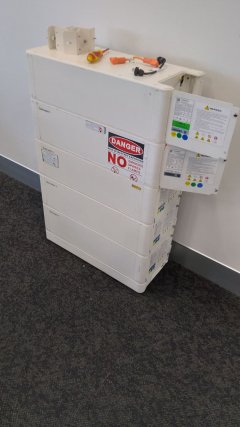
Anyway, we're seeing these 2.5 kWh, 51 V (16s LFP) modules coming in by the ute-load, and the Growatt system makes it super easy to parallel the modules for more capacity. We're looking to bump the capacity up to 12.5 kWh with 5 modules in parallel.

Since the BMS isn't going to talk to the MPP solar BMS particularly well, and we hope to install a couple of small 2 kW wind turbines to the system this year, we decided to use a single BMS and parallel all 5 modules at the balance wire level, a bit like @fechter and Icecube did with the LiPo harnesses. There is a risk of some big imbalance at either end of the charge profile, but the BMS should catch that before it gets too high a current.
I found some IP68 18-way plugs and sockets good for 5 A, which will fit where the BMS ethernet sockets are, so the students will be busy soldering next week!
Anyway, a student works for a solar installer and they are in the process of replacing *literally hundreds* of battery systems installed just a few years ago, for much bigger systems thanks to a generous federal rebate here in Australia.
Sorry rest of the world, skip ahead if you might get upset, but we're seeing 30 and 40 kWh batteries with 10 kW solar PV systems being installed for well under $8k. If like me you're OK with rolling your own battery, you can have a system for under $6k with no engagement with the government, other than the electrician registering the system on the network.
Anyway, we're seeing these 2.5 kWh, 51 V (16s LFP) modules coming in by the ute-load, and the Growatt system makes it super easy to parallel the modules for more capacity. We're looking to bump the capacity up to 12.5 kWh with 5 modules in parallel.
Since the BMS isn't going to talk to the MPP solar BMS particularly well, and we hope to install a couple of small 2 kW wind turbines to the system this year, we decided to use a single BMS and parallel all 5 modules at the balance wire level, a bit like @fechter and Icecube did with the LiPo harnesses. There is a risk of some big imbalance at either end of the charge profile, but the BMS should catch that before it gets too high a current.
I found some IP68 18-way plugs and sockets good for 5 A, which will fit where the BMS ethernet sockets are, so the students will be busy soldering next week!

