
walterwitt
🔌 New-ish
Got a datasheet for a Great Power 60Q cell, they're claiming 60A true continuous discharge with a 110A temp limited discharge. does anyone here think they can actually achieve that in a 6000mAh cell?


unlikely this year in mass production. end 27 or later with decent cycle life.Got a datasheet for a Great Power 60Q cell, they're claiming 60A true continuous discharge with a 110A temp limited discharge. does anyone here think they can actually achieve that in a 6000mAh cell?
View attachment 391045
Got a datasheet for a Great Power 60Q cell, they're claiming 60A true continuous discharge with a 110A temp limited discharge. does anyone here think they can actually achieve that in a 6000mAh cell?


Thanks for the info about Great Power 60Q, It seems that it is already available at Alibaba. As far as I know, models such as the Reliance RS60, Tenpower 60XG, and Linkdata 60P cannot handle even a 40A continuous full discharge at room temperature without reaching the 80 °C limit.Got a datasheet for a Great Power 60Q cell, they're claiming 60A true continuous discharge with a 110A temp limited discharge. does anyone here think they can actually achieve that in a 6000mAh cell?

Depends on how they qualify that rating.Got a datasheet for a Great Power 60Q cell, they're claiming 60A true continuous discharge with a 110A temp limited discharge. does anyone here think they can actually achieve that in a 6000mAh cell?


whats the cycle life specGot a datasheet for a Great Power 60Q cell, they're claiming 60A true continuous discharge with a 110A temp limited discharge. does anyone here think they can actually achieve that in a 6000mAh cell?
View attachment 391045
whats the cycle life spec
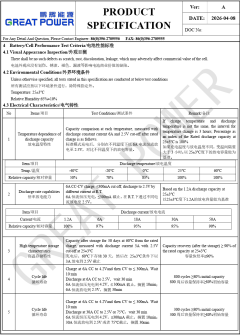
Amprius 60Q in datasheet stated standard 120 mA charging cut-off and promised 6000 mAh minimal capacity. Great power 60Q with this 300 mA cut-off promises only 5900 mAh minimal capacity.The 300 ma cutoff charge current spec is interesting.

Actually, going below 3.0 or 2.8V is far from scraping to the bottom of the barrel until we stop using silicon into anodes.I can see why 300ma termination current would be used in cycle life estimations, and to perhaps reduce the amount of time to perform cycle testing.
Maybe it takes these cells another hour for amps to taper from 350 to 120ma at 4.20v and they said 'F' it and said call it 300ma or less is close enough, send it.
I think even if we acknowledge that below 3.0v or 2.8v is scraping the bottom of the mah barrel, it is important to see how much that barrel can hold and where that false bottom may lay.

So, do you have any official Test Report documents for the Great Power or Amprius 60Q cells?(like the attachment)I did a little research, and the Amprius INR21700/60Q should also be available. Unless something has changed, the Amprius 60Q and Great Power 60Q should be twins, both manufactured by Great Power in China, i.e. the same story as with the 50Q model.
As for Trydan Tech, its cells are also manufactured by a partner in China, and something tells me that Great Power might be that manufacturer as well. Well, at least that gives us testers a more work to do.
Surprisingly, Yes Apparently.Hi. Does the 60Q have the CCC mark?
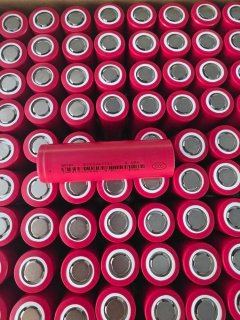
Hi. Thanks.Surprisingly, Yes Apparently.
View attachment 391444
At least according to a supplier that's been pretty good with genuine cells as far as I can test for, and I test every shipment for Voltage and IR with a Fnirsi HBM-10 meter.

 basquevolt.com

Now would be a good time to be on a student electric motor sport team.Hadn't seen this European pouch cell mentioned here. 402Wh/kg, 8.9C pulsed power, Lithium-metal chemistry, and apparently in production.
BASQUEVOLT Launches BQV400L, a new benchmark for European battery cells
With 402 Wh/kg energy density and European manufacturing, the BQV400L sets a new standard for what a commercially available battery cell can deliver in Europe. The launch marks BASQUEVOLT’s transition from deep-tech development to industrial deployment, and a new phase of ambition for European...
About:Energy have samples: Basquevolt Releases Commercial Li-Metal Pouch Cell BQV400L | Gavin White posted on the topic | LinkedIn
Wait a minute.Hadn't seen this European pouch cell mentioned here. 402Wh/kg, 8.9C pulsed power, Lithium-metal chemistry, and apparently in production.
BASQUEVOLT Launches BQV400L, a new benchmark for European battery cells
With 402 Wh/kg energy density and European manufacturing, the BQV400L sets a new standard for what a commercially available battery cell can deliver in Europe. The launch marks BASQUEVOLT’s transition from deep-tech development to industrial deployment, and a new phase of ambition for European...
About:Energy have samples: Basquevolt Releases Commercial Li-Metal Pouch Cell BQV400L | Gavin White posted on the topic | LinkedIn
This mentions NMC/li-metal chemistry: BASQUEVOLT Launches BQV400L, a new benchmark for European battery cellsAnother question since I didn't find anything in search engines: lithium metal anode or anode less architecture? Anodeless designs are considerably easier to make and are overall better.
Honestly, their presentation strikes me as being just like Donutlab. Regardless of whether they have that cell or not, failing to list key specifications such as weight and dimensions is a sign of blatant unprofessionalism, particularly when it comes to pouch format.Hadn't seen this European pouch cell mentioned here. 402Wh/kg, 8.9C pulsed power, Lithium-metal chemistry, and apparently in production.
BASQUEVOLT Launches BQV400L, a new benchmark for European battery cells
With 402 Wh/kg energy density and European manufacturing, the BQV400L sets a new standard for what a commercially available battery cell can deliver in Europe. The launch marks BASQUEVOLT’s transition from deep-tech development to industrial deployment, and a new phase of ambition for European...
About:Energy have samples: Basquevolt Releases Commercial Li-Metal Pouch Cell BQV400L | Gavin White posted on the topic | LinkedIn