• Hello ES! We could use some help to get us past the finish line on building the new knowledgebase for the forum.
    Can you donate? Please see our fundraising page. Thank you!

What should I do with this to improve it?

AC-EUV

⚡ Regular
Joined
Nov 17, 2010
Messages
101
Hit me with your advice as to what components to change to make this better..

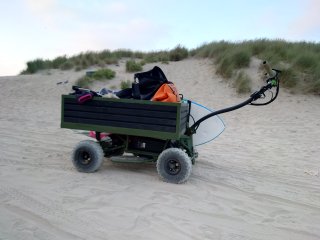
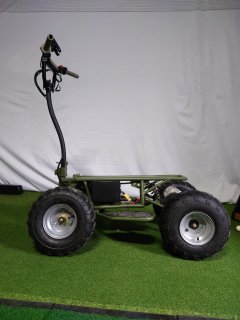
I have built this (Multi-purpose) Electric Utility Vehicle
See pics

It is a motorised beach cart when box is attached and handlebars are down
and Stand up scooter/ Golf buggy vehicle with handlebars in up position

I've nearly got it working really well it is just slightly underpowered when being ridden off road and on sand (I did just add the larger 6" wheels and bigger tyres for the sand in last pic)

It currently has a 48v 1000w my1020 motor with 48v 13ah hailong style 30amp BMS battery and flipsky 75100pro V2 controller

Riding it on flat pavement it is really good I have it topping out at 18mph at the moment and wouldn't really want it going much faster. If it could do that off road it would be great it just struggles a bit to pull up hills when riding off road and on sand.
I did a separate post about potentially going 4 wheel drive with this but decided not to as I don't want to spend too much.
but was thinking what should I do?..

Option 1:
Upgrade to 72v 60amp bms battery with 3000w motor maybe just another my1020 style motor for now (til I can afford a QS or similar) and also upgrade to the bigger flipsky 75200 controller?
or will this setup be too fast for what I want?

Option 2:
keep my 48v setup but upgrade just my battery to a 45amp BMS one for more amps.
Would a 15amp increase be worth doing?
And maybe the bigger 75200 controller?

Option 3:
Get a slightly bigger 52v hailong style battery with 40amps BMS?
(Slightly more voltage with more amps) But keep my 75100pro V2 controller?

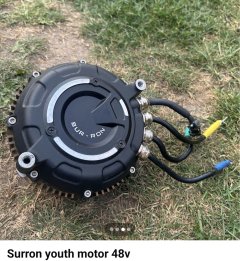
Or there is also a 48v surron youth motor near me for sale fairly cheap could this be worth getting with one of the above options?


Or any other ideas
What would you guys do?
 

Attachments

  • 20241026_104812.JPG
    20241026_104812.JPG
    1.7 MB · Views: 25
  • 20250812_195630.JPG
    20250812_195630.JPG
    1.8 MB · Views: 26
  • 20250812_195651.JPG
    20250812_195651.JPG
    2.2 MB · Views: 26
  • 20250917_091727.JPG
    20250917_091727.JPG
    1.6 MB · Views: 28
Last edited:
From what I have read others here report, increasing the voltage will increase the speed.

Struggling only up-hill suggests inadequate torque for the load it's facing when attempting weight vs. up-hill. I have addressed this in my own design by introducing a reduction (using Gates sprockets - see link for the trike in my sig(nature) below). I'm not certain this is an option for your design.

Increasing the voltage would also decrease the amperes (current) required to provide the same power. I don't know if this would also show up as more power at lower rpm. Others here will comment.

I just entered my own system into Grin's simulator page with two identical systems except that one uses 36V and one uses 48V to see the predicted effect. The maximum torque available is the same, but the higher voltage does seem to provide a higher torque at lower rpm - I think this points to some value from increasing the voltage. I'd analyze it more to decide if that was in all ways the best approach to take:
36V vs 48V
 
By the way, the 'larger 6" wheels' may decrease the hill climbing ability - depends on whether this meant an increase in overall diameter - that would produce less leverage for the motor. The wider tires would certainly offer more 'float' on loose surfaces, such as beach sand. I'm gathering the parts to build 65mm rims for my trike in the hope I can get enough float to ride on sand, which Australia has an abundance of.

It's the overall diameter that matters - the outside circumference of the tire, or the effective diameter (tires squash) or effective radius - as that is the lever arm the motor torque is applied through. I don't know if smaller wheels/tires is otherwise practical for your design.
 
By the way, the 'larger 6" wheels' may decrease the hill climbing ability - depends on whether this meant an increase in overall diameter - that would produce less leverage for the motor. The wider tires would certainly offer more 'float' on loose surfaces, such as beach sand. I'm gathering the parts to build 65mm rims for my trike in the hope I can get enough float to ride on sand, which Australia has an abundance of.

It's the overall diameter that matters - the outside circumference of the tire, or the effective diameter (tires squash) or effective radius - as that is the lever arm the motor torque is applied through. I don't know if smaller wheels/tires is otherwise practical for your design.
Thanks I did take larger wheels into account for not helping with the hill climbing.
I was now going to play with a smaller drive sprocket to help with this.
I think these bigger wheels should solve the problems I had pulling through soft sand though so would like to keep them ideally
 
I was now going to play with a smaller drive sprocket to help with this.
As that's an option, it may certainly increase the torque delivered. It could also reduce the top speed, and then bumping to a higher voltage could restore your desired speed and also provide more torque at lower speeds (according to the Grin simulator).

Do your electronics work with higher voltages?
 
As that's an option, it may certainly increase the torque delivered. It could also reduce the top speed, and then bumping to a higher voltage could restore your desired speed and also provide more torque at lower speeds (according to the Grin simulator).

Do your electronics work with higher voltages?
That sounds good
My controller I have will work up to 84v I believe.
The motor is 48v though but I'm sure pushing that to 52v should be ok

Or was you thinking more like 60 or 72v?
 
Or was you thinking more like 60 or 72v?
Do the math. You write of top speeds that seem satisfying for the vehicle geometry - I would let that be my guide. From there, I would consider the change in reduction possible with your set up (size of sprockets available and appropriate) and choose a voltage that then restores the best top speed for the applications. Like not maiming yourself because you rolled the machine while traveling side-hill while off-road.

Have you considered using a Gates Carbon Belt? That eliminates most of the sand/mud problem for the long term. You will need to design a way to tension the belt, and alignment is important, but done once and the benefits continue into the future - like serious longevity and really, really low maintenance. I'm considering the next design for my own motor cradle (current design not shown in my thread) to make up for some shortcomings now I know the concept works well (apart from the shortcomings, ahem).

And along those lines, applause for your sensible use of resources for a multi-task-appropriate design. Gandhi is reported to have said "There is more to life than increasing it's speed".
 
Do the math. You write of top speeds that seem satisfying for the vehicle geometry - I would let that be my guide. From there, I would consider the change in reduction possible with your set up (size of sprockets available and appropriate) and choose a voltage that then restores the best top speed for the applications. Like not maiming yourself because you rolled the machine while traveling side-hill while off-road.

Have you considered using a Gates Carbon Belt? That eliminates most of the sand/mud problem for the long term. You will need to design a way to tension the belt, and alignment is important, but done once and the benefits continue into the future - like serious longevity and really, really low maintenance. I'm considering the next design for my own motor cradle (current design not shown in my thread) to make up for some shortcomings now I know the concept works well (apart from the shortcomings, ahem).

And along those lines, applause for your sensible use of resources for a multi-task-appropriate design. Gandhi is reported to have said "There is more to life than increasing it's speed".
I did think about belt drive to be better in sand
The Gates belt drive looks really good but not sure they do a sprocket to fit my motor without some welding/modification
I have just built a full chain guard to cover the chain top and bottom to help stop sand getting to it but I know chain and sand isn't ideal so will look more into belt drive I think👍
 
Just the motor will likely take a higher voltage. If there is electronics "in the motor" that might not handle any voltage increase. To Be Determined.
Would this Surron youth motor be any good?
It is for sale near me

I believe they are 48v 2000w and have a higher rpm than my 1020motor but not sure if this would solve low speed torque?

Edit: I have since found out these Surron motors run a separate drive gear sprocket before then running the rear sprocket on the rear bike wheel
Could this motor work with 13" sized quad wheels? Without the two stage gear reduction??
 

Attachments

  • Screenshot_20251002-101645~2.jpg
    Screenshot_20251002-101645~2.jpg
    673.8 KB · Views: 3
Last edited:
Increasing the voltage would also decrease the amperes (current) required to provide the same power.
Only on battery side. Not on motor side. The motor output power is only depending on the motor current (= torque) and the rpm. The battery voltage is irrelevant there, as long it is high enough to drive the motor current ;)
For high torque at low speed, you need motor amps, not battery voltage.
 
Last edited:
Only on battery side. Not on motor side. The motor output power is only depending on the motor current (= torque) and the rpm. The battery voltage is irrelevant there, as long it is high enough to drive the motor current ;)
For high torque at low speed, you need motor amps, not battery voltage.
So a battery with larger amp bms should help more in this case?

Surely going from a 48v 30amp BMS battery to a 52v 40amp BMS will be better all round? For the amp draw and efficiency?
My understanding is the 52v wouldn't be working as hard to produce those amps as the 48v is that not right?
 
At low rpm it's not the matter of the battery, but of the controller. On better controllers you can set the limits for the battery current and the motor current independently.

We had a quite similar discussion here: #47
Ok thanks

I have vesc so have all parameters to play with

At the moment I have it set at
30amp Max battery current (for my 30amp battery)
90amp Motor current Max (phase amps)

I also have field weakening at 30amps which feels great mid to top end and have tweaked the acceleration ramp times and observer gain to get it to run smoothly

So what would be better to try first a higher amp battery or bigger controller? Or both?
 
So what would be better to try first a higher amp battery or bigger controller? Or both?
You should look first, what is limiting you in the critical riding situations. Are you in zone A, B or C in the linked graph? Is it the battery current (zone B)?!
I don't know, how the VESC implements field weakening. But for maximum torque at low speed it doesn't help. It helps only for higher top speed, zone C.
 
Last edited:
KT controllers has often been reported to provide higher torque at low rpm with higher battery voltage.

This behavior of KT controller is different from the controllers that control phase current (behavior of which was mentioned by @stancecoke). Seems KT has shunt only in the battery path & KT pas levels set battery current reference rather than phase current.

My reasoning for this KT behavior: With higher battery voltage, duty will be less at any certain low speed as compared to that at low voltage. Since phase current is approximately battery current/duty, with a constant battery current, higher battery voltage would result in higher phase current and thus higher torque at any certain low speed.

Caveat: I don't have KT controller to validate the above inference.
 
not sure they do a sprocket to fit my motor without some welding/modification
On the small side, I am using one of the three Gates sprockets (22T, 24T, 26T) that mount to a standard 6 bolt 44mm BCD ISO brake rotor mounting pattern. Other Gates mountings in this size range (considered 'rear' sprockets although I am using mine as the 'front' sprocket for reduction) are for other semi-standard mountings.

Consider making an adapter that secures to your motor and then provides whatever is the most convenient sprocket mounting? I was mounting my sprockets to existing motors with the options already narrowed, but with a custom adapter, the sky is the limit for you. I'd be hesitant to weld, but 3 or more bolts seem possible with several of the mounting systems Gates caters to.

I'm thinking of a laser or water cut plate with a center hole very closely matched to your motor shaft to provide axis alignment, then butted up against another part that provides the mechanical connection to the motor shaft (keyway or whatever) and is then secured together with welding or perhaps match drilling for bolts. I'm not certain about balancing the assembly after - what is the range of motor rpm?

Alignment is critical, but it's static and should not be difficult to arrange. Tension is also important, and that's about the distance between the motor and the axle shaft and the interaction with the suspension. I'd consider 'floating' the motor mount so it's position is fixed relative to the axle and moves within a safe envelope relative to the rest of the chassis - but you're there to look into the best approach.

Does your drive provide regen braking? If not, Gates now offers 'snubbers' to take up belt slack in some designs to accommodate moving suspensions. There might be a solution there. You can download design documents from them.

On the other side, I use a custom spider from the ISO brake rotor mount to either the 4 bolt 104mm BCD or 5 bolt 130 BCD chainring mounting using standard chainring bolts.

I will follow the discussion about motor power with interest - I am learning about this too.
 
I replaced a 27amp controller with a 40amp controller and it has a Lot more torque but now hard use does heat it up more. It's a 48v 1000W DD hub motor
 
@AC-EUV , IIRC, in VESC app, both battery current & phase current can be observed. In the relevant riding situation, check the value of those. If phase current is hitting the limit. I think here most likely that is the reason, in that case increase phase current & check. Although seems it is near max rated for the controller, then you will have to go for a bigger controller. But instead if battery current limit is hit, increase it, if it is satisfactory, no setup change would be needed (provided battery is capable of that).
 
what amp battery do you use?
At 48 volt it's 30 amp continuous and higher peak.I am now using a 60 volt with 40 amp continuous and the bike is very powerful. The 60 volt makes it go faster but going from 27 amps to 40 controller was a big boost in torque. I used a cheap square wave controller because I was not sure if the motor was any good
 
@AC-EUV , IIRC, in VESC app, both battery current & phase current can be observed. In the relevant riding situation, check the value of those. If phase current is hitting the limit. I think here most likely that is the reason, in that case increase phase current & check. Although seems it is near max rated for the controller, then you will have to go for a bigger controller. But instead if battery current limit is hit, increase it, if it is satisfactory, no setup change would be needed (provided battery is capable of that).

In vesc where do I see if I am hitting my battery limit?
I would like to know if I'm near hitting the 30amp BMS on my battery

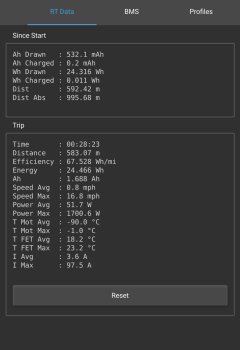
I have a screenshot attached of some numbers from a test run up and down the road..
I see it says iMax is this the phase amps I hit?
 

Attachments

  • Screenshot_20251004-202448~2.jpg
    Screenshot_20251004-202448~2.jpg
    173.1 KB · Views: 2
In vesc where do I see if I am hitting my battery limit?

IIRC, there was a tab that shows currents, rpm etc. as dials. Here continously changing current values can be observed.

If you are still not able to find out, let me know, I must be having an old version VESC mobile app built from sources somewhere (it has been more than a year since I played w/ VESC, was trying to install it from play store, now it is paid!). Based on the screenshots in play store, tab is "APPUI"

I have a screenshot attached of some numbers from a test run up and down the road..
I see it says iMax is this the phase amps I hit?
It says that some time during the trip, phase current has reached that value. This value will be easily reached at starting & low speed uphill. But what we are interested is the instantaneous phase & battery current (seen in the tab mentioned above) during the relevant riding condition.
 
IIRC, there was a tab that shows currents, rpm etc. as dials. Here continously changing current values can be observed.

If you are still not able to find out, let me know, I must be having an old version VESC mobile app built from sources somewhere (it has been more than a year since I played w/ VESC, was trying to install it from play store, now it is paid!). Based on the screenshots in play store, tab is "APPUI"


It says that some time during the trip, phase current has reached that value. This value will be easily reached at starting & low speed uphill. But what we are interested is the instantaneous phase & battery current (seen in the tab mentioned above) during the relevant riding condition.

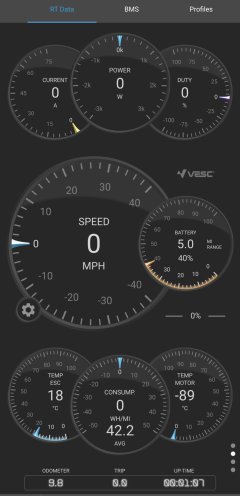
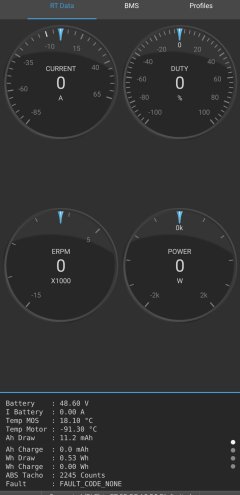
Thanks I have the real-time data screens (pics attached) but my vesc doesn't have the 'appui' page/tab it only has the real-time data tab

Regarding the current Amps dial is this not the phase amps on the motor side? Or is this battery amps being used?
 

Attachments

  • Screenshot_20251012-173617~2.jpg
    Screenshot_20251012-173617~2.jpg
    288.5 KB · Views: 4
  • Screenshot_20251012-173915~2.jpg
    Screenshot_20251012-173915~2.jpg
    210 KB · Views: 4
Last edited:
Back
Top