
• Hello ES! We could use some help to get us past the finish line on building the new knowledgebase for the forum.
    Can you donate? Please see our fundraising page. Thank you!

Invert the freewheel inside the hub motor

gonsp

New here
Joined
Nov 7, 2025
Messages
16
Location
Switzerland
Hi!

I'm building a special vehicle that has two wheels, but they are placed "side-to-side", instead of aligned in the direction of travel like in a bike. Something similar to a tricycle.

I want to put an ebike hub motor inside each lateral wheel, but I need to invert the direction of one of the wheels. The problem is the freewheel inside the motor, which I also need to invert.

I got my hands into a broken motor which I opened and saw that the freewheel mechanism was attached to the hub, and it was very easy to invert. Then I bought these two motors hoping that they would be built similarly. Unfortunately, the inside is pretty different and the freewheel is located around the axle:
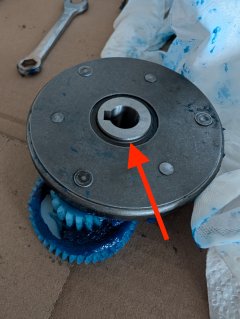
PXL_20251114_080652983.jpg

So I don't think I can manage to invert it... I would need to remove those rivets (I believe they are rivets) and still I don't have much faith I can mount it back.

I guess I need to buy other motors that either don't have a freewheel or that are easy to invert. However, I'm struggling to find options. I'm considering this one, which says "Support for rotor flywheel" but I don't know what that means. Does this mean that the motor itself doesn't have freewheel mechanism and that you can optionally attach it to it?

I'm open to any ideas or suggestions!
Cheers! :)
 
Last edited:
Maybe I should be looking at other types of wheels? Do you know if escooter wheels like this one don't have a freewheel

A freewheel or freehub allows the wheel hub to rotate freely while the chain is stationary.

Geared hubs have an internal clutch system, to allow the tire to spin faster than the motor without back driving the gearing.

I would recommend looking at direct drive hub motors, without the internal clutch. Perhaps even better would just be flipping the way the motor is mounted so that both can just rotate forwards.
 
Thanks! I want the motor hub to be geared, since I will need high torque.

Ideally I would like to have a freewheel/freehub, but I need to be able to invert it. Note that I won't have a chain, the vehicle will only be powered by the motors.

I can't flip the motor when mounting it since the cable needs to be on the interior side...

So I'm looking into escooter wheels. Do you know if they have a freewheel/freehub?
 
Thanks! I want the motor hub to be geared, since I will need high torque.

Ideally I would like to have a freewheel/freehub, but I need to be able to invert it. Note that I won't have a chain, the vehicle will only be powered by the motors.

I can't flip the motor when mounting it since the cable needs to be on the interior side...

So I'm looking into escooter wheels. Do you know if they have a freewheel/freehub?
Weld the clutches.
 
As you don't need a chain but want the power cable in the inside, wouldn't you just reverse one of the controllers so they both drive forward?
 
I need to invert the direction of one of the wheels. The problem is the freewheel inside the motor, which I also need to invert.

Note that I won't have a chain, the vehicle will only be powered by the motors.

If I understand correctly...

The freewheel function in a motor is only with respect to the chain input.
There is:
  • A chain input - usually with a sprocket on it.
  • A stationary segment - that mounts to the frame and does not turn - the axle or QR is part of this.
  • A rotating segment - that usually turns and is attached to the rim by spokes so the outer wheel turns.
Three segments.

The 'freewheeling' aspect only applies to the relation between the chain input segment and the rotating segment - it fixes the rotation of the chain segment to the rotating segment in one direction of rotation and frees this rotation in the other direction.

My Grin GMAC geared motor has this - but the motor may be directed to rotate in either direction by flipping a signal on a wire. This does not mean that the motor does not turn the wheel - it means that the chain input does not turn the wheel in one direction. It also means that the motor does not turn the chain input segment in one direction.

With a conventional non-electric bicycle hub, backing the bicycle turns the pedals backwards. Pushing the bicycle forwards does not turn the pedals. That is the effect of the freewheel.

If you have no chain or other input to the sprocket part of the motor, the freewheel has no impact whatsoever. You can mount the motor 'backwards' and it will work as you say you want - no modification necessary.

If I've understood what you want.
 
If I understand correctly...

The freewheel function in a motor is only with respect to the chain input.
There is:
  • A chain input - usually with a sprocket on it.
  • A stationary segment - that mounts to the frame and does not turn - the axle or QR is part of this.
  • A rotating segment - that usually turns and is attached to the rim by spokes so the outer wheel turns.
Three segments.

The 'freewheeling' aspect only applies to the relation between the chain input segment and the rotating segment - it fixes the rotation of the chain segment to the rotating segment in one direction of rotation and frees this rotation in the other direction.

My Grin GMAC geared motor has this - but the motor may be directed to rotate in either direction by flipping a signal on a wire. This does not mean that the motor does not turn the wheel - it means that the chain input does not turn the wheel in one direction. It also means that the motor does not turn the chain input segment in one direction.

With a conventional non-electric bicycle hub, backing the bicycle turns the pedals backwards. Pushing the bicycle forwards does not turn the pedals. That is the effect of the freewheel.

If you have no chain or other input to the sprocket part of the motor, the freewheel has no impact whatsoever. You can mount the motor 'backwards' and it will work as you say you want - no modification necessary.

If I've understood what you want.
They were referring to both the clutch of a geared hub motor and the freewheel of a hub as the freewheel, but I believe for their problem they simply want to have a non clutched geared hub motor- E-HP's suggestion of welding the clutch is probably the simplest solution.
 
Thanks for your explanations guys!
They were referring to both the clutch of a geared hub motor and the freewheel of a hub as the freewheel, but I believe for their problem they simply want to have a non clutched geared hub motor- E-HP's suggestion of welding the clutch is probably the simplest solution.
Yep exactly, sorry if I used wrong names.

I welded the inner clutch and I achieved what I wanted! :)

The bad thing is that I lost the freewheel functionality in one of the wheels, but for a prototype is okay 👍🏻
 
Back
Top