Is it really your aim to have simple speed levels? That's the way worst way to ride a bicycle I ever experienced

But of course, it would be no problem to achieve your wanted behaviour. This would be simple speed levels with a torque override. The torque signal would be interpreted like the throttle.
My apologies, I suppose I wasn't clear enough; I'll try to correct that but it takes me a lot more words. I hope it isn't too long; I minimized the necessary divergences as much as possible:
I myself don't want / need speed levels. No speed limits enforced by levels (an overall speed limit based on whatever reason, such as the local legal speed limit (20mph here in Arizona). ****see bottom of post for more about levels
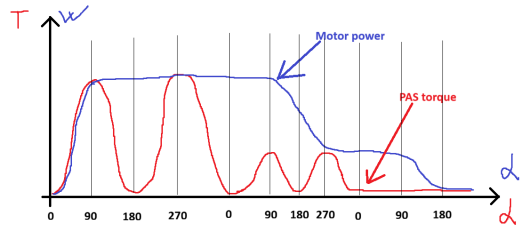
What I want with any future dive system is what I have now: Cadence-controlled-speed, because torque varies signfiicantly throughout the pedal rotation, especially for people like me that have a hard time pushing at all because of the serious pains in various body parts, among other issues. By Cadence-controlled I mean that if I pedal faster, then the system does whatever it needs to to increase speed by that proportional amount. If I pedal slower, the system lessens assist proportionally to allow speed to drop.
This works very well, once the load has been overcome; especially from startup from a stop where it needs to have pure torque control and not wait for sufficient cadence measurement to occur.
It's possible that I simply have never been able to set up torque sensing to work correctly at "cruising speed" without varying too much because of the varying road conditions and slopes. Since I need a constant speed when riding in traffic, cadence-controlled speed works better than torque-controlled. Otherwise I end up getting bursts of speed when I don't want it just because there was a slight momentary incline in the road surface that is gone by the time the system reacts to my input and now I'm too fast and have to brake to ensure I won't get too close to the vehicle in front of me. Conversely the road dips and my speed decreases because of the sudden drop in pedal torque and then the vehicle behind me gets too close. Etc.
I couldn't use more "smoothing" on the pedal-torque control or then it doesn't give power fast enough when I need it to overcome loads "instantly" such as at startup....I ended up having to just turn off torque control because I couldn't tune it to do what I wanted (almost certainly my brain problem rather than the system's) without unsafely interfering with normal riding, and just went with pure cadence control, which other than the situations in which I can't move the pedals first (or quickly enough to do what's needed), works "perfectly" or as close as I've ever come for the majority of riding.
If pedal-torque control behavior can maintain speed correctly without doing unsafe things, by reacting "instantly" to torque demands under the right conditions (like from a complete stop) but not reacting like that when riding along "at speed" just because of small road surface variations, but would still react to large changes in pedal torque required for large road surface variations or rider-demand (*** more thoughts below), then pure cadence control at speed and pure torque at other situations would be unnecessary.
*** Further thoughts: This might be too complex to implement, or I might just be making it harder than it has to be, but: During riding "at speed" (whatever speed that is), then when the detected road speed drops *and* the rider cadence hasn't dropped before that (to demand less speed) but is dropping *as the road speed drops*, the pedal torque would also be increasing at that same time, and *then* the torque-control should begin adding in a contribution to the cadence control until the pedal torque drops to the previous level, indicating the rider now is getting the cadence-controlled-speed they are demanding, and the torque-controlled assist can lower proportionally as the pedal torque drops.
Presently I use a throttle for those situations where it is not possible for me to overcome the forces needed to move the pedals but *must* begin moving (or increase speed) to get out of someone's way (usually because they are an impatient (well, you know) that can't wait literally less than ten seconds for anything).
But using any of the throttle designs I've bought or built so far (including various types pulling a cable-operated-throttle box) hurts my hands (imagine having your thumb pulled away from your hand and bent backwards toward your wrist continuously and more forcefully with every passing second--that kind of pain), so can't be used for more than a few seconds on a good day.
Throttles are also not legal in some places, so it would be nice to have a throttle-less system like this for those like me that must do what I do in those places.
**** I actually personally don't need or use any levels, I need the full amount of assist available at any instant for when it is needed...but if a system can or does have levels as part of it's nature, I don't know what the best type of limit there would be for them.
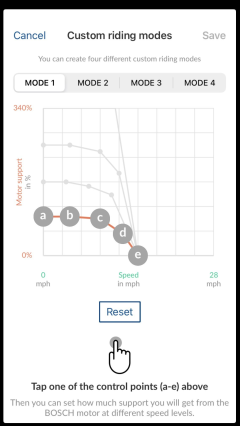
I once thought speed limit levels would be useful for certain low-speed situations, and tried that with a 5mph and 10mph version, (as well as a full 20mph one) in the system I have now, but after having tested them a few times, found it was better and safer to not have them because of the various dangerous users of the same areas (parking lots, primarily) where being limited in speed meant I couldn't get out of their way quickly enough.
I can imagine a situation where a power / current limit level might be useful to maximize battery usefulness and minimize stress on it when environmental conditions (cold, etc) and battery condition (age, low SoC, etc) combine to make it unable to operate the system normally, so that the rider doesn't have to change system settings in the menus to decrease what the battery has to handle just to get to the next charge point wherever that might be.
There could be other situations I have not run across myself that might make some form of levels useful. (power or speed restrictions for children or beginners, etc).