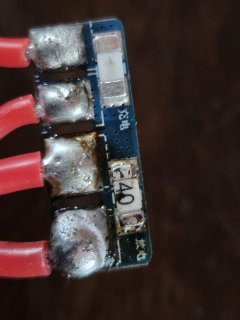
Are fuses blown? Cut red wires and test with Ohm meter.
I would like to swap out the board for two inline blade fuses that are easier to replace.
I hereby give permission to replace fuses with same Amp. DC? Fast, slow?
learn about fuses
What is an Electrical Fuse?
An electric fuse is a device included in a circuit to protect your wiring and circuit components. It safeguards your devices by limiting the excessive current flowing through them during an overload or fault conditions like a short circuit or ground. A fuse comprises a fusible link (or links) encased in a tube and connected to a contact terminal. The electrical resistance of these fusible links is so low that it (normally) acts as a conductor. These fuses should be connected in series with each phase conductor to allow the current to flow through it. For every fuse, the manufacturer mentions the rating (usually in amperes), which decides the maximum amount of current the fuse will carry without opening. When the circuit current flow exceeds this value, the fuse link melts due to the heat generated by the current flow and opens the circuit.
Figure 1: An electrical fuse (Image courtesy: LITTELFUSE)
Meaning of the term ‘Speed of Fuse’
The speed of the fuse is the time it takes to rupture. It depends on the fuse element material, the overload current, and the ambient temperature. Here are the types of fuses based on the speed of blow:
- Very fast acting fuses (Flink Flink/FF): These fuses primarily provide short circuit protection in consumer electronics devices (PCs, TVs, etc.), Industrial controllers (PLCs, DCS, etc.), Automotive control units (ECU, TCU, etc.). The fuse element of these fuses is made up of silver and opens within the first half cycle of overcurrent.
- Fast-blow (Quick-acting) fuses (Flink /F): They are designed to protect general-purpose electrical circuits and cabling from overloads and short circuits. The fuse element of fast blow fuses is made with copper and has a tolerance limit of 500% of rated current for 0.05-2 sec.
- Slow-acting fuses (Trage/T): They are designed to tolerate short-duration current surges. They are commonly used in applications with unexpected momentary overloads, such as motor and lighting circuits. The fuse element of slow-acting fuses is also made with copper and has a tolerance limit of 500% of rated current for a minimum of 10 sec.
- Medium blow fuses (Mitteltrage/M): They are used in automotive, commercial, and industrial electronics to protect the circuits subjected to moderate to high inrush current. The fuse element of fast blow fuses is made with copper and has a tolerance limit of 500% of rated current for 4-6 sec.
How many types of fuses are available in the market today:
There are three main categories of fuses available in the market based on different requirements, which are as follows:
- DC fuses: DC or direct current fuses are designed explicitly for use in DC circuits. They are larger than AC fuses and reduce the arc by increasing the distance between the electrodes.
- AC fuses: In an AC system, the magnitude and polarity of current and voltage vary concerning time. This variation in voltage helps terminate the arc produced by the heat generated in the fuse element due to excess current. Therefore, AC fuses are slightly smaller compared to DC fuses..............................................................................................................................
...........................................................................................................................................................................................................................................