
I am looking for a 48 spoke rear hub for a new build on a Primos Dame, but most of the ones I've found are bolt-on, like a BMX bike. Is it possible to adapt a bolt-on to a thru-axle? I confess I don't entirely grasp the distinction. I'm a big guy and I live in a semi-rural area with a history of broken spokes and wheels coming loose way too fast. I used to think I needed thicker spokes, but have been persuaded by my own experience with my RadWagon 3 and in my time lurking here that I would be better served by more spokes instead.

-
Hello ES! We could use some help to get us past the finish line on building the new knowledgebase for the forum.
Can you donate? Please see our fundraising page. Thank you!
You are using an out of date browser. It may not display this or other websites correctly.
You should upgrade or use an alternative browser.
You should upgrade or use an alternative browser.
Bolt On vs Thru Axle
- Thread starter vklurk
- Start date

BicycleJoe
🔋 Established
I haven't heard of a thru-axle frame being modified to accommodate a bolt-on axle. However, since your frame is steel it can be modified.

bolt on and thru axle are two different standards and frame modification + custom hardware is required to make one work with the other.
ebikes.ca sells some hub motors that are designed to fit thru axles, there are a few other random makers also.
You will have a very hard time finding a hub motor that accepts 48 spokes, they're all generally 36 spoke. A quality 36 spoke wheel is usually quite sturdy. A not quality one will be nothing but problems.
ebikes.ca sells some hub motors that are designed to fit thru axles, there are a few other random makers also.
You will have a very hard time finding a hub motor that accepts 48 spokes, they're all generally 36 spoke. A quality 36 spoke wheel is usually quite sturdy. A not quality one will be nothing but problems.
You will have a very hard time finding a hub motor that accepts 48 spokes, they're all generally 36 spoke. A quality 36 spoke wheel is usually quite sturdy. A not quality one will be nothing but problems.
Yeah, I'm going mid-drive for this and other reasons.

So you’re looking for a 48 hole thru axle hub; nothing to do with a hub motor, correct (bicycle, not ebike question)?Yeah, I'm going mid-drive for this and other reasons.
how much do you weigh? I believe there are a few big guys on the forum, or have built bikes to haul heavy cargo, and haven’t had an issue with 36 spokes. You can build a pretty strong wheel if you choose a strong rim and build it right.
They do make 24hole rear hubs with thru axles, so if you have a drill press, you can make a custom 48 spoke hub.
Last edited:
Yeah, exactly. Sorry, I see where the confusion was looking back. I'm just not finding a lot of 48 or even 40 spoke hole wheel hubs that fit the Dame. I've never built a bike DIY before and I am possibly misunderstanding a few things.
Maybe starting your build using a bike with suspension might help?Yeah, exactly. Sorry, I see where the confusion was looking back. I'm just not finding a lot of 48 or even 40 spoke hole wheel hubs that fit the Dame. I've never built a bike DIY before and I am possibly misunderstanding a few things.
I don't follow, why would a suspension bike help? I've hated every suspension bike I've ever had.Maybe starting your build using a bike with suspension might help?
ETA: I weight 275 lbs and I like to carry stuff - my riding environment is probably best described as 'gravel', since it's a mixture of pavement, natural surface, and occasional level singletrack. I'm not doing anything too crazy, try my best to avoid potholes and roots, and I've had these problems regular pavement as well.
Last edited:
I thought perhaps the spokes were breaking due to the wheel taking some hits on rough terrain or potholes.I don't follow, why would a suspension bike help? I've hated every suspension bike I've ever had.
ETA: I weight 275 lbs and I like to carry stuff - my riding environment is probably best described as 'gravel', since it's a mixture of pavement, natural surface, and occasional level singletrack. I'm not doing anything too crazy, try my best to avoid potholes and roots, and I've had these problems regular pavement as well.
My thought is drilling a 24 spoke hub shouldn’t be too hard since it’s doubling the holes and wouldn’t take any complicated calculations. Anyway, the member who has a lot of hands on experience on these things isn’t available, so hopefully someone else can chime in with other suggestions.
Ooooh.I thought perhaps the spokes were breaking due to the wheel taking some hits on rough terrain or potholes.
My thought is drilling a 24 spoke hub shouldn’t be too hard since it’s doubling the holes and wouldn’t take any complicated calculations. Anyway, the member who has a lot of hands on experience on these things isn’t available, so hopefully someone else can chime in with other suggestions.
I'm a bit slow today, apologies. The possibility of terrain being a factor has occurred to me, but I think it's mostly my weight. Anyways, I prefer hardtails. Thank you though!
I think I may be overthinking things a tad. I have a 36 hole RadWagon 3 and while I genuinely love it, it never stays true for long. I guess in my mind, I feel like if the "big spokes are bad" folks are wrong, if I also get more spokes for my new build it won't matter as much.
Not that I don't believe the folks in the forum who say that the bigger spokes the RW has are counterproductive are wrong, per se. I just have tried a lot of things at this point - one of the reasons a younger me bought the Wagon in the first place was the weight rating and thicker spokes. So I am scared to trust the latest approach to a fix, and feel like throwing multiple fixes - regular sized spokes, likely Sapim strong - and more of them together at once is likely to improve things.
hmm, i used to be 280lbs and never had issues with 36 spoke wheels, unless they were made with poor quality components.
It could be that your factory hub motor wheel is made up of low quality components. Is the rim name brand? if it's not, you probably have some rim/spokes made of chinesium, which is not redeemable, and may be the source of your problems.
Big spokes usually are bad. The ride quality is worse and they're heavier. Big spokes are used in cases where the manufacturer doesn't care to use a quality spoke, so they use a big crappy one to compensate. These are so stiff that they can break hub shells and rims.
It could be that your factory hub motor wheel is made up of low quality components. Is the rim name brand? if it's not, you probably have some rim/spokes made of chinesium, which is not redeemable, and may be the source of your problems.
Big spokes usually are bad. The ride quality is worse and they're heavier. Big spokes are used in cases where the manufacturer doesn't care to use a quality spoke, so they use a big crappy one to compensate. These are so stiff that they can break hub shells and rims.
It could be that your factory hub motor wheel is made up of low quality components. Is the rim name brand? if it's not, you probably have some rim/spokes made of chinesium, which is not redeemable, and may be the source of your problems.
Yeah, I believe chinesium is definitely a factor. That said, the issue is that the Wagon is not the first bike I've had rear wheel problems on, so while it clearly isn't the silver bullet it's given me a certain desire to...brute force the solution? Like, if I just got a 36 spoke wheel using Sapim strong or the like, I'd be constantly wondering if I could really trust it and if anything did happen I'd be very dispirited. If I build a wheel with 40 or 48 spokes and a new rim (I'm thinking of a new build anyways), I'll feel like I've done everything I could.
What I have noticed is that shortly after a truing, almost all of them will get very noisy. I know some of that is normal, but it's definitely more than any other bike I've ever been on.Big spokes usually are bad. The ride quality is worse and they're heavier. Big spokes are used in cases where the manufacturer doesn't care to use a quality spoke, so they use a big crappy one to compensate. These are so stiff that they can break hub shells and rims.

I'd recommend looking at images of the two different kinds, how they mount, etc., so you can see the differences. It may also show you how to make yourself adapters to affix to the frame to allow a bolt-on axle to mount there.Is it possible to adapt a bolt-on to a thru-axle? I confess I don't entirely grasp the distinction.
The major difference is a thru-axle frame doesn't have any opening for the bolt on axle to slide up into (no actual dropout), so if the wheel you want to use doesn't have a hub you can take the axle out of so that it can be installed into the bike and then still be able to reinstall the axle while the wheel is already in place (not the normal way these are done), you would have to modify the frame, probably by cutting into it (preventing usage as a thru-axle frame afterward without yet more modifications) to allow the axle to go up into the frame without taking it out of the wheel.
If it's your motor wheels breaking, it's probably because the spokes are typically too thick already (usualy 12g), and need to be thinner (14g or 15g, or 13/14 butted) to be properly tensionable without overstressing and damaging the rim, which then loosens the spokes, and prevents them from ever being tensionable again without replacing the rim.I'm a big guy and I live in a semi-rural area with a history of broken spokes and wheels coming loose way too fast. I used to think I needed thicker spokes, but have been persuaded by my own experience with my RadWagon 3 and in my time lurking here that I would be better served by more spokes instead.
Even some regular wheels are built with spokes too thick for the rims they use, and/or they are simply not tensioned correctly to start with.
Sometimes it's just crappy spokes made incorrectly and/or of the wrong metal.

There are a lot of posts about wheels, spokes, rims, breaking, fixing, lacing, etc, if you need more info on this topic; many of the detailed ones are by Chalo, or me.
Yes, I've been lurking for a while and the information has been very helpful.There are a lot of posts about wheels, spokes, rims, breaking, fixing, lacing, etc, if you need more info on this topic; many of the detailed ones are by Chalo, or me.
I've never broken a spoke on the RadWagon, only find it comes wildly out of true very quickly after a truing and generally isn't reliable.
I used to break a spoke once a month on my old hybrid commuter bike, the experience of which was so frustrating it led me to the RadWagon's promising-sounding thick guage spokes. Alas, it was another wrong turn.
I carry hundreds of pounds on my SB Cruiser trike (which itself plus me is also hundreds of pounds) without spoke failures, even on rough roads, on wheels I built myself (mostly from info learned from Sheldon Brown's bicycle website).The possibility of terrain being a factor has occurred to me, but I think it's mostly my weight. Anyways, I prefer hardtails.
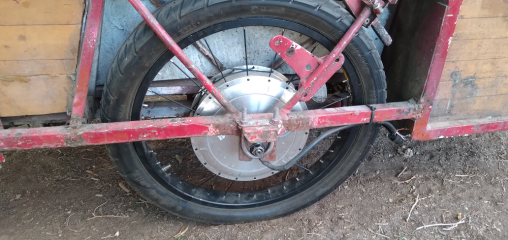
The small 20" hubmotor wheels in the rear that carry most of the load are made with Sapim 13/14 single butted spokes and nipples from grin, with eyeletted (important!) nipple hole doublewall aluminum rims (50mm, I think, but at least 40mm wide). The tires are Shinko SR714 2.25"x16" moped tires, equivalent to wide but not quite fat 20" bicycle tires but heavier duty at lower pressure, providing some cushion against road defects.
The front wheel (until recently when I had to swap it out for a crappy ebike front wheel temporarily, because the QR hub in it failed) uses regular 15g spokes off some old 1980s bicycle wheel, a cheap QR hub out of some old mongoose wheel, and an old recycled Sunlite heavy-duty rim from something else I don't even remember.

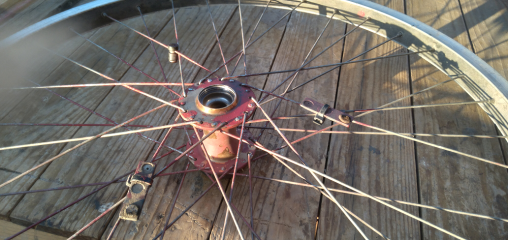
The temporary replacement wheel creaks and makes other disturbing noises, even though the spokes appear to be correctly tensioned.
I haven't checked to see which spoke size it uses, but it's got a crappy "powercircle" rim, of which I have had two fail from common-ebike-size spoke tension problems, with cracking and deformation around the nipple holes, so I don't trust them even in non-motor wheels like this one.
I *have* broken hubmotor axles and destroyed rims on various potholes, but except during one extreme event, haven't had spoke failures. (taht event surprised me in that the wheel remained intact enough to complete the ride home; it was such a severe impact I had expected to find it disintegrated and thought I'd have to ride home on the hubmotor flanges
)(I don't count the one OEM hubmotor wheel I used on it as an experiment--one entire side of the wheel simply zip-snapped almost all of it's spokes on my ride home not long after I started using it, with no warning, on smooth pavement...but it almost certainly wasn't designed for the load even the empty trike puts on it. Since the rim was not eyeletted, I suspect that's the problem, but there were other issues when the whole thing was disassembled for failure analysis).
Just use the right size spokes for the rim, and use an eyeletted rim. Do not reuse the rim you already have--it is almost certainly already damaged and is the cause of the spokes continuing to loosen after tensioning.I think I may be overthinking things a tad. I have a 36 hole RadWagon 3 and while I genuinely love it, it never stays true for long. I guess in my mind, I feel like if the "big spokes are bad" folks are wrong, if I also get more spokes for my new build it won't matter as much.
I guarantee you that unless you use a rim designed to handle the higher tension of thicker spokes, the thicker spokes cannot help, and instead will only cause more problems (having more spokes that are too thick still won't help becuase they break / deform the rim which causes the whole problem in the first place).Not that I don't believe the folks in the forum who say that the bigger spokes the RW has are counterproductive are wrong, per se. I just have tried a lot of things at this point - one of the reasons a younger me bought the Wagon in the first place was the weight rating and thicker spokes. So I am scared to trust the latest approach to a fix, and feel like throwing multiple fixes - regular sized spokes, likely Sapim strong - and more of them together at once is likely to improve things.
The thicker-spoke usage on motor rims is a copypasta failure chain--one manufacturer did it way way back when, and others copying what htey did also copied that, and then more copied those, and so nowadays it's just "a thing they all do" for no reason other than that they always did it so they always do it even though it causes these problems.
Under some circumstances (lighter loads, better roads, infrequent usage, better rim than usual, etc) the wheels don't fail in the lifetime of the rider or system, so not every wheel will fail. When they do fail, it's usually because of the mismatch between required spoke tension and rim tension handling capability at the nipple holes. When it isn't that, it's usually the spokes not being tensioned correctly int he first place, so that they break without having first damaged the rim...but then the wheel fixer tensions them all up nice and tight and causes the other problem.
As long as the spokes you use are matched to the rim you use, or the rim is better than the spokes require, you can use however many spokes you want.Yeah, I believe chinesium is definitely a factor. That said, the issue is that the Wagon is not the first bike I've had rear wheel problems on, so while it clearly isn't the silver bullet it's given me a certain desire to...brute force the solution? Like, if I just got a 36 spoke wheel using Sapim strong or the like, I'd be constantly wondering if I could really trust it and if anything did happen I'd be very dispirited. If I build a wheel with 40 or 48 spokes and a new rim (I'm thinking of a new build anyways), I'll feel like I've done everything I could.
If you use a rim that isn't designed to handle the tension required by the thickness of spokes you use, it will probably fail again.
Typcally, the larger the wheel diameter, the longer the spokes and the more load they can typically take before they untension enough to let the nipple move which loosens them. (smaller wheels sometimes take sideloading better, but that's only normally an issue on trikes and quads, not bikes).
You can also use various nipple-locking techniques, but I have never needed to use those. (all of my bikes are heavy-cargo haulers, the trike even moreso as it can directly carry even the St Bernards that had to ride in trailers for the bikes).
What I have noticed is that shortly after a truing, almost all of them will get very noisy. I know some of that is normal, but it's definitely more than any other bike I've ever been on.
I've never broken a spoke on the RadWagon, only find it comes wildly out of true very quickly after a truing and generally isn't reliable.
That is a typical sign of a damaged rim whose nipple holes are cracked / deformed / continuing to deform from the spoke tension. It doesn't have to be all of the holes damaged...just enough to let enough spokes to loosen to allow all the rest to loosen as the rim "wobbles" around during the tension/detension cycle as the wheel rolls down the road under load.
The only good way to fix that is to replace the rim. (even if you reuse the spokes and nipples). I have seen attempts to use spoke nipple washers to fix this, but the rim is already damaged and will continue to grow worse, even if it's delayed by the load-spreading of the washers. Eyelets installed into already-damaged holes do the same thing--they temporarily reinforce the holes, but the damage is already present....
The causes of that would depend on what the wheel was built from and how, riding conditions, loading, etc.,I used to break a spoke once a month on my old hybrid commuter bike
I've had plenty of failures of wheels over my life of riding, since I overloaded most of the things I have ridden by up to several times their design intent
and that's the main reason I learned wheel building (which I am no expert at, but they don't fail, so...better than what I had).The temporary replacement wheel creaks and makes other disturbing noises, even though the spokes appear to be correctly tensioned.
I *have* broken hubmotor axles and destroyed rims on various potholes, but except during one extreme event, haven't had spoke failures. (taht event surprised me in that the wheel remained intact enough to complete the ride home; it was such a severe impact I had expected to find it disintegrated and thought I'd have to ride home on the hubmotor flanges
Wow, that's seriously impressive. One of my big fears regarding my RadWagon was the possibility of a damaged axle. Your trike is beyond amazing, thank you for showing me!
I'm glad I'm not the only one who gets very alarmed by lots of creaking sounds from a wheel whose spokes are, ostensibly, properly tensioned.
Just use the right size spokes for the rim, and use an eyeletted rim. Do not reuse the rim you already have--it is almost certainly already damaged and is the cause of the spokes continuing to loosen after tensioning.
I guarantee you that unless you use a rim designed to handle the higher tension of thicker spokes, the thicker spokes cannot help, and instead will only cause more problems (having more spokes that are too thick still won't help becuase they break / deform the rim which causes the whole problem in the first place).
I guess I assumed, being a cargo bike and with these thicker spokes advertised at the time, that the manufacturer would've been selecting a better rim. I think that's probably not the case, however.
The thicker-spoke usage on motor rims is a copypasta failure chain--one manufacturer did it way way back when, and others copying what htey did also copied that, and then more copied those, and so nowadays it's just "a thing they all do" for no reason other than that they always did it so they always do it even though it causes these problems.
Was that manufacturer Rad Power Bikes? Because that's the ebike I have.
The big takeaways I am getting from this are 1.) for my existing ebike, when it next comes out of true and I take it to the shop, I want to ask my LBS to rebuild the wheel with new spokes and a new rim, and make sure they know the previous spokes were too thick; and 2.) that I need to increase my technical skills and knowledge. I feel like my project to build up a bike from just the frameset - with the goal of adding a ToSeven or CYC kit to it along the way - would be a good way to learn, but am I biting off too much at once?The causes of that would depend on what the wheel was built from and how, riding conditions, loading, etc.,
I've had plenty of failures of wheels over my life of riding, since I overloaded most of the things I have ridden by up to several times their design intent
Thank you very much for your advice and for listening to the specific 'symptoms' I have on Cookie Policy (the name I have for my RadWagon). I definitely will try a wheel rebuild and in particular ask for a new rim and spokes.
Thank you also for your detailed pictures and technical information of your amazing bike! And here I had thought that Cookie Policy was a car replacement, but your SB Cruiser is on another level. It's awesome to see what's possible here.
sure. i build stuff out of whatever i have, or can get cheap, as i don'treally have a budget for anything. :lol: so i've broken lots of stuff, and learned what not to do, the hard way.Wow, that's seriously impressive. One of my big fears regarding my RadWagon was the possibility of a damaged axle. Your trike is beyond amazing, thank you for showing me!
i'm not an engineer, just a hack, so what i know about things is from my experience or that of others or both, along with whatever principles i've managed to stuff into my head along with all the other crap that doesn't belong in there.
I'm glad I'm not the only one who gets very alarmed by lots of creaking sounds from a wheel whose spokes are, ostensibly, properly tensioned.
especially for a front wheel, cuz a collapsed rear you jsut drag along and skid, but a front....
maybe, maybe not; my bet is always that whoever designs something makes a choice that is probably appropriate, but then the pennypinchers go in there and "well, we can get *this* part cheaper, and it can't really matter *that* much, so...". (true in everything that gets made, anwyhere,)I guess I assumed, being a cargo bike and with these thicker spokes advertised at the time, that the manufacturer would've been selecting a better rim. I think that's probably not the case, however.
you can certainly build a wheel with thicker spokes and a stronger rim for those that will then be more capable than a ligher weight one, but that's not usually what happens. almost always, whether it's a diy build or a corporate one, they only thicken the spokes, because they don't understand how a spoked wheel actually works in practice.
until i saw the failures, i used to think the same way, cuz it's an easy mistake to make and without knowing what's going on in a wheel it's counterintuitive to use thinner spokes, thinking that the spokes 'hold up" the wheel like columns in a building, or "mag wheel" "spokes", or old wooden wheel types, etc., but they don't....
btw, if a wheel keeps realy going out of true, so that it's obviuos even when not using rim brakes, tha'ts a pretty serious problem that means either the rim is bent / deformed, or some spokes ahve such high tension compared to others that it's deforming the rim as the others loosen up.
if you ever have an old bike wheel you do'nt care about, i highly recommend getting a spoke nipple tool and going to whatever wheelbuilding site / page / videos suit your learning style, and playing with the wheel to see how wheels work--you will eventually learn enough to "see" which specific wheel problem you have when different things happen to your wheels.
(this is how i learned, as i used to collect every bike that no one wanted and use their parts to build things from, and experiment and take apart and reassemble just to learn how without risking my ride)no, it was an a2b probably a metro but i don't remember since i only got the wheels, not the bike. (these ultramotors are great motors for my purposes so i have tried to collect them whenever i could get hold of them; stromer also used to use them).Was that manufacturer Rad Power Bikes? Because that's the ebike I have.
i've seen a few rads and worked on a couple for upgraidng their controller/dispaly systems, and not seen wheel problems with them but they were used lightly and infrequently.
it won't really matter to them what the old parts were if the wheel is being rebuilt--if they are competent at all, they will use the right spokes for the rim they are using. (and they'll already know the spokes are too thick for that rim, assuming that it is not a tougher rim made for that gauge's tension). they should also discuss with you about the right rim for the usage (weight carried, terrain, etc), as it matters. you might need a heavy duty wheel and that might mean a strogner rim that does handle the thicker spokes.The big takeaways I am getting from this are 1.) for my existing ebike, when it next comes out of true and I take it to the shop, I want to ask my LBS to rebuild the wheel with new spokes and a new rim, and make sure they know the previous spokes were too thick;
chalo recommended this over here if you have one of the 22" rw's
There are some 22" BMX rims that are plenty wide for a 3.0" tire, and plenty strong enough for cargo bike use. Alienation Vandal is 37mm wide, which is typical of "XL" BMX rims these days.
it isn't uncommon for a freshly built wheel to need slight retensioning after a few dozen miles; some wheelbuilders will put it thru that before providing it to the customer so ti just stays good and the customer doesn't have to come back for that part, some just tell them to bring it back then or if it pings, etc.
(note that typical bicycle spokes are 15g. sometiesm 14g. non-walmart-level bikes are likely to use butted spokes that are thinner by at least one gauge size in the middle, and thicker at the elbow end (single butted) and sometimes at both ends (double butted). that lets them tension better with less stress on the rim, but be thicker where the stresses of interface with the wheel parts are higher. decent bicycle rims can even deal with 13g, at least if they're butted down to 14 in the middle, but pure 12g just takes too much tension for cheap rims and cheap is the name of the game with just about all typical ebike stuff out there. )
i didn't see in here yet: is this the hubmotor wheel or the regular wheel that's failing? or is this one of the dual=-hubmotror rads?
a regular wheel is easier to build right and work better when wrong for longer than the hubmotor wheels just because of the size of the hub itself, for a number of reasons, so if the probelm is in the regular wheel and not in the hubmotor wheel, might be time to upgrade to heavy duty bike parts (rim, etc).
wheels can be built for all sorts of usages, but one for oen usage may not work well in another. regular bike parts can even be found in pedicab wheels that have to carry thousands of pounds of passengers, so it's certaily possible to build wheels that work for you.
as long as you are willing to learn bits and pieces as you need them, you can do anything you want that you can find the budget for. (see my wolfybot project thread for the immense amount of things i'm still learning to begin achieving *that* goal).and 2.) that I need to increase my technical skills and knowledge. I feel like my project to build up a bike from just the frameset - with the goal of adding a ToSeven or CYC kit to it along the way - would be a good way to learn, but am I biting off too much at once?
just make sure you can keep your regular ride operational while the new one is in progress.
originally i just rode bikes utnil they broke then got another at a thrift store or yard sale and rode it to death, etc. as i had no idea how to fix anything more than a flat tire or other simple obvious mechanical things. at some point i started learning how to fix things, ran across sheldonbrown's site and my real adventure began, and i started building custom bikes for my needs intead of just trailers to pull behind the bike. then i started taking those bikes id ridden to deaht and using them for parts to make my bikes from, and collectging more. this was before i needed a motor....that was a whole other adventure.
personally, i like the simplicity of hubmotors, because a direct drive hubmtoro can be silent and virtually maintenance free. a geared hubmtoor is minimal maintenance and can be pretty quiet but not silent. either one of these can be driven by "any" controller so you have a huge range of ways the system can work and interface with the user. easy to customize the system to your needs.
a middrive requires all the bike's drivetrain to work correclty, and reuqiers being used correctly to not destroy that drivetrain, and you ar e usually limited to howver the designers of the drive thought it should work, whatever sensors it has built in, etc, and locked to the capabilities and uiser interface that they thougth was good...none of which may apply to how you use a system.
and you are locked to the parts sources for the system, if there are any spare parts avialable at all.so if you go for a middrve, you have to make sure it will actually fit on the frame, that it works with the drivetrain on that frame, or the one you want o use on it, that it does the things you want it to do in the way y9ou want them to work, that it has spare parts from non-original-manufacturers (cuz some like bafang change and discontinue things without noticeand not everything is compatible with other units that have the same model!).
etc.
i guess next time you'll have to read the whole thing before you accept the cookie policy.Thank you very much for your advice and for listening to the specific 'symptoms' I have on Cookie Policy (the name I have for my RadWagon).
not everything i built has been a success--poke around for the delta tripper thread. :lol:Thank you also for your detailed pictures and technical information of your amazing bike! And here I had thought that Cookie Policy was a car replacement, but your SB Cruiser is on another level. It's awesome to see what's possible here.
the raine trike for my brother might be a success but he never uses it so i don't really know. i think it oculd use some improviements in hte pedal drivetrain but he would never use those anyway (*tehy're only there for legality on his trike, on mine i use them to control the motor system and as a backup in case all the motors fail).
tehre are even "better" cargo trikes; trucktrike is one i'd like to borrow bits of engineering from; they're not aroudn anymore but you can still find good images.
and things like this could be inspiring; you could build something like it for a lot less than the six thousand ish they want for it.
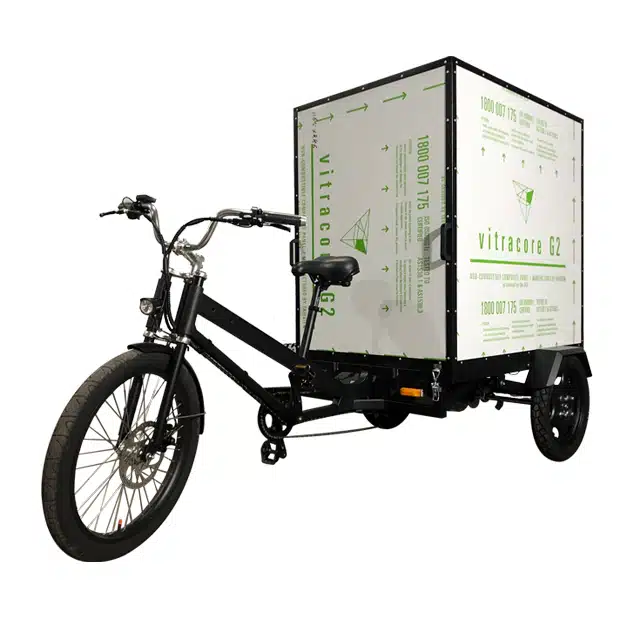
Electric Box Cargo Bike Trike
Electric box cargo bike delivery trike truck 3 three wheels motorized tricycle Electric box cargo bike delivery trike truck 3 three wheels motorized
 mobility4less.com
It is deeply weird to me that, despite having had rear spoke problems on three different bikes of one sort or another and the occasional pinch flat as well, I have never had any kind of problem with a front wheel. I suppose I should count my blessings!especially for a front wheel, cuz a collapsed rear you jsut drag along and skid, but a front....
I think the "deforming as others loosen up" might be what's happening. I suppose I could invest in some spoke wrenches as a maintenance tool in the interim.btw, if a wheel keeps realy going out of true, so that it's obviuos even when not using rim brakes, tha'ts a pretty serious problem that means either the rim is bent / deformed, or some spokes ahve such high tension compared to others that it's deforming the rim as the others loosen up.
I will definitely have to try that! I am inspired by all the cool creations on the forum. I want to be able to make - and especially maintain - cool things like these.if you ever have an old bike wheel you do'nt care about, i highly recommend getting a spoke nipple tool and going to whatever wheelbuilding site / page / videos suit your learning style, and playing with the wheel to see how wheels work--you will eventually learn enough to "see" which specific wheel problem you have when different things happen to your wheels.
Ah, the thing I love about Cookie Policy is it's a model 3 RW, using 26" wheels. I've used smaller wheeled cargo bikes before and I absolutely cannot stand the combination of small and fat. 26 x 2.5 is definitely a sweet spot for me. I tried out a Yuba Kombi once and it also felt very similar. I will regularly ride Cookie Policy on PAS level 1 for the exercise and fun - I only really go up into 3 or 4 when dealing with hills, as I don't much like hill climbing.it won't really matter to them what the old parts were if the wheel is being rebuilt--if they are competent at all, they will use the right spokes for the rim they are using. (and they'll already know the spokes are too thick for that rim, assuming that it is not a tougher rim made for that gauge's tension). they should also discuss with you about the right rim for the usage (weight carried, terrain, etc), as it matters. you might need a heavy duty wheel and that might mean a strogner rim that does handle the thicker spokes.
chalo recommended this over here if you have one of the 22" rw's
As far as the LBS goes, well, that's the rub. I like them well enough, but I have been burned before with other shops. They mentioned that the spokes were unusually big but didn't say anything about the spokes being too big for the rim when I inquired about wheelbuilding and asked if there were any nonstandard parts. I have reached out to them to get their opinion on if oversized spokes might be part of the problem, but haven't heard back yet.
Hrm...I definitely need to invest in a spoke wrench and tool. My LBS is in a nearby city, and a bit of a hike by bike or by car.it isn't uncommon for a freshly built wheel to need slight retensioning after a few dozen miles; some wheelbuilders will put it thru that before providing it to the customer so ti just stays good and the customer doesn't have to come back for that part, some just tell them to bring it back then or if it pings, etc.
That's good to know! I know from Grin's website they use 13g butted down to 14g, and I was worried that I would be asking for some weird thing if I brought that up to a wheelbuilder.(note that typical bicycle spokes are 15g. sometiesm 14g. non-walmart-level bikes are likely to use butted spokes that are thinner by at least one gauge size in the middle, and thicker at the elbow end (single butted) and sometimes at both ends (double butted). that lets them tension better with less stress on the rim, but be thicker where the stresses of interface with the wheel parts are higher. decent bicycle rims can even deal with 13g, at least if they're butted down to 14 in the middle, but pure 12g just takes too much tension for cheap rims and cheap is the name of the game with just about all typical ebike stuff out there. )
The hubmotor wheel. My two analog bikes that have had wheel problems were also rear wheel, although one of those was a Walmart bike.i didn't see in here yet: is this the hubmotor wheel or the regular wheel that's failing? or is this one of the dual=-hubmotror rads?
Oh, I am a big hubmotor fan, for exactly those reasons and for regen braking. It's just that I'm in a hilly area and I'm curious how the other side lives, so I figure for my next ebike I will try a mid-drive. Plus, there is a company in Seattle that will drill IGHs to 48 drillings (voids the warranty, of course, but still), so if I really need to I could try and pick up a Nexus or Alfine. I would need to very very gentle with the shifting, though, hence my initial quest for an ordinary cassette hub first.personally, i like the simplicity of hubmotors, because a direct drive hubmtoro can be silent and virtually maintenance free. a geared hubmtoor is minimal maintenance and can be pretty quiet but not silent. either one of these can be driven by "any" controller so you have a huge range of ways the system can work and interface with the user. easy to customize the system to your needs.
I am definitely going to check out more of your projects, they are very fun and I am seriously impressed. The only ideas I've had for trikes have been what I call the "tadpole semi-truck", aka "what if a catrike had a long deck with a fifth wheel for a huge trailer". I don't own any land, but if I ever do it would be cool to build a whole yard maintenance system up around a trike that also works as a trike.
Rear wheel problems are more common on a typical-wheelbase bicycle becuase the rear is usually much more heavily loaded than the front. That's exasperated further with rear-loaded cargo or heavy riders.It is deeply weird to me that, despite having had rear spoke problems on three different bikes of one sort or another and the occasional pinch flat as well, I have never had any kind of problem with a front wheel. I suppose I should count my blessings!
More weight deforms the rim further, slackening hte spokes more. As long as this doesn't exceed the amount the spokes were stretched by tensioning, it doesn't affect the wheel.
But as soon as the deformation slackens the spokes enough to exceed the tension-stretching, the spokes in that spot are now slack, and a few things happen. The elbow gets cyclic stressing, as it slackens then retightens, and that eventually cracks it at the elbow. (that's why most spokes break there). The nipple isn't pulled against the rim and the spoke threads, and so it can unthread itself, a tiny bit at a time. (nipple locking techniques like linseed oil, loctite, etc prevent that, but do nothing for the cyclic stresses). The rim's nipple hole is cyclically unloaded and then re-loaded.
So you can have one or all of those cause failures of the wheel. The most commonly visible is the broken elbow of the spoke. The next one that people see easily is the nipples having unthreaded off the spokes, and rattling around inside the rim with the spoke just hanging there by the elbow, or missing completely because it fell out on the road somewhere. The least commonly seen because it's not always obvious is the cracked holes in the rim where the nipples damaged it, either from the cyclic loading / unloading or from too high a tension (which you can cause even with the right spokes by overtightening!).
Most of the images in this search link are obviously cracked, but you can find some that are subtle. I had some here on ES like that but can't find them ATM, from an old uneyeletted crystalyte wheel / noname rim, and what I think was a powercircle rim on a 9C or clone motor (both of these were probably on the Crazybike2 from 2014 or before):
You can see most rim cracks just by looking in direct sunlight, and others you can see by rubbing a grimy oily finger over the area around the nipple hole so the crack picks up goop, some you need magnification for, and some you can see after retensioning a wheel that has loosened up but not while it's loose. Etc. There are also dye methods for checking--use a low viscosity UV-reactive dye or color then wipe it off, then use a UV light to cause it to light up the cracks.
I'd expect any decent wheelbuilder / repair shop that was retruing / retensioning any wheel to check for that kind of thing.
I can't find my pic of a spoke split at the elbow but there's probably lots on a google search like the above.
Other wheelbuilding probelms include spoke flanges taht aren't thick enough to secure the entire elbow, or spokes bent incorrectly by the factory so that part is too long, etc. Like this; see the lower red arrow marking the large gap (and the upper one that *might* be showing a crack, but that wasn't followed up by the OP in the thread it was from). As long as the wheel is correclty built tensionwise and doesn't experience the cyclic unloading/loading, that probably won't matter, but it can exacerbate the problems if that does happen.
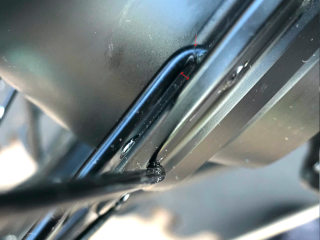
remember that if this is happening, the "maintenance" is probably breaking things further.I think the "deforming as others loosen up" might be what's happening. I suppose I could invest in some spoke wrenches as a maintenance tool in the interim.
I'd still recommend at least having a "universal" spoke wrench (something above the cheapest one you can find; many of those don't fit the nipples right and will damage them making it hard or impossible to turn them afterward) in your on-bike toolkit. In the event of a serious roadhazard interaction
you might still be able to retension a damaged wheel enough to make it home or at least to a destination vs walking while pushing the whole mess from the "middle of nowhere". Ah, the thing I love about Cookie Policy is it's a model 3 RW, using 26" wheels. I've used smaller wheeled cargo bikes before and I absolutely cannot stand the combination of small and fat.
bigger wheels have advantages, it's why I want to build a mk2 of SBC with 29" rear (and front), vs the 20" rear 26" front I have now, simply because of road degradation and that it is too complicated to create a good suspension on the trike that can deal with both fully loaded and unloaded conditions (cargo-wise).
They might not actually know anything about wheelbuildng, and may just knwo the technical procedures to do the truing, tensioning, etc.As far as the LBS goes, well, that's the rub. I like them well enough, but I have been burned before with other shops. They mentioned that the spokes were unusually big but didn't say anything about the spokes being too big for the rim when I inquired about wheelbuilding and asked if there were any nonstandard parts.
Lots of people know how to do a specific procedure in whatever technology, but have no idea why that is important, or why it must be done in some specific exact way. Plenty of airplanes have crashed or had serious but non-fatal inflight failures (up to and inlcuding engines falling off the wing) because the people doing the maintenance didn't know the why behind the thing they were doing, and figured that one way is just as good as any other.... :/
The hubmotor wheel. My two analog bikes that have had wheel problems were also rear wheel, although one of those was a Walmart bike.
My guess is that the loading on the wheels exceeds their ability to remain tensioned. In the case of the hubmotor wheel, I'd guess at teh previously mentinoed cause; for the others it could be they were never tensioned right to start with, or they weren't capable of the loading they had to handle.
I had one crappy BSO wheel I used on DayGlo Avenger's rear solely because it had a "solid" tire already on it, and I was sick to death of flats*** and in my cargo-bike usage the wheel literally fell apart on a ride.
***this turned out to be a bad idea and caused more serious failures than just a flat tire on every occasion I have tried them even on the lightly-loaded front wheel of delta tripper....
You don't need to drill the hub; you can bolt a new flange that has the right number of holes, to it's existing flange. Make the new flange as a ring that will correctly mate with the outer surface of the existing flange for full surface contact (depends on how that one is shaped if this is simple or complex), then the new flange ring will have an inner ring of holes to match the hub's flange holes, and an outer ring of holes to match the spoke count of the rim. The ring must be largen enough diameter and of the right thickness to deal with the spoke tension, and must fit the hub itself--and it's outboard side must clear everything that the hub spins past; it will make the lacing that much wider at the hub, so it may not fit every build this way.Plus, there is a company in Seattle that will drill IGHs to 48 drillings (voids the warranty, of course, but still), so if I really need to I could try and pick up a Nexus or Alfine. I would need to very very gentle with the shifting, though, hence my initial quest for an ordinary cassette hub first.
It is "simpler" to drill the hub, but it probably voids all warranties and if the hub was designed for the stresses of the spacing between holes it already has, and new holes are drilled between those, or closer to teh outer circumference of the flange, etc., it weakens the whole flange structure and this can then fail, splitting pieces of the flange off from spoke tension. (this stress is worse on a more heavily-loaded wheel, so....)
There are a lot of really good projects by many different people around here, depending on the job you need to do there is almost certainly something you can copy-while-customizing to your usage.I am definitely going to check out more of your projects, they are very fun and I am seriously impressed.
The way I recommend doing things is to define a job you need something to do, then finding the simplest least-complex system that will do that job but still has all the features you need to do it. The more complex the job, the more likely it will take a more complex set of tools packaged up to do that, and the less reliable it will be. Not always, but usually. :/The only ideas I've had for trikes have been what I call the "tadpole semi-truck", aka "what if a catrike had a long deck with a fifth wheel for a huge trailer".
I don't own any land, but if I ever do it would be cool to build a whole yard maintenance system up around a trike that also works as a trike.
I sometimes use SB Cruiser to help me move tree limbs and yard tools and whatnot during yardwork; if I had land (this is just a corner lot in the city, so not big) I'd build something specific for the purpose.

ZeroEm
🏍️ Giga poster
It's worth your time to read some of the wheel building threads here. You will learn why your wheels fail and build them back better.
You weight is not an issue. You learn not to cheap out on rims, spokes and take time to do it right and you will get a lot of trouble free miles.
If You don't want to build your own find the people that do good work. Most wheels on store bought is borderline good enough. My favorite people are Grin but the rest of the time is me and have not built but a couple and they are still rolling.
You weight is not an issue. You learn not to cheap out on rims, spokes and take time to do it right and you will get a lot of trouble free miles.
If You don't want to build your own find the people that do good work. Most wheels on store bought is borderline good enough. My favorite people are Grin but the rest of the time is me and have not built but a couple and they are still rolling.
Similar threads
- Replies
- 0
- Views
- 1,306

- Replies
- 5
- Views
- 4,460
- Replies
- 11
- Views
- 5,349

- Replies
- 28
- Views
- 16,451
- Replies
- 6
- Views
- 12,270