• Hello ES! We could use some help to get us past the finish line on building the new knowledgebase for the forum.
    Can you donate? Please see our fundraising page. Thank you!

eCVTs on EBikes

stancecoke

Minor legend
Joined
Aug 2, 2017
Messages
3,540
Location
Bavaria, Germany
The last Eurobike showed some prototypes, we discussed in the Magic Drive thread a little, but they are off topic there.
So I start a new thread.
I wonder, what is the efficiency of such a two motor setup, where one motor can run as a generator to set the wanted gear ratio and feeds the second motor that drives the bike :unsure:

In the age of big batteries the efficiency might be less important...

 
Same as digital drivetrain. 50% of your pedaling effort will be waisted. But humans do not contribute much if you use powerful motors controllers like over 1500 watts so 50% of human power is negligible so it will not change your mileage much


Here is a perspective of how little human can generate energy


With that being said it makes sense to design a powerful INNOTRACE eCVT motor controller for such motor. It does not make sense to use such motor with less than 1000 W of power at which humans contribution becomes more noticeable.
 
Last edited:
if you use powerful motors controllers like over 1500 watts
Even if your controller can deliver a peak power of over 1500 W, a bicycle (EPAC) will not use them, or only in rare situations for a very few seconds. I'm not talking about motorcycles with pseudo pedals. ;)
 
Last edited:
Was a recent thread here, but it got hijacked: CVT for pedal bikes

Bafang has an eCVT that works with their mid drives. Auto gear selection based on motor speed, torque, gyro etc... *correction, looks like theirs is referred to as a GVT (Gear Variable Transmission)
 
Last edited:
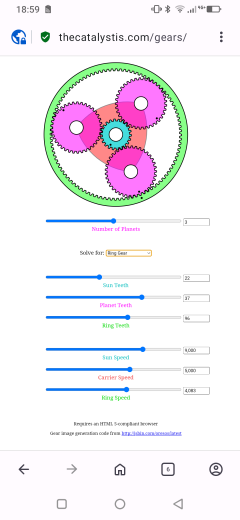
Here is a nice online tool to calculate the speeds of the sun gear, the planet carrier and the ring gear using the Willis equation. But I did not find an online tool, that calculates the resulting torques on each component :(
For the Magic Drive (hubmotor) the setup is
Ring gear --> rear wheel
Planet carrier --> sprocket/crank
Sun wheel --> motor

In the link above (middrive), it's what?!
Ring gear --> first motor, that is setting the gear ratio from crank speed to chainring speed.
Planet carrier --> crank
Sun wheel --> chainring and second motor, that's driving the chainring directly

but the labelling "torque motor" and "speed motor" seems to be misleading?!:unsure:

1784226180973.png


Screenshot_20260716-185906.png
 
Last edited:
It's possible hub motors and derailleur based hubs will disappear on most ebikes. If the ECTV prove durable and close in efficiency to other systems. Most people don't want to shift gears. I can't wait until I see some hill climb testing of these bikes really curious on what is possible. Hopefully it won't take long for a bolt on mid drive with this built into it.
 
Last edited:
I think these probably have a a lot of potential but the key I think is the conditions they are tuned for. You can adjust the gear ratios in various ways but in the end the key is to have as little energy as possible passing through the generator and into the motor because that is where your efficiency is lost.

And I think the system may actually work better than in hybrid cars because the goal here isn't to use a smaller battery which means you may sometimes need to use the generator to generate power from the engine to then run the motor to counter the engine torque. We can just use a large battery, same size as on any current E-bike and run the motor the whole time. We don't need the generator part unless we want to be able to adjust how much torque the rider puts in.

I do expect we'll see the dual motor/generator+motor (they are all both motors and generators) so that the motor connected directly to the pedal input can be used to adjust how much torque the rider needs to put in, basically you can change both how fast and how hard you need to pedal.

There are probably some efficiently losses I'm not considering though like when the motor has to run in reverse. And the controls to make it all feel nice will be a trick, people expect the pedaling to be harder when you start for instance and it's going to feel weird when it's not. I bet we'll see some fake pedal input torque curves to make it "feel" right.
 
It's possible hub motors and derailleur based hubs will disappear on most ebikes. If the ECTV prove durable and close in efficiency to other systems. Most people don't want to shift gears. I can't wait until I see some hill climb testing of these bikes really curious on what is possible. Hopefully it won't take long for a bolt on mid drive with this built into it.

My big problem with this is, how does it perform when the battery is out?
It's just a single speed with the wrong gear ratio, isn't it?
 
But I did not find an online tool, that calculates the resulting torques on each component :(
I thougt about that a little. For the planetary gear, the sum of all torques has to be zero, as we don't have any fixed connection to the housing. The torque on the pedals should be in the same direction as the torque on the chainring, as we don't want to pedal backwards for riding forward :) So the torque of the ring gear has to be negativ to fulfil sum of torques = zero.
Forward speed and backward torque means regen for a BLDC. (four quadrant operation)
1784275964364.png

If we want to have a similar gear ratio like on a typical 11 gear cassette (42 teeth chainring and 11-46 teeth cassette) the ratio is about 4:1 (42:11) So I've set the speed of the crank (planet carrier) to 2 and the speed of the chainring (sun gear) to 8. (Assuming the ratio of chainring to sprocket is 1:1 on this kind of system)

This leads to a positive speed of 0.61 for the ring gear with negative torque = regen.

1784275360687.png
 
Last edited:
a reserve amount of battery that runs the gear motor
The gear motor does not need energy, it produces energy! So as long as the battery is not fully charged, the motor can produce the necessary torque to withstand the torque from the pedals. But of course the torque/regen strenght has to be controlled by the motor controller. In case the motor controller is switched off, you will not be able to apply any torque on the cranks...

Of course, you could short circuit the phases wires of the gear motor by a relay, that's closed if not powered. In this case, it takes a great deal of force to move the motor shaft and you can transmit torque from the pedals to the wheels. This would be some kind of "limp-home mode"
 
Last edited:
The gear motor does not need energy, it produces energy! So as long as the battery is not fully charged, the motor can produce the necessary torque to withstand the torque from the pedals. But of course the torque/regen strenght has to be controlled by the motor controller. In case the motor controller is switched off, you will not be able to apply any torque on the cranks...

Of course, you could short circuit the phases wires of the gear motor by a relay, that's closed if not powered. In this case, it takes a great deal of force to move the motor shaft and you can transmit torque from the pedals to the wheels. This would be some kind of "limp-home mode"
I got this off the manufacturers site they claim it needs power to shift and wouldn't the drive motor be doing the Regen braking.
 
they claim it needs power to shift
Only power to run the controller. If the battery is completely empty and the BMS switches off the supply, you would have to turn the pedals with enough speed, that the BEMF of the gear motor is sufficient to drive the controller. And of course the hard- and firmware has to be so clever to start up the controller, if a voltage about 12V is applied. About 12V are needed for the half bridge drivers to work.

Of course all my statements are from theory, no idea, how it is solved on a commercial product....
 
Last edited:
A direct drive is quit. Bafang middrives are coffee grinders, some more, some less. I did a lot of test rides with various Bafangs the last weeks and month;)
I only heard mine over normal tire and chain sounds from the bike when it needed grease or when I was lugging it at low speed and high load. It was quieter than a hub motor using a square wave controller. My buddy's hot rodded BBSHD makes more noise, about the same as a geared hub on square wave. I would not call it noisy. Even that is very quiet compared to a Cyclone 3kW or a Heinzmann brushed hub motor.
 
I think there was a requirement under the European standard EN15194 2017 that the bike can still be peddled if the assistance fails. Would this meet this requirement or pass the test below?

PS According to Google AI, the test involves something like below
  • a) Remove or completely disconnect the battery pack from the bicycle.
  • b) Ride the bicycle to accelerate and maintain a speed of up to 10 km/h.


Failure Mode.jpg
 
Last edited:
I think there was a requirement under the European standard EN15194 2017 that the bike can still be peddled if the assistance fails. Would this meet this requirement or pass the test below?

PS According to Google AI, the test involves something like below
  • a) Remove or completely disconnect the battery pack from the bicycle.
  • b) Ride the bicycle to accelerate and maintain a speed of up to 10 km/h.


View attachment 390572
You could pedal it just will not shift it needs a battery to shift is why if you run it down they will cut battery to the drive motor and save some for the gear motor so you can shift.
 
but the labelling "torque motor" and "speed motor" seems to be misleading?!:unsure:
There is a quite detailed animation on the Owuru hompage.
This concept is eliminating the main advantage of a middrive o_O. It doesn't use "the gears" to keep the main (big) motor in an efficient speed range on low speeds uphill, as there is a fixed connection between the main (big) motor and the little chainwheel. Or am I completely off the mark here?

1784552677956.png

1784552262490.png

1784552114242.png
1784552581060.png
 
Maybe when the center motor is going in a direction that tends to drive the outer ring in reverse, the outside motor experiences a lower gear. To make one rpm of the wheels the outer motor then has to rotate through every tooth it normally does, plus it has to undo all the teeth the center motor driving the outside ring in reverse took up. So effectively it needs to go through more teeth to achieve one wheel rpm.

Then for a higher gear you just do the reverse. Run the center motor in the opposite direction (could be the same direction as the outer motor since the planets might reverse the effect). Then the outer motor will have to account for fewer teeth on its own to achieve one wheel rpm since the gears are spinning forward without it anyway.
 
There is a quite detailed animation on the Owuru hompage.
This concept is eliminating the main advantage of a middrive o_O. It doesn't use "the gears" to keep the main (big) motor in an efficient speed range on low speeds uphill, as there is a fixed connection between the main (big) motor and the little chainwheel. Or am I completely off the mark here?

View attachment 390702

View attachment 390700

View attachment 390698
View attachment 390701
Looks like a lot of plastic in their, wonder how hot it can get with 2 motors in a confined space.
 
Back
Top