• Hello ES! We could use some help to get us past the finish line on building the new knowledgebase for the forum.
    Can you donate? Please see our fundraising page. Thank you!

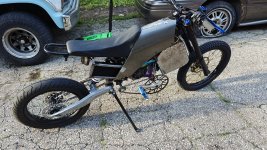
Joe's E-bike build

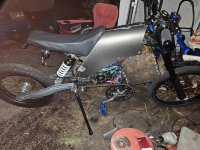
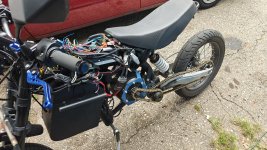
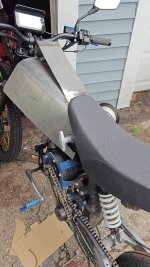
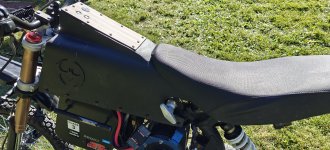
I started making a cover for the controller.1000005446.jpg
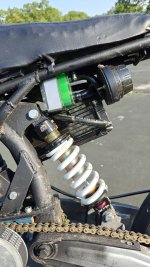
It's made from the drivers side front fender of an 03' LeSabre. Still haven't painted the bike yet. I put a DNM rear shock on it because the other ones were just too soft. The old ones had 250# springs and the new single shock has a 1000# spring. It's stiff but I'll be using this for groceries etc... so the extra weight capacity will be needed. I'm planning on putting bags on the sides of the seat.
1000005452.jpg
I put a big spring inside the fork to stiffen it up. I got the spring from work. It goes into a folding cafeteria table to assist the user in folding it up. It was about 3ft long but I cut it to the right size and it ended up working out. The tire doesn't rub the battery anymore but I'm still going to stretch the frame out about 2" when it comes apart for paint. I need room for a fender and I'd just feel better knowing the tire has plenty of clearance.
1000005451.jpg
I've been riding it on the weekends when I go to the garage to work on it. I ran the battery low one day and pedaled it without the motor about a mile. Even with the gigantic front sprocket the ratio to the wheel is pretty short. I can only go about 10mph with the pedals. It would be better if I had a way to disengage the motor. However, they are usable and its actually quite comfortable to pedal with the pedals being out in front of the rider.
1000005444.jpg

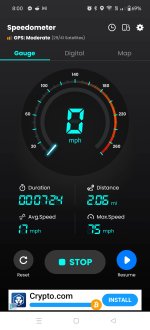
This is a screenshot from the top speed run I did. I only held this speed for a short time. I don't think it's smart to go this fast on the BMX front tire. The sidewall is too soft. The bike was actually very stable at that speed but I'm sketched out by the tire. Had to test it out though now that I'm more confident on it. Overall, it rides pretty good. I sit upright and it's comfortable. The turning radius is wide with so much rake. It has tons of torque even with the small controller. It's a far driver nd72360. 180 line amps and 360 phase amps. I think that's more of a peak rating honestly. It won't wheelie but from about 20mph on up it takes off like a bat out of hell if you give it full throttle. When I chose the pulleys and sprockets I sized them for the peak torque to be in that range. Video coming soon.
 
No video yet. Planning on ordering a GoPro this week. I have the cooling system set up now.1000005524.jpg
The water pump is 12v and runs off a buck converter along with the lights. There's no reservoir although I may end up adding one in the future. It seems to work well this way. The square thing with the acrylic sides is a flow meter for PC water cooling. The fitting on the top is a barb with a rubber cap on it. That's where I fill the system. The air bubbles settle in the flow meter and I have enough hose there to move it around and get the bubbles up to that top fitting. It took a couple days before they all worked their way up there.
1000005525.jpg
That's the radiator there on the side below the seat. The pump pulls coolant from the bottom of the radiator pushes it through the flow meter and then through the motor and back to the radiator. I'm planning on making another sheet metal panel with louvers to cover the radiator and help direct air through it. I just have a button to turn the pump on and off. The plan is to add some kind of thermostat to the circuit so that the pump only runs when it's needed but I haven't been able to significantly heat the motor no matter what I do. I don't think the controller is powerful enough to get it to that point. The motor gets warm to the touch but barely. The top speed run was done before I had this set up. It didn't get hot at all even with no water cooling.
1000005523.jpg
I put a shinko 241 2.75x18 on the 22" BMX rim on the front. It's heavier but it's much better. The bike handles better and I don't feel the sidewall folding on sharp corners now. I'm loving that tire! It was a little tough to get it on the rim with the big motorcycle tube in there but I got it on there and the bead seats well.
1000005526.jpg
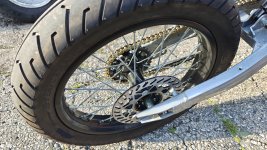
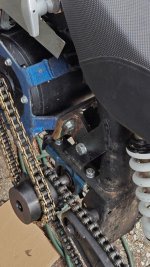
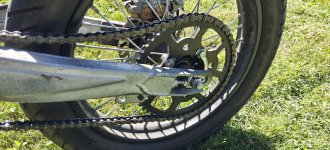
I also switched out the wheel setup for this pit bike wheel. Same tire from the old wheel. It's a little heavier but not by that much compared to the 20" BMX rim with the moped hub, although that's not taking into consideration the weight of the caliper that will go with it. Originally I planned to use the freewheel on the moped hub for the pedals but my plans changed and I no longer needed it. This disc brake setup should be better than the drum brake on the moped hub. This thing needs all the braking power I can get. I didn't start fabbing the caliper bracket since I was working on that blue f150 in the background this weekend. Ball joints and suspension bushings ate up most of my time. I also switched to a 420 chain since the pit bike sprockets are all 420 or 428. I'm planning to do some experimentation with different sprockets. Originally it had a 22 tooth on the motor, 40 tooth on the input of the jackshaft a 19 tooth on the output of the jackshaft and a 31 tooth on the wheel. Now it's 22,40,18,35. Very close to what it was with the old wheel setup but I have a lot more options now that I don't have to modify sprockets to fit the wheel. The sprocket I modified for the original wheel was slightly off center because I couldn't drill the holes perfectly. The bike feels smoother now and is also quieter. I do miss the look of that giant 530 chain though 😁
 
A couple videos of the bike from my backpack strap mounted GoPro. I'm not real good with it yet. The angle kind of sucks at certain points.
I kept it around 30mph In the second one because that's as fast as the motorized bicycle(aka the brapsicle) goes.

For the record, I don't typically ride this on trails meant for normal bicycles for obvious reasons. In this case we felt it was safe because the trail is flooded and, generally, nobody goes down there when that happens because the end of the trail is the lowest point and ends up under 4-5ft of water.

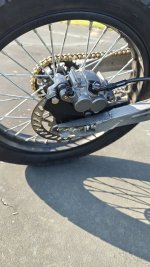
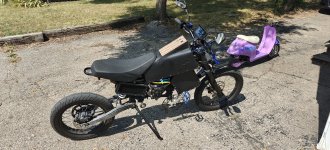
Since the last post I've added a few things to the bike. It has a front fender, turn signals, rear disc brake finished, paint, the battery is sealed with RTV and coated entirely in flex seal, removed coolant flow indicator and installed coolant reservoir instead, and added box like structure on top of the fairing/cover for the switches.
1000007449.jpg
1000007453.jpg1000007452.jpg1000007451.jpg1000007450.jpg1000007454.jpg1000007455.jpg

Those last two pics are from the day I painted the frame. The cooling system and brake caliper are not present.

I made the rear caliper bracket out of the thickest flat stock they had at Menards. It has a bushing welded into it and the axle goes through it. The part that extends forward has a slot in it that engages the big pin on the inner part of the swingarm. It can slide forward and back with the wheel to allow adjustment of the chain. The caliper is a front caliper for a Honda application.

The swingarm will be painted at a later time. I may need to weld something to it first. That's why I didn't bother taking it off or masking it when I painted the rest of the frame.

I've been searching for new forks. I think they need an upgrade. These are the $250 knockoffs from AliExpress and I don't totally trust them. The tubes flex somewhat and it makes me nervous. Is that normal? I've been trying to find some trials bike forks or something along those lines. Something stronger but still on the lighter side weight wise. Provisions for dual brake calipers would be awesome too and I see a couple mountain bike forks that have that. I think two of the Magura calipers would be sufficient for the bike. Not sure how much beefier those forks really are though. Motorcycle stuff may be the way to go if I'm going to drop the change for nicer forks. It would be convenient if I could find something that would fit in the existing triple clamps(42mm tubes) but there are other routes I could go too. Does anyone have recommendations?
 
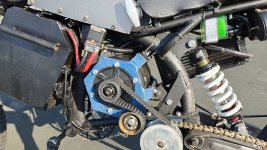
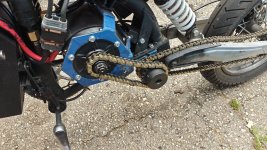
I put a fardriver nd721800 on the bike. I initially set the line amp setting to 400 amps. The belt stripped and broke when I gave it half throttle. It tore the teeth off. So I replaced the belt and set the tension extremely tight. It was still doing the same thing so I switched to a chain
IMG_20240804_202018.jpg
The chain was able to handle slightly more but the chain was jumping too! So I've determined that it's the amount of flex in the motor mount bracket causing the problems. I haven't done anything to strengthen it yet but that's going to be my next move. The QS138 has a ridiculous amount of torque at 400amps! The motor bracket is not thin steel but it's bending it like it's cardboard. Part of the problem is due to my low gear ratio. The chain/belt driving the jackshaft sees much more torque than it would if I geared it shorter. So, I could just put a larger sprocket on the wheel and I'm sure most of my problems would go away, however, the motor RPM stays low with the current setup and I like it that way. The motor stays very cool and it's very efficient while just cruising around at sane speeds(which is the primary purpose after all) 😉. With the chain setup I have a 13t on the motor and a 20t on the jackshaft. 20t and 35t on the wheel chain. This setup is a 2.69 ratio. The bike still pulls like a bat out of hell and reaches 70mph+ easily. I have to say that I'm very impressed with the QS138 having come from a background in ICEs and never having built anything electric like this.The torque is insane!

I also put a different seat on it which I think is much better.1000011031.jpgthis is a Chinese ATV seat. It even has a little latch on the bottom for easy removal which was pretty simple to adapt to the frame. I no longer have to unbolt the seat and it's much more comfortable being so much wider.

I have a shinko 244 for the rear as well. Although I like this street tire a lot and it seems to be lasting, it is utterly useless on dirt or grass or anything other than pavement. I guess that should have been obvious to me when I bought it but I didn't forsee the potential situations where I would actually want to ride on other surfaces. Now I do so I'm going to try the shinko out. I hope it does well on wet pavement. That is my only concern about it. The street tire is excellent on wet pavement.

I'm pretty sure the extra torque has loosened some of the spokes on the rear wheel too. I never had trouble before but I checked earlier today before riding it and some of the spokes were loose. I guess it could've been a bad hit too but I don't recall anything out of the ordinary happening since the last time I checked. I tightened them and the wheel is still mostly true although it has never been perfect and could actually use some work. It's not a high quality wheel. Just a generic Chinese steel wheel.
 
Last edited:
I'm pretty sure the extra torque has loosened some of the spokes on the rear wheel too. I never had trouble before but I checked earlier today before riding it and some of the spokes were loose.

It's not torque. It's not impact. It's that the spokes are too thick, and/or the tension wasn't turned up high enough to begin with.

Most Chinese motors are laced to rims with spokes that are way too thick to maintain tension under ordinary riding loads. There's no remedy except to relace them with thinner spokes.
 
Haven't updated this thread in awhile. The bike still isn't 100% done. It's starting to cool down here and winter will be here soon. I've decided that it's probably best not to try and ride this in the snow. I'll probably put her away for the snowy months.

Updates:
Made a stronger motor mount because the old one bent/twisted from the torque.
1000012775.jpg
This is the old mount. It's clearly not strong enough.
1000012779.jpg
The new one isn't adjustable and it's made from much thicker steel. I have zero flex issues now!

1000012777.jpg
Constructed a new cover for the wiring and the larger controller.
1000012683.jpg
I rode it to a local flea market and found the bat emblems there. The guy selling them had a ton of different shapes he cut out with a plasma cutter. He was selling them for $1 a piece. I had to grab them since the "bat cycle" name has kind of stuck with the bike now.

1000012841.jpg
I put fastace forks on it. This meant that I had to get rid of the bicycle wheel on the front. I couldn't get the bigger caliper to work with the bike hub easily. It needed a better brake on the front so I put a 17" pit bike wheel on it with a shinko 244. The scratches you see in the black spray paint as well as the bent chainring are from a small accident I had a couple weeks ago. I gave it a little too much coming out of a turn in the rain and low sided. I wasn't severely injured. Just some road rash. I was wearing the new helmet I bought a couple weeks prior. The bike was not damaged much either. The pedals act like frame sliders. These forks are a vast improvement over the old ones. I feel much more confident in their strength as well.
1000012842.jpg

I put the same Honda style caliper on the front that I have on the rear. I had to fabricate an adapter. It still needs a little bit of smoothing on the corners and paint. You can see the yellow paint marker still haha. No more brake fade when stopping from 60+mph.
1000012843.jpg
I put a 53 tooth sprocket on the back. It has so much torque like this that I can't give it full throttle from a stop. It will loop. Easily does wheelies with this setup. I think it's too much though. It still gets to 83mph like this but there is much less torque on the top end. The motor gets too far out of it's efficient RPM range. I have another sprocket to try when I put the shinko 244 on the rear. It's a 41 tooth I believe. I think that will give me a happy medium between the super low gearing I had originally and the gigantic 53 tooth.

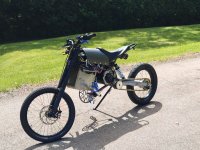
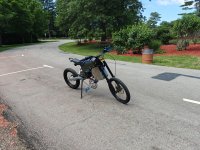
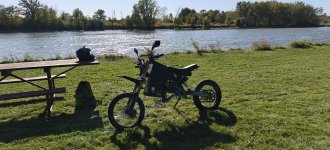
Just a few pics of the bike I took at a park the other day.
1000012844.jpg
1000012846.jpg
1000012847.jpg


Chalo, I think you are dead on with what you said about spoke thickness and tension above. When I got the new wheel for the front I went over the spokes and made sure they were all tightened properly and the wheel has stayed true so far. With the rear wheel I only gave the spokes the squeeze test but I don't think that was enough. The aluminum bicycle wheels I built for it originally took many very hard hits(nasty railroad tracks around here) and never skipped a beat. Even with the thinner bicycle spokes. Very strong wheels and lightweight compared to these steel ones.
 
It's not torque. It's not impact. It's that the spokes are too thick, and/or the tension wasn't turned up high enough to begin with.

Most Chinese motors are laced to rims with spokes that are way too thick to maintain tension under ordinary riding loads. There's no remedy except to relace them with thinner spokes.
Do you know how I determine the condition of the spokes on my rear wheels with 12 kg motors? I hit them with a small screwdriver like a Romanian musician hits cymbals with hammers and determine by ear the spokes that need to be tightened, this is the most accurate way to maintain the same tension of the spokes, you will not find a more accurate one:D.https://www.youtube.com/watch?v=N63gikqYyWI
 
I hit them with a small screwdriver like a Romanian musician hits cymbals with hammers

Cimbalom! What a cool instrument. I knew a guy in Seattle who was a formidable beast at playing his.

and determine by ear the spokes that need to be tightened, this is the most accurate way to maintain the same tension of the spokes, you will not find a more accurate one:D.https://www.youtube.com/watch?v=N63gikqYyWI

That's a very good technique for discerning relative tension between spokes, but there are so many factors that affect pitch that it can't tell you really anything about absolute tension.

Even when all the parts are brand new, the components in a wheel are never so perfect that uniform tension results in the wheel being true and round. It's the discrepancies (hopefully small ones) in tension that force the rim into its correct shape.
 
Last edited:
Do you know how I determine the condition of the spokes on my rear wheels with 12 kg motors? I hit them with a small screwdriver like a Romanian musician hits cymbals with hammers and determine by ear the spokes that need to be tightened, this is the most accurate way to maintain the same tension of the spokes, you will not find a more accurate one:D.https://www.youtube.com/watch?v=N63gikqYyWI

I've never seen anyone play one of those. That's awesome and I loved the song he played at the end! Thanks for putting that link in here it made my day better.

That is exactly the method I used. Some of the spokes on the new front wheel were very loose. I tightened them all to what I felt was slightly looser than perfect using that method, then went around the wheel tightening a spoke here or there to get the wheel as true as possible. I did it on the bike with the front wheel off the ground, using zip-ties as my reference points. Rode it, then trued again. It was already very very close to true when I got it but the tension of the spokes was all over the place. I haven't had any issues with it yet. With the back one, I squeezed them and they all felt tight enough. It was pretty straight, so, I just left it. After a few rides I noticed some loose spokes and that the wheel was wobbling. I have since tried to true it up again but it's still pretty bad. It causes some weird oscillations at higher speeds on certain roads. I'm probably going to replace it. I want to switch the rear hub to a wider one to allow more clearance for a bigger tire. As it is right now, a wider tire would come too close to the chain. I'm having difficulty finding a hub that will work well though. The main problem is the 15mm axle. That's an uncommon size for motorcycle axles. Most of the hubs I've been finding in my searches have 20mm or 22mm axles. I may end up buying one of these hubs and swapping out the bearings to fit the 15mm. I need to do more research to find out if that will work the way I'm thinking it will. Plan B is to re-lace the hub I have with a dish and use different spacers to move the sprocket over. I've yet to do a dished wheel though. It seems challenging.

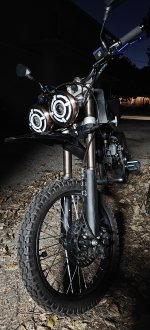
I put new lights on it last weekend. The white circles and the cross shape are DRLs and also change to amber for the turn signals. I felt like the small turn signals on the fender mount weren't getting peoples attention.
IMG20241020185211.jpg
I also ordered turn signals for the rear as well as more brake lights. I was nearly rear ended by a woman on her cell phone in a rural road just outside of town. I was in the traffic lane, about to make a left turn and I could see that she was not slowing down despite me signalling and lightly squeezing the brake handle just enough to illuminate the brake light. She was looking down. I pulled over onto the shoulder before braking and sure enough she didn't see me until what would've been the last second. Although I was totally out of her path by this time, she slammed on her brakes and pulled up right beside me where I was rolling at about 5mph to give me a startled shrug and an exaggerated look of confusion. Cell phone in hand and child in the passengers seat. I'm so glad I bought those mirrors. My brake light has amber turn signals too but I don't think they are visible enough in bright sunlight. I'm going to make a mount for the new ones similar to the one it has in the front right now. A piece of tubing with nuts welded on the ends and ground smooth. I am always vigilant of what is behind me but imagine if there had been another vehicle behind her when she abruptly slammed on her brakes in a panic the way that she did. Could've been a bad situation for everyone. I was disturbed by the incident because, although she seemed to be on her cellphone and not paying attention to what was going on in front of her, I can't help but blame myself as well considering that I'm knowingly riding an unusual vehicle with possibly inadequate lighting installed. I can do more to be safe.
 
It's been quite awhile since I've posted any updates in this thread. I'm still around and so is the Batcycle! I rode it daily through the winter including my 30 mile weekly trip on the weekends. It was pretty rough some days. Heated gloves and Carhartt overalls were my best friends. The battery (20s10p molicel p42a for those who followed this in the past but may have forgotten) performed beyond my expectations through the cold weather. The heat press foam and silicone sheets I cover the pack with inside the steel housing provided enough insulation to keep the battery warm for the entire 30 mile trips. I was able to deplete the battery completely without it getting too cold. This was a surprise, because my intentions with the foam and silicone were not to thermally insulate but to electrically insulate only. It ended up serving a dual purpose. By the end of my rides, the pack was around 50* from about 78* room temperature indoors. When there was significant snow coverage I deflated my shinko 244s to about 10psi cold. They sag under the weight at this pressure but provide good grip and don't unseat from the rim. Slides were controllable and predictable. I had a couple close calls but the bike stayed upright all winter miraculously. No wipeouts! I put an antifog pin lock insert on the inside of my helmet visor and that worked great. I would get condensation on the inside of the helmet but the visor always stayed clear. The battery even performed well when I did let it get cold too. I would leave the bike outside when I was at work and it would get down to 20* or lower some days. There was noticeably more voltage sag on my ride home of course but the molicels have no problem operating below freezing on a regular basis. If I tried to pull more than 200A or so, the voltage would sag too much for my comfort, but what do I need 200A for in the winter anyway? 😁 I have 154 cycles on the battery as of today and I have not noticed any difference in range at all. I did not charge the pack when it was cold. Ever.

I have a new shop now. Me and a couple friends are renting a small building to work on our projects and make a little side money. I'm planning to build Batcycle 2.0 this summer. I'll be building a new frame and transferring over the old forks and motor.
1000019095.jpg
I put together this hydraulic tubing bender at the new shop! I'll be using this to bend my new frame and probably more.
1000019096.jpg
It's a cheaper bender from eBay. It's exactly the same one you will get from Woodward fab's website but not painted and it's cheaper. I fabricated the mount for the hydraulic ram and it runs on a Ford power steering pump from a crown Victoria.
1000019097.jpg
I connected the power steering pump to a 1hp electric motor and bypassed the internal pressure relief valve in the pump. I also drilled out the orifice in the flare for the pressure line for more flow. The 2 gallon gas can is The fluid reservoir. The result?
1000019098.jpg
That's .120 wall 1.5" DOM 1026 tubing. It's noisy but it works and I spent a little over $600 for the whole shebang.

The new frame will be roughly based on the dimensions of the current frame but with added strength. I will be improving the pedal setup so that it actually works right and doesn't eat freewheels anymore. Putting the freewheel on the jackshaft was a mistake because it spins much too fast. The freewheels wear out and fail. I will be going back to a belt on the primary drive side of the jackshaft. I have 50mm wide 8m pulleys that I will be using. The original setup used a 25mm wide belt and it failed. I think much of the reason for the failure was due to flex in the motor mounting which caused the belt to skip and shred up but, to be on the safe side I went with the 50mm belt. I believe that's the widest 8m belt that exists. Beyond 50mm it goes up to 14m belts. I'll need all the strength I can get because I plan to build a larger more powerful battery for the new frame. I have less need for The battery to be removable now because I figured out how to make an adapter to charge the bike at EV charging stations. It's much faster charging there because the EV stations are 240v with at least 30A available.
1000016185.jpg
50A charger
I posted a writeup on how to construct the adapter on reddit if anyone is interested in reading it https://www.reddit.com/r/hyperebikes/s/oc8qYRDw6I
1000017237.jpg
1000017221.jpg
1000017088.jpg
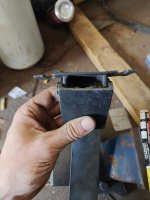
The new battery will be a little bit larger. Probably 12 or 14 parallel groups and I'm hoping either the Molicel p60b or the EVE 50PL is available by then. If higher capacity cells aren't available I may just stick my current pack into the new larger case until the better cells become readily available. I'm planning to build something with 800A burst capability so I can turn my controller up to the max current setting. This weekend I'm heading to the steel supply place to get square tubing to make a legitimate frame jig. This time the frame will be square, and the backbone will be one continuous piece of tubing instead of three pieces welded together! No more eyeballing it on the garage floor. I may start a new thread for the new frame since this has evolved into something that probably belongs in the motorcycle section anyway. I will detail the whole thing.

 
Didn't see your build till now. Impressive work!

I have a question about your starter solenoid/ car battery spot welder.

1. How many Ah is the battery?
2. How strong / consistent were the welds? Did you do any peel tests?

I bought a Ford starter solenoid from Ebay to do some tests with but it arrived DOA- coil was open circuit. I sent a video to seller, got a full refund w/o needing to return it.

Took mine apart trying to fix it but unable to. The plunger seems to be part of the pull in coil circuit. I bent the wiper so it makes contact to the terminal w/o wire but the coil circuit is still open. This solenoid is cheaply made, all the copper colored parts are magnetic = copper plated iron!

I am looking to buy another one that works. Which one did you buy?
 

Attachments

  • IMG_0041.jpeg
    IMG_0041.jpeg
    1.6 MB · Views: 7
Didn't see your build till now. Impressive work!

I have a question about your starter solenoid/ car battery spot welder.

1. How many Ah is the battery?
2. How strong / consistent were the welds? Did you do any peel tests?

I bought a Ford starter solenoid from Ebay to do some tests with but it arrived DOA- coil was open circuit. I sent a video to seller, got a full refund w/o needing to return it.

Took mine apart trying to fix it but unable to. The plunger seems to be part of the pull in coil circuit. I bent the wiper so it makes contact to the terminal w/o wire but the coil circuit is still open. This solenoid is cheaply made, all the copper colored parts are magnetic = copper plated iron!

I am looking to buy another one that works. Which one did you buy?
Thanks! It's been a long journey and I've learned a lot!

I bought my starter solenoid and the battery from the local O'Reilly's. The battery isn't anything special. It's a larger car battery but it's a cheapo. I believe it's 65Ah. As for the solenoid, there are many variations of the Ford style solenoids. Some are a lot nicer than others as you have discovered. I believe this is the one I bought https://www.oreillyauto.com/detail/...nition-4-terminal-starter-solenoid/std0/ss581
Also, note that a key part of the design is to use a separate power supply to power the solenoid and the relay triggering it. This takes voltage sag and state of charge of the battery out of the equation and gives you consistent results. I used a small 12v DC SMPS I had on hand. I did do a lot of tear tests as I was experimenting with different sized capacitors for the simple timing circuit. Once I determined the correct sized capacitors I was getting excellent welds every time. I think a large factor which is commonly overlooked with any spot welder is the electrodes and the cables. The cables need to be huge. If your cables are jumping significantly when you make a weld then they're too small. I also noticed that sharpening the electrodes too much made it more difficult to get the correct pressure consistently. With sharp points on the electrodes I was getting more sparks and blowouts. A wider, more blunt tip seems to work best. I was cleaning up the tips every so often with fine grit sandpaper to maintain the shape of the tips. The welds were very strong. Initially, I was welding test tabs to washers and doing tear tests with the washers. I was using zinc plated steel washers. Once I got results I liked with the washers I tested it on some junk 18650s I had on hand. I got very similar results on the 18650s and so I moved on to the real cells. It worked great and I've actually used that same setup to build a couple other smaller packs for various things since I did the big pack for the bike. There are probably better spot welding setups, the main reason I used that particular method is because my cheap spot welder board failed after an accidental short, so I threw that battery welder together from parts I sourced locally and some things I had laying around. I was determined to get that pack built that particular week so I could get the bike going that weekend. It was surprisingly successful!
 
I've also just noted, cool build! Did you weigh it recently? I'm curious what it came up to finally.

Also side note, but a water cooled 138-90H is such an overkill, lol. I'm not surprised it twisted the first set of mounts and wheels.
 
Back
Top