• Hello ES! We could use some help to get us past the finish line on building the new knowledgebase for the forum.
    Can you donate? Please see our fundraising page. Thank you!

Lebowski's motor controller IC, schematic & setup, new v2.A1

Is there a data stream from the Lebowski? I've been playing with VESC based controllers. But I have a board on the way for a Honda IMA inverter. I've been developing a ESP32 screen display for the VESC, but I'd like to port it over to use with the Lebowski. If there was a stream of data that contained Battery voltage, Wattage, Motor temp, controller temp, phase amps, total amps, and speed. That would match what I'm working on. The speed/distance, if I had RPM, I could perform a calculation in the esp32 to display that.
 
At present the open source firmware it has doesn't have a data stream with all that info that I know of...but it supports canbus for throttle sharing already, AFAIK (like master/slave, IIRC), so if it already monitors the specific things you're looking for, you could simply add code that sends all that out as often as you need it to.

If it doesn't monitor it yet, you can add *that* code. ;)

I still can't code myself out of a wet paper bag, so I can't really help with that, but if your'e working on an ESP32 display project, you can probably figure out Lebowski's code well enough to do it, then add that to the open-source codebase. :p


Is there a data stream from the Lebowski? I've been playing with VESC based controllers. But I have a board on the way for a Honda IMA inverter. I've been developing a ESP32 screen display for the VESC, but I'd like to port it over to use with the Lebowski. If there was a stream of data that contained Battery voltage, Wattage, Motor temp, controller temp, phase amps, total amps, and speed. That would match what I'm working on. The speed/distance, if I had RPM, I could perform a calculation in the esp32 to display that.
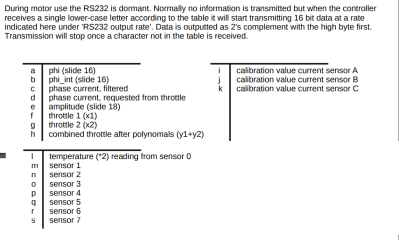
The latest manual is on page one of this thread. There is a list of data types that can be streamed over serial in there somewhere. Just be aware that the data is big endian 16 bit format.
 
The latest manual is on page one of this thread. There is a list of data types that can be streamed over serial in there somewhere. Just be aware that the data is big endian 16 bit format.

I just pulled down the source code and have made some initial changes to it. I'll try to develop this more when I get mine up and running and try to merge the two projects together. It looks like voltage is monitored internally. So at least the current, voltage, and wattage are a possibility out of the gate.
 
This section? If I understand correctly, it will only send one data type at a time, so wouldn't do what was requested without changing the coding? Or maybe I"m missing something....happens a lot. :oops:
View attachment 375879

The data is transmitted in a serial stream. Say for instance there is a frame of data transmitted with four different types of information and a delimiter to signify the beginning of the data frame and thus the positions of the four variables you are interested in. How many of those bits of data can you access at any one instance of time. The answer in this specific case is one. To extract the data you could put the data into an array and based on the delimiter extract the data one piece at a time using an index. No less expensive in computing cycles in any meaningful way than simply sending a new data type request and getting what you want when you want it.
 
I just pulled down the source code and have made some initial changes to it. I'll try to develop this more when I get mine up and running and try to merge the two projects together. It looks like voltage is monitored internally. So at least the current, voltage, and wattage are a possibility out of the gate.
That sounds great, I will interested to see what you come up with.
 
The data is transmitted in a serial stream. Say for instance there is a frame of data transmitted with four different types of information and a delimiter to signify the beginning of the data frame and thus the positions of the four variables you are interested in. How many of those bits of data can you access at any one instance of time. The answer in this specific case is one. To extract the data you could put the data into an array and based on the delimiter extract the data one piece at a time using an index. No less expensive in computing cycles in any meaningful way than simply sending a new data type request and getting what you want when you want it.
Ah, thanks!
 
Back
Top