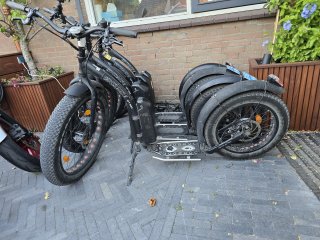
Okay, so today my geared hub died... Time to upgrade.. :)

dutchlincoln

⚡ Regular
Joined
Sep 27, 2011
Messages
189
Hello.

I have 2 (ok, now already 4) Electric Footbikes that i'm slowly upgrading (see my other threads)

One i have equipped with a controller from Topbikekit T09S, and it runs acceptable. Some minor details to be tuned. Gas response is dead on the first quart, and kicks in in the middle to max. Need to sort that out to have the full 270 degrees in speed control.

The other has a geared hub, and i bought a controller locally on the marketplace. (A Hudamzky controller) A bit bigger, 30 Amps continuous. (12 fet i guess where the KT is 9 fet) After install i heard the motor spinning but the wheel wasnt moving. it looked like the magnetic field was turning and not strong enough to turn the wheel. or something like it.. Adjusted some settings here and there, and after that it worked. Did auto tune, and voila.

Anyway. Did a nice trip with it yesterday, and it was a tad faster than the other bike. We did over 40 kilomters with it.
Today we wanted to get a lunch and do some groceries, and after 4 kilomters there was a loud noise and no drive.
I lifted the rear wheel, and the wheel spinned freely forward but a bit tougher backwards.
Tried a few times, and when i slowwwwly increased throttle, it took the wheel again, but with quite some noise.
We turned around and went home to get a other footbike. 6-8 km/h was max achievable.

I havnt opened it yet, but i think the geard and/or motor are toast.
Is it wise to rebuild, or just throw away?

So, my planned new hubmotor with rim need to come quite faster as planned....

I'm thinking about a 9C RH212. Any comments on that?

For the comparison:
I have a 36Volts 250watt motor now running on 48 volts. Its not speed that i'm after, its torque. Wheel is 20 inches with a 20"x4" fat tire, 135mm opening width.
I want to have a decent range left, and i aim for 26-27km/h normal (legal)limit, and 30km/h max speed (no problem if it goes a bit higher as i can limit the controller, as long as it doesnt hurt efficiency....)

Reason for the 9C is the bigger diameter, running 26 magnets instead of the usual 23, helping torque here.

I know a lot more than i did a few weeks ago, but compared to many here i still know nothing at all, so shoot, comment, and advise please :)

Thanks!


Dutch.

ps. I started with the idea of a Grin controller, but when all options are added its a quite pricey controller, and i think a bit overkill for my purpose. Now, im looking at VESC, Flipsky, Spintend, and Fardriver. Any recommentations here? (or do-not because....?) I don't need PAS or torque sensor (as i have no pedals... :) )
 
Last edited:
RH212 is an absolute beast of a motor and weighs 14lbs / 6.3kg
Absolute overkill for an effective 22 inch wheel.
Will easily hit 100km/h given the right voltage and produce more torque than you know what to do with outside of a dragstrip.

Because you have a 22 inch effective wheel, a 500w rated geared hub motor, given the right voltage to hit the top speed, with some phase amp increasing, could result in very strong torque. The smaller the wheel, the more torque/power potential is available on a hub motor :)

Your initial torque problem is very likely to due with controller settings. most stock controllers come with a crappy tune.
More phase amps is the ticket, but i don't know if you can tune that parameter on this controller.

I wrote a good article about basic controller tuning that could be helpful.
Knowledgebase

As for the existing motor, it'd be helpful to open it up and see it's guts.
 
Hello.

I have 2 (ok, now already 4) Electric Footbikes that i'm slowly upgrading (see my other threads)

One i have equipped with a controller from Topbikekit T09S, and it runs acceptable. Some minor details to be tuned. Gas response is dead on the first quart, and kicks in in the middle to max. Need to sort that out to have the full 270 degrees in speed control.

The other has a geared hub, and i bought a controller locally on the marketplace. (A Hudamzky controller) A bit bigger, 30 Amps continuous. (12 fet i guess where the KT is 9 fet) After install i heard the motor spinning but the wheel wasnt moving. it looked like the magnetic field was turning and not strong enough to turn the wheel. or something like it.. Adjusted some settings here and there, and after that it worked. Did auto tune, and voila.

Anyway. Did a nice trip with it yesterday, and it was a tad faster than the other bike. We did over 40 kilomters with it.
Today we wanted to get a lunch and do some groceries, and after 4 kilomters there was a loud noise and no drive.
I lifted the rear wheel, and the wheel spinned freely forward but a bit tougher backwards.
Tried a few times, and when i slowwwwly increased throttle, it took the wheel again, but with quite some noise.
We turned around and went home to get a other footbike. 6-8 km/h was max achievable.

I havnt opened it yet, but i think the geard and/or motor are toast.
Is it wise to rebuild, or just throw away?

So, my planned new hubmotor with rim need to come quite faster as planned....

I'm thinking about a 9C RH212. Any comments on that?

For the comparison:
I have a 36Volts 250watt motor now running on 48 volts. Its not speed that i'm after, its torque. Wheel is 20 inches with a 20"x4" fat tire, 135mm opening width.
I want to have a decent range left, and i aim for 26-27km/h normal (legal)limit, and 30km/h max speed (no problem if it goes a bit higher as i can limit the controller, as long as it doesnt hurt efficiency....)

Reason for the 9C is the bigger diameter, running 26 magnets instead of the usual 23, helping torque here.

I know a lot more than i did a few weeks ago, but compared to many here i still know nothing at all, so shoot, comment, and advise please :)

Thanks!


Dutch.

ps. I started with the idea of a Grin controller, but when all options are added its a quite pricey controller, and i think a bit overkill for my purpose. Now, im looking at VESC, Flipsky, Spintend, and Fardriver. Any recommentations here? (or do-not because....?) I don't need PAS or torque sensor (as i have no pedals... :) )

I’m on my tablet so I’ll address a few things at a time and others can chime in. Eliminating the throttle dead zone is pretty simple, requiring adding a variable resistor to adjust the starting point.
Look at the section titled:

‘Starting Voltage/ Dead Zone Elimination Mod...”

It’s normal for a geared hub to freewheel in the forward direction, but exhibits resistance when rotated backwards due the engagement of the clutch. This isn’t something that would occur on a direct drive hub like the RH212. The RH212 will give you massive torque if you feed it properly, but for what you are describing, you may want to stick with a geared hub, which may provide adequate torque without requiring the level of current that will put the grin on your face with RH212.

What’s your battery situation?
 
Thanks for the replies.
I want to use a hub motor instead of geared due noise and stability. Gears can and will break, and torque is less i think due the less magnetic material (hub width).

maybe the 9C is overkill.... i love overkill though :) :)

maybe something to add: i want to use these footsteps also for trailing and MTB tracks, hilly terrain, etcetera, hence the torque need.
I rode on these with 500W motors and i felt a that it was a tad underpowered. From my guts i'd say 750-1000W is sufficient.

My battery setup is one onframe 48V 15Ah, and i'm planning to put 2 of those in parallel, maybe one onframe, and one bracket nounted above the rearwheel.
 
Can you get me a picture of said bike?
Is the use case mostly off road?

If you put two batteries in parallel, this will prevent you from using regen, which is bad news on such a powerful motor.

500w rated geared hub motor can be a lot of fun on 1000W+..
My Bafang G020 500 is 500w rated but seems to do 1000w on the flats all day long at 30mph/48kph on the flat.
I could tune up the phase amps for more torque but i'd rather have maximum reliability... it is "fast enough", let's say
 
Can you get me a picture of said bike?
Is the use case mostly off road?

If you put two batteries in parallel, this will prevent you from using regen, which is bad news on such a powerful motor.

500w rated geared hub motor can be a lot of fun on 1000W+..
My Bafang G020 500 is 500w rated but seems to do 1000w on the flats all day long at 30mph/48kph on the flat.
I could tune up the phase amps for more torque but i'd rather have maximum reliability... it is "fast enough", let's say
For all day regular use; yes, more that enough, i agree fully. But through the forest, hills, trails, etc. i need a tad more torque.
Also, our country is as flat as a pancace so i dont need it, but when i go on vacation, roads tend to be a bit steeper..
 
I want to use a hub motor instead of geared due noise and stability. Gears can and will break, and torque is less i think due the less magnetic material (hub width).
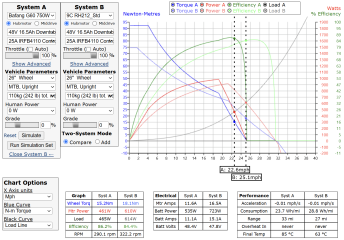
Nope. Provided with the same current and voltage, the geared hub will have the torque advantage over the direct drive, due to...gearing.
1786474935002.png

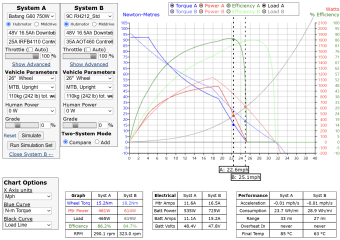
In this example upping the current to 35 vs 25 on the direct drive ends up with similar torque to the geared:
1786475115218.png

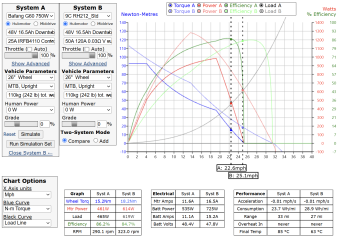
And only when doubling current will the DD motor show it's stuff
1786475236648.png
You need more battery for the direct drive hub, and even with two in parallel, it probably won't be enough.
 
To get the idea.
Those look like they'd be pretty scary to wheelie on. My little standup scooter when set to the highest setting will wheelie from a standing stop unless I lean forward. Scared the crap out of me the first time it happened unexpectedly.
 
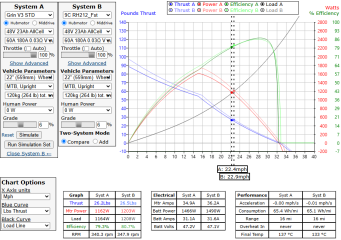
OP, here's some scenarios for you.
Simulation link:
Motor Simulator - Web Tools - Resources

Image version:
1786476997879.png

A 28mm 9C type motor like the grin all axle would work, if weight matters. That's because it's more at home in a small wheel versus the RH212, so the motor size difference disappears somewhat, thermally. And you also save 4lbs.

Yeah maybe the RH212 is the better motor... in fact we are not fully pushing it here and it's putting out, peak, small 4 cylinder engine type torque. at 60A you are punishing the 9C style 28mm stator motor, so realistically you want to run less. But this graph is just to show the close to full power capability of these motors.

I would run less power than this because the vehicle has a much worse center of gravity due to where you stand and could be quite the injury machine. I'm riding with something close to motorcycle gear, or not at all, above 20mph because disturbances in vehicle balance are a lot worse than on a bike. Plus offroad terrain can be irregular and unpredictable. The added speed will make this characteristic more apparent!

DD will take plenty of bashing offroads compared to a geared hub, so it is the right way to go, now that i know more about the vehicle
 
I'm all good choosing a 500w or 750w smaller DD if thats sufficient indeed.
Tbh: even with this small 250w motor with some more amps and voltage, already is tricky from zero when you dont expect it. Thats also why i want to be in control of the throttle curve, and flatten/smooth it the first 5 Kmh, and then steadily make it steeper.

But, now when we are talking smaller motors; what would be a price reducing controller that runs smooth, not too powerful, but has all the bells and whistles to dial it in for a perfect smooth ride? Im leaning towards Vesc 9clone) due the amount of settings and auto-learn.
 
For controller you should think about a VESC because it allows for really fine control of throttle etc... was designed with scooters in mind, which are more challenging to control properly ( even shorter wheelbase on top of what gravity is doing to you )

I'm a big fan of spintend vescs because they make adapting to ebike parts easy with the ewheel adapter, but i haven't kept up on what the best bang/buck is today.
 
Why would regen not be possible when having packs in parallel?

Usecase is mostly on road, asphalt, and sporadic offroad/forest/mtb tracks etc.
 
Last edited:
Those look like they'd be pretty scary to wheelie on. My little standup scooter when set to the highest setting will wheelie from a standing stop unless I lean forward. Scared the crap out of me the first time it happened unexpectedly.
Wheelie is a big big nono. Too unstable indeed, which is why i dont want to overspeed at all.
 
Why would regen not be possible when having packs in parallel?

Usecase is mostly on road, asphalt, and sporadic offroad/forest/mtb tracks etc.

I'm told that you need a diode between two packs that have BMSes in parallels and this inherently prevents regen from happening.
 
Technically, if they are the same chemistry and you always connect them when they are the same voltage, it should be relatively safe to put them in parallel without diodes. I even connected at 1V different once and only saw 3A of cross charging current. So if you have ancient batteries with high internal resistance it can be even less dangerous. With a good battery that might trigger 80A, which may be dangerous. Needless to say, larger voltage differences result in even larger current.

I think the one case that can nail you is if one BMS cuts off discharge due to an imbalanced p-group or something. On my batteries, I have to turn a key off and on again to bring that battery back to discharging. And if I don't for a long time, like for the rest of my commute, the voltages are going to differ a lot by the time I do. If the voltages differ a lot, the cross charging current will be very high and can even start a fire.

There's also complications with some BMS being common port and some separate port. A separate port BMS can't cut off charging via its discharge port, only via the charger port. So it will always accept current in over the discharge one.
 
You bring me back to when i was matching lipo packs in series/parallel.. my golden rule was no more than a .1v difference.. a powerful battery will flow to another super fast..
 
I'm told that you need a diode between two packs that have BMSes in parallels and this inherently prevents regen from happening.
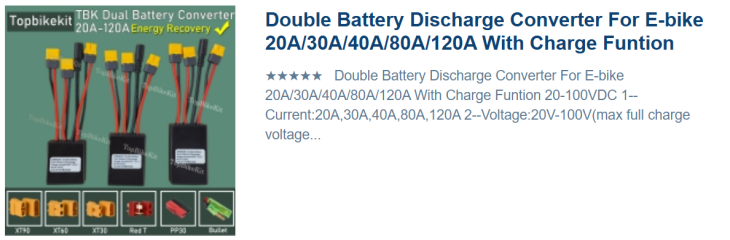
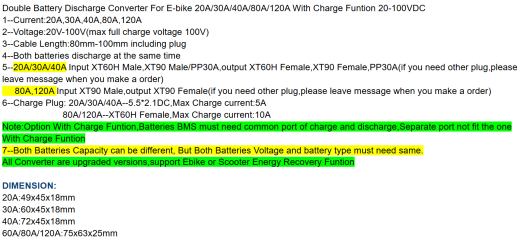
This is partially true. When using diodes this is correct, but when using a battery combiner with regen function, this is possible. I have such a combiner in it. (not tested yet as i dont have brakes with switch yet.)

No advertising intentions, but for those interested: Double Battery Discharge Converter For E-bike 20A/30A/40A/80A/120A With Charge Funtion [Double Battery Converter] - $19.95 : Zen Cart!, The Art of E-commerce
 

Attachments

  • batcomb1.png
    batcomb1.png
    222.8 KB · Views: 1
  • batcomb2.png
    batcomb2.png
    134 KB · Views: 0
Last edited:
Technically, if they are the same chemistry and you always connect them when they are the same voltage, it should be relatively safe to put them in parallel without diodes. I even connected at 1V different once and only saw 3A of cross charging current. So if you have ancient batteries with high internal resistance it can be even less dangerous. With a good battery that might trigger 80A, which may be dangerous. Needless to say, larger voltage differences result in even larger current.

I think the one case that can nail you is if one BMS cuts off discharge due to an imbalanced p-group or something. On my batteries, I have to turn a key off and on again to bring that battery back to discharging. And if I don't for a long time, like for the rest of my commute, the voltages are going to differ a lot by the time I do. If the voltages differ a lot, the cross charging current will be very high and can even start a fire.

There's also complications with some BMS being common port and some separate port. A separate port BMS can't cut off charging via its discharge port, only via the charger port. So it will always accept current in over the discharge one.
The last i didnt know. How to check this?
I use the battery combiner i just posted to be safe for this all, and want to use the combined charge port, but as i read now, this might be unsafe apparently. How can i check this?
 
This is partially true. When using diodes this is correct, but when using a battery combiner with regen function, this is possible. I have such a combiner in it. (not tested yet as i dont have brakes with switch yet.)

No advertising intentions, but for those interested: Double Battery Discharge Converter For E-bike 20A/30A/40A/80A/120A With Charge Funtion [Double Battery Converter] - $19.95 : Zen Cart!, The Art of E-commerce

Super interesting. I was not aware of a battery combiner that allowed regen, this is the first one i've seen.
Would be interested to see how that turns out :)
 
Super interesting. I was not aware of a battery combiner that allowed regen, this is the first one i've seen.
Would be interested to see how that turns out :)
There was a whole thread on it a month or so ago. I had a couple of questions that would allow me to be more convinced about how it functions, so for now I remain a bit skeptical. It has to be more sophisticated and use some logic, beyond what the "battery blender" solutions provide, in order to handle regen.
 
Why would regen not be possible when having packs in parallel?
Very possible and generally problem free if both batteries are similar, and with single port BMSs. I have been running this way for several years/ thousands of miles. Batteries stay connected always.

Some batteries with single port BMS have separate discharge and charge connectors on the battery exterior, but inside these charge and discharge wires are spliced together and ultimately connected to a single (+) and (-) on the BMS.
 
There was a whole thread on it a month or so ago. I had a couple of questions that would allow me to be more convinced about how it functions, so for now I remain a bit skeptical. It has to be more sophisticated and use some logic, beyond what the "battery blender" solutions provide, in order to handle regen.
The manufacturer's thread mentioned that it always directs the regen current to the highest voltage battery (to avoid requiring expensive current sensing components and stick to only voltage comparisons). That's the same battery it was discharging from before regen started.

When a MOSFET is enabled it actually allows bidirectional current (both driving the motor and regen). When disabled, it only allows current one direction through its body diode (although we can put two FETs back to back to prevent that when needed, like a common port BMS does).

So I think they are basically just taking advantage of that. It's actually kind of less sophisticated because most blenders use an ideal diode OR'ing IC which is specifically designed to detect and block reverse current across whichever FET it happens on as fast as possible to avoid breaking power supplies and the like. So they just need less protections than the ICs usually offer, basically.
 
I opened the motor, and the gears are toast.
They are 38mm diameter, 11mm thick, 36 teeth.

Plenty available, so will order new ones and assemble again.
 
Back
Top