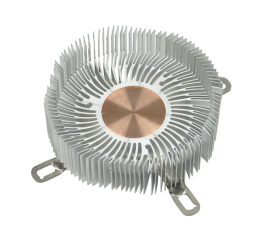
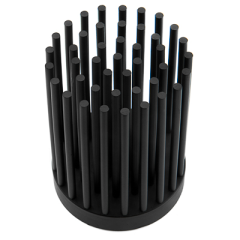
It's a super efficient motor, just has a super thin case, and i think a little heatsink slapped on the side where the stator conducts the best to the case might result in a noticeable bump to continuous wattage.
If you think it will survive your conditions, something with the thinnest fins and the most of them, should provide the most surface area for getting rid of the heat. If the fins are splayed out radially it helps, vs all being parallel.
If you need something tougher, then thicker fins spaced farther apart, or even ones iwth pegs vs fins (for more surface area).
Back in the old computer-overclocking-for-gaming days, there were some decent thermal transfer silicones used for mounting liquid-cooling-system's heatsinks to the electronics side of harddisks. I can only imagine they've gotten better in the couple decades since.
It's likely that the ones we used were by the big PC heat-managment companies like Thermaltake, etc., but I don't know if they bought and rebranded what they sold, or if they designed and made it themselves.
The two biggest characteristics to be concerned with are the thermal conductivity (which needs to be high), and the curing volume-change (which needs to be negligible). (thermal volume change, too).
The former for obvious reasons, the latter because you don't usually want mechanical stresses added to a system from expansion, or the heatsink to pull away from the cooled device from contraction.
I'm wondering how a thermal glue would compare to a thermal paste - in terms of heat transfer?
That's dependent on the specific glue...and how you use it. Most pastes are better than glue, but:
If you use it the same way you would use thermal paste, it doesn't matter much how good it is, because you are only using it to fill the tiny imperfections between the flat surface of the HS and the flat surface of the cooled device. The rest is direct metal-to-metal contact.
All the thermal transfer material is intended to do is fill the air gaps, which have a pretty awful thermal conductivity, so you could literally use toothpaste and get better than that.

If you use the paste or glue in place of metal to metal contact, then the entire thermal load passes thru the paste or glue, so you only have whatever it's thermal conductivity is.
So the more metal-to-metal you've got, the better heat evacuation you get.
I know that lots of systems don't use it this way, but you'll get much better results if you do.
Oh, also, if you use paste rather than metal contact, then if (as usual) the carrier flows away or evaporates over time, then you have air gaps and particles, so much worse thermal transfer as the system ages. The glue would have less of this problem depending on it's expected volume change rates / conditions.
I'm noticing that they say not to use it on a CPU, so to some degree, i imagine it is not good as thermal paste.
Well, it's partly because the thermal paste is probably much better at heat transfer, but It's also that you can damage the CPU (or it's mounting socket, or even the motherboard) trying to remove the heatsink, and you usuually can't access the CPU-mounting-hardware without removing the heatsink, so gluing the HS on the CPU can make a system unserviceable.