• Hello ES! We could use some help to get us past the finish line on building the new knowledgebase for the forum.
    Can you donate? Please see our fundraising page. Thank you!

thermal glue - does it work well for adding heatsinks?

Re: use a fan

The non forgiving aspect of this motor is that the cooling fins and thermal mass are designed to cool the controller first and motor second. On The motor side, the case is very thin also, so it can only carry so much heat to the controller heatsink. I want that heat out of the motor area as fast as possible and the wind passing through the front can only do that so fast.

I'm thinking adding thermal mass in the weakest area would be helpful and reduce my time to overheat, even if it isn't getting awesome airflow. Because it would more than double the wall thickness.

lightest-jpg.367033


The problem with a fan is that i live in the desert and it can get quite dusty and lots of little rocks can get picked up, water spray, etc on the bottom of the bike. I can't see any kind of fan working proper. In fact, fans inside computers here have shortened lives... indoors!

Might as well put a watercooling block on the side because it's at least easier to relocate the fan upwards and drawing air from behind the bike, but that's quite the ugly apparatus.

I'd like to avoid fans if possible.

One thing i haven't explored yet is thermally bridging the mid drive to the frame.

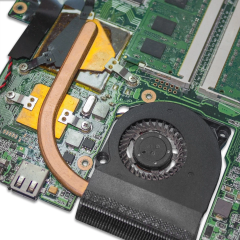
Another idea. You can buy those copper pipes filled with liquid metal made for laptops and bend them about. There is room for 2-3 of these in the motor. Going from inside the motor to a heatsink outside could be really effective. Using these to thicken up the thermal mass around the motor and helping shuttle it to the heatsink may have an impact. Or at a minimum if you could get good contact, you at least get thermal mass from that liquid metal inside.
1753070514282.png
 
Last edited:
As many have pointed out most thermal adhesives are pretty bad but I do recall seeing Tech Ingredients develop this awhile ago, Thermal Epoxy - 10ml + 3ml | tech-ingredients There is a whole video on how it works and even how to make it if you want, if I recall it performed quite well in comparative tests. Still as with any thermal application check to make sure both the body and heatsink are as flat as can be and ideally remove the paint/anodizing.

Watched the video on this and i'm kinda wowed. The stuff was 3x better than a high end thermal paste.

sounds like all the magic is due to the thermal conducting elements being able to touch each other easily due to their shapes.


The prospects of tacking on a pound of copper heatsink with this is pretty appealing. I sent them an email re: how it fares with thermal contraction/expansion and vibration.
 
Another idea. You can buy those copper pipes filled with liquid metal made for laptops and bend them about. There is room for 2-3 of these in the motor. Going from inside the motor to a heatsink outside could be really effective. Using these to thicken up the thermal mass around the motor and helping shuttle it to the heatsink may have an impact.

I recently saw someone's phaserunner or baserunner that uses one of those, but I can't remember which thread it was in... :oops:
 
Would have been nice if they could have gotten more copper on those windings, heat wise, not bad overall but not the best I've seen either. Potting those windings could improve thermal transmission quite a lot as well but that is a tricky project unless you know what you are doing.

I think winding motors I still one of those things that isn't really solved, each way we do it now as issues and I think technology will keep solving those issues and before long higher motor efficiency from reduced copper losses will be common and cheap. I kinda want to see the winding technique that Lucid uses in more applications for instance.
 
I'm thinking adding thermal mass in the weakest area
There is very little benefit to adding any kind of heatsinks to the outside. Think of the motor assembly as an incandescent light bulb. There is air between the filament and the glass. No matter how many heatsinks you put on the outside glass, or how much you blow on the glass, the filament will still be very hot. Will blowing and adding heatsinks help? Yes. But it might lower the temperature of the filament from 5000 degrees to 4950 degrees. It's the same with the motor. That's why Grin "invented" a terribly messy solution like Statorade. Nothing else will work.

You could drill a hole in the case and bring in forced air through a closed loop intercooler, kinda of like a turbo but using air instead of coolant. Any other solution will bring you less than 1% improvement.
 
Would have been nice if they could have gotten more copper on those windings, heat wise, not bad overall but not the best I've seen either. Potting those windings could improve thermal transmission quite a lot as well but that is a tricky project unless you know what you are doing.

I think winding motors I still one of those things that isn't really solved, each way we do it now as issues and I think technology will keep solving those issues and before long higher motor efficiency from reduced copper losses will be common and cheap. I kinda want to see the winding technique that Lucid uses in more applications for instance.

Yeah the design favors lightness over brute power.
I think we could count that extra copper as a large amount of end turn losses What's strange is how good the efficiency is despite that.

Potting is an interesting idea, I could pot the easy to access side of the stator and this would improve the thermally thin area. I hear that potting can go quite wrong and comes with some downsides. Maybe an option of last resort.
 
That's why Grin "invented" a terribly messy solution like Statorade. Nothing else will work.

Yeah, that's designed for an outrunner that spins at 12x lower rpm though and i wouldn't call it a slam dunk unless you've seen someone else run that successfully in a casing that would allow the ferrofluid to be flung into gears and circuit boards.

You could drill a hole in the case and bring in forced air through a closed loop intercooler, kinda of like a turbo but using air instead of coolant. Any other solution will bring you less than 1% improvement.

That's a problem because there isn't a good way to prevent air from coming into the gears and quickly contaminating any lubrication. If we let air in, in my dry and dusty environment, we also need a fan and filter system to protect the motor, which ends up being an ugly apparatus.

I'm happy with 1% improvement if that's all i get from adding metal to the motor. 10 watts of extra heat expelled is another 65-85 watts i could input into the motor.

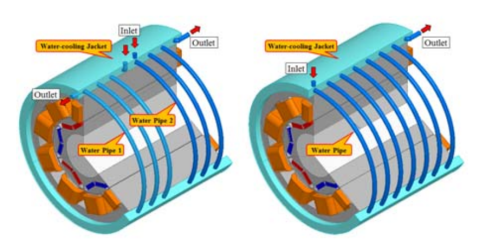
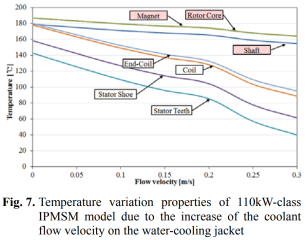
I was reading about water cooling jackets for inrunners and came across the attached paper describing what looks like an extra fancy watercooling jacket for a RC motor.

1753113235935.png

Looks extremely effective. I'm surprised we can even go so far as to lower the temperature of the inner rotor also, but notice how hard it is to make it budge
1753113219473.png

What i was thinking with the copper heatsink tubes is to essentially create this jacket inside the motor, but with liquid metal instead of water, for added mass and hopefully improved transfer to the case. This could be more impactful if you ran the coper tubes outside of the case to a heatsink.

That would make an exterior heatsink more effective.
 

Attachments

  • Thermal_Analysis_of_IPMSM_with_Water_Cooling_Jacke.pdf
    695.6 KB · Views: 0
Last edited:
What i was thinking with the copper heatsink tubes is to essentially create this jacket inside the motor, but with liquid metal instead of water, for added mass and hopefully improved transfer to the case.
Keep in mind that it's not just about mass, it's also about the specific heat absorption capability of a material before phase change, and if phase change is acceptable within the system, how much energy is absorbed by that phase change.

For instance, with water, you can take in energy up to the point it turns into steam. The energy input before phase change doesn't expand the water significantly, but that phase change to steam expands it by something like a thousand times (which would blow up a sealed cooling system wiht no expansion or venting capability).

With the metal, it would take a lot more energy before it phase changes from liquid to vapor, and you'd never reach that before the system fails from overheating. But it doesn't take very much energy into the metal itself during the operational thermal range of the system, compared to water.


However....apparently most of those heatpipes actually use water as the working fluid inside. So the term "liquid metal" is misleading, as it should be "liquid / metal" meaning it is liquid and metal, not just metal that is liquid. ;)

Modern CPU heat pipes are typically made of copper and use water as the working fluid.[3]
From the notes in the article above, showing some details of a heatpipe construction, if useful
www.arrl.org/files/file/QEX_Next_Issue/Jul-Aug_2010/Jansson.pdf

From a manufacturer
While heat pipes are made from a wide range of materials, copper is often used because of its high conductance. Many fluids can be used though, de-ionized water is often the choice as the working fluid due to its high latent heat, surface tension, thermal conductivity, and boiling temperature.

Another article, full text not available without subscription, showing different constructions, and about wicks vs internally-open tubing, reasons, etc:


EDIT: Coolermaster's article
At the most basic level, heat pipes are hollow tubes which contain a heat transfer liquid that absorbs heat and then evaporates at one end of the pipe. The vapor then travels to the other end of the pipe, condenses, and releases heat. The liquid then returns to the beginning of the process usually via gravity and completes this cycle over and over again


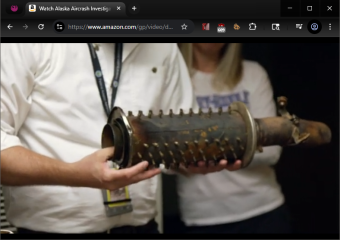
BTW, I was just watching this Alaska Air Crash Investigation,
and they show an engine exhaust heat transfer unit that takes heat from the exhaust and heats cabin air with it. The heat transfer fins are just round pegs spaced apart a fair bit. It's presumably built based on the specific amount of heat an engine in a small single-engine-plane makes vs the amount of heat needed to keep the pilot cabin at a certain temperature given prevailing conditions at altitude in the typical Alaskan environment. If they needed more heat there would probably be more pegs more closely spaced. I don't know the airflow rate from the cabin circulation fan, but expect it to be similar to an automotive one for noise / comfort reasons.
1753134612108.png
 

Attachments

  • Jansson.pdf
    697.7 KB · Views: 0
Now this I can answer! :)
(I've been overclocking since the days where water cooling meant make your own water block, fish-tank pumps and car interior heater cores.
I had a water cooled P1 233mhz at 292mhz. (83 x 3.5) Unheard of in those days! :) )

The best Thermal Adhesives back then, and still way better than you are finding, where made by Arctic Sliver.
Google AI says 7.5 W/mK..?

Back then the adhesive was too strong, so we used to mix it ~50/50 with their thermal compound.
That gave a mix with better Thermal conductivity, that stuck heatsinks on well, but did not remove the chip off the PCB with the HS when you wanted to remove the HS.

BUT:
This guy has his 'Even Better' Thermal adhesive and compound for sale on his website. (if you don't want to DIY it)
I don't recall the numbers and wont be watching he video again, but way better than Arctic Silver's stuff IIRC.

I NB that the same; Weaker bond but better TC from mixing his adhesive and compound probably applies..?
 
Last edited:
AW:
I'm told some heat pipes contain a soft but toxic metal with higher conductivity than water.
water being the standard is ok and i prefer non toxic materials.
Water boils at 100c, which is not a problem. For maximum efficiency, i want to not exceed 90c.

Logic: glad to see a PC overclocker here. This mid drive unit is very efficient so it produces heat more along the lines of a server or otherwise big desktop CPU, so i think a lot of the tricks apply.

I await an email from the fancy thermal paste guy about mechanical durability. Seems like the candidate of choice for gluing heatpipes inside the mid drive case.
 
Water boils at 100c, which is not a problem. For maximum efficiency, i want to not exceed 90c.

Water boils at 100C at 1 bar of ambient pressure. Water in a closed container can be within a wide range of pressure.

The thickness of the bond line of any thermal compound is relevant to its conductivity. One point in favor of thermal epoxy rather than thermal paste is that you can apply it and then press the parts while the adhesive cures, yielding a thinner and more conductive, but still stable, layer.
 
I've lived at 6000 ft elevation and sea level. Big difference in ambient pressure, and you can tell because the chip bags you bought at sea level nearly explode. Don't notice any difference in how a laptop heatpipe operates - CPUs throttle and stay below 90C typically, which is identical to the application i want to use them in.

What assumptions do i have wrong about this?
 
Aren't laptop heat pipes sealed? Outside pressure would be irrelevant, wouldn't it? High altitude makes water in an open pot boil at a different temperature. Doesn't make water in a pressure cooker act different.

Chip bag is different because the volume can change.
 
They're sealed and typically contact the hot chip with pressure + some thermal goo in computers.

It's a weird design honestly. You'd think that since metal has higher conductivity than water, it'd be silly to use water, just use moar copper!
I just know it works in computers to very efficiently transfer heat from one area to another.
I wonder if it's a way of cheaping out on copper or for some other reason it's a superior way to achieve what's needed.

But even in the high end / high performing PC heatsink designs we see the use of what looks like water pipes all over the place. Even though we're disadvantaged by using what looks like aluminum instead of copper, the heat pipe seems to work. On the other hand, two fans is probably doing most the work.

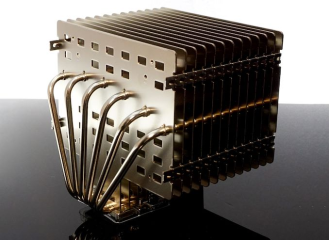
Here is a high end noctua passive cooler. Those heat pipes are doing a lot of the work and we're brute forcing the task with metal.

This is a good demonstration of how much extra volume metal you need versus using fans, the typical heatsink + fan combination is half or third of the metal.
1753145422459.png

I do like the idea of going fanless and using a bunch of tubes to shuttle heat to a larger surface. No problem to me to add 1lbs of metal to a 4lbs ~1.25kw mid drive.
 
Last edited:
It's a weird design honestly. You'd think that since metal has higher conductivity than water, it'd be silly to use water, just use moar copper!

Metal is solid. Water is liquid. That's the whole point. Hot water flows up, cold water flows down.
 
Metal is solid. Water is liquid. That's the whole point. Hot water flows up, cold water flows down.

Yeah but water has a fraction of the thermal conductivity, and in a laptop, the heat is moving horizontally. So it seems like a weird choice.

Must have missed some things in physics class, either that or it's a way to make laptops lighter / cheaper by not using solid copper.

I just know this kind of device is effective and i'm surprised that the distance from heat source to fan doesn't matter that much.

1753070514282-png.373747
 
They use them in satellites, too (see the article I linked and attached previously for one example). I don't know the specific reasons (the article might explain but I only skimmed it), but it could be for weight.

There more we talk about it the more it makes sense.
Think about a tube that's solid and the same shape.
- the outer layer has a higher contact area with everything, therefore is more functional.
- the inner layer is functionally mostly thermal mass that helps the outside do it's thing somewhat.
- therefore just having it hollow is a weight hack that doesn't have too big a negative consequence; you can also use this to increase surface area ( more effective ) for the same weight versus a non-hollow tube.

In the case of the big noctua cooler i can see that water rises vertically is maybe a factor in how the heat tube functions in a desktop cooler.

Wish i studied physics more at this moment
 
This ancient thread at AnandTech has some useful thoughts
Heatpipes are already used in a large amount of notebooks beacuse the space required for the heatsink is too large to fit directly over the CPU.
Heat pipes are very good in spaces (like laptops) where you dont have room for a CPU and a HSF in the same area. The Heatpipes transport the heat to a suitable area.

As some other posters have very elegantly explained, that transition from liquid (water) to gas (steam) eats up a tremendous amount of energy.... but it has to be transferred BACK to water for the system to be effective. In the Shuttle Mini-PCs (I think the SS40G with the Athlon), the heat pipes are used to transfer the heat to a "radiator" near the fan of the case. Or in the Itanium case (I believe), they let the "heat pipes" travel up to the top or back of the case where they are better ventilated, thus allowing the steam to change back into water (because energy dissipation is easier/better in the more well-ventilated environment).

Also note that this "process" is basically what goes on in EVERY air conditioning system. Freon (or some nicer fluid) changes from a liquid to a vapor (or vice versa) to absorb/dissipate heat in places with different temperatures. Your radiator in your car also works on a similar principle.


Normally, I wouldn't use reddit as an info source, but there is some good info and useful links; only quoted the first one:
corvairsomeday

Ooh, good question. My first job was at a heat pipe manufacturer for spaceflight applications. That scene can get a bit proprietary and there are some arms trafficking restrictions that probably limit some of what I can share (although to be honest, my memory is probably the biggest limit at this point).
Here are some pointers:
  • Heat pipes work using 2-phase heat transfer: the fluid inside boils off, the gas expands off down the empty core of the pipe, condenses on the walls at the cold end, and the liquid crawls back grooves in the walls all the way back to the hot end where it does it all over again. This is driven by the heat delta between hot and cold, as well as the performance of the grooves using capillary action to coax the fluid back. As a result, heat pipes are severely limited in elevation change between hot and cold sides (they have to be mostly level with respect to gravity). They work in all orientations in zero-gravity. You probably know this already.
  • Satellite pipes mostly use aluminum and ammonia. Terrestrial computer pipes like you are thinking about are usually copper and water (largely because those materials aren't toxic to the consumer).
  • A vertical heat pipe on Earth (with heat below and cold sink on top) is called a thermosiphon. It's a fair bit simpler because gravity helps pump the liquid back down, but it might not work for you.
  • If your company isn't large enough to design your own heat pipe extrusions (yes, the bodies are extruded to get the internal grooves), then you'll have to find an extrusion on the market that's made for this purpose. Not sure what's out there.
  • Most of the performance (and therefore proprietary bits) are associated with the geometry of the grooves and how many there are, etc.
  • Bend, solder on the interface surface, final machine if necessary, then charge with fluid. (There are lots of other steps, but I don't want to go there on Reddit. :)
Two links from it (that I glanced at the pages they bring up)

There's lots more out there, but that's a couple of minutes poking at this

while I waited for this to upload
 
Iv used a generic thermal glue a handful of times. Does decent - at least as decent as thermal pads - but still isnt great for transfer. Probably enough for this use case. The stuff I use takes DAYS to set up and even then isnt terribly strong. Wouldn't trust it to hold fins on a bouncing motor case. I could see where it would be waaaay too much for cpu use however.
I primarly use it on diy discharge banks, where I let the paste set up then add some high temp silicone or gasket material around the edges.
 
I've lived at 6000 ft elevation and sea level. Big difference in ambient pressure, and you can tell because the chip bags you bought at sea level nearly explode. Don't notice any difference in how a laptop heatpipe operates - CPUs throttle and stay below 90C typically, which is identical to the application i want to use them in.

What assumptions do i have wrong about this?
In heatpipes, regardless of working fluid, the boiling point is set/adjusted by pulling a vacuum on the pipe before pinching it off and sealing it.
ie: The temperature at which the liquid boils is completely independent of altitude.
  • Want a HP that holds temperature of say 40C: pull a vacuum that sets the boiling point at 40C.
  • Each HP can handle X watts before there is too much temperature for condensation to occur. If you want to pull more than X Watts; add a 2nd HP.
  • Done.
So you just choose/buy according the the temperature you want and the Watts you want to pull out.
NB the 'capillaries' on the inner tube walls, so that the HP is NOT orientation dependent...


The fluid is normally water because:

AI Overview
Water has exceptional thermal properties due to its unique molecular structure and hydrogen bonding. These properties include high specific heat capacity, ... and high heats of vaporization ...​
  • High Specific Heat Capacity:
    Water can absorb a large amount of heat with only a small increase in temperature. This is because a significant amount of energy is needed to break the hydrogen bonds between water molecules, allowing them to absorb heat without a drastic temperature change.
  • High Heat of Vaporization:
    Water requires a large amount of energy to evaporate or change from a liquid to a gas. This is because the hydrogen bonds need to be completely broken for the water molecules to escape into the gaseous phase
And price! :)
 
AW, this link is gold, thanks!
Heat Pipe Learning Center - Everything You Need To Know About Heat Pipes

Hey @Logic11, thanks so much for this info.

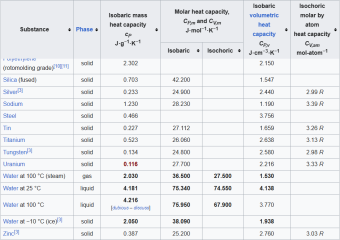
Wikipedia has a table of heat capacities and water has about 3x the capacity of most metals until we hit 100c. That's fine by me.
Table of specific heat capacities - Wikipedia

The heat pipe now makes a ton of sense.

1753545837531.png

I'm learning a lot here.

Are those gears steel/metal, or some sort of Nylon-ish type plastic?

It's a combination of plastic/nylon and metal.
I think i get what you're thinking - drawing more heat towards the heatsink might be a problem because the gear sits above it.

It may be smart to put the heat collection on the outer edge of the stator instead.

I suppose this really depends on how effective the device is inside the motor as a heat transit device. I'm imagining that it's very effective, so this gives me pause about substantially boosting the heatsink area's ability to shed more heat.

It'd be better to create an additional area that acts like a heatsink - right where the heat is.
 
On paper, metal-metal heat transfer is ideal. In practice, tiny air gaps between seemingly smooth metal surfaces need to be filled with some sort of thermal compound in order to achieve adequate heat transfer. This is why thermal paste is used on CPUs in the first place.

I think that a thermal glue/epoxy AND 2mm screws might be the most straightforward approach to yield good results.

In this case, the glue/epoxy is for heat transfer and adhesion. The screws are just there to pull the motor & heat-sink together, which forces thermal glue/epoxy into tiny air gaps before it cures & prevents air gaps from forming in the future.

Because adhesion is provided by your thermal compound, you do not need big screws nor a ton of thread engagement. But the more screws the better - even tension around the mating surface is what you're after.
 
Last edited:
In heatpipes, regardless of working fluid, the boiling point is set/adjusted by pulling a vacuum on the pipe before pinching it off and sealing it.
ie: The temperature at which the liquid boils is completely independent of altitude.
  • Want a HP that holds temperature of say 40C: pull a vacuum that sets the boiling point at 40C.
  • Each HP can handle X watts before there is too much temperature for condensation to occur. If you want to pull more than X Watts; add a 2nd HP.
  • Done.
So you just choose/buy according the the temperature you want and the Watts you want to pull out.
NB the 'capillaries' on the inner tube walls, so that the HP is NOT orientation dependent...


The fluid is normally water because:

AI Overview
Water has exceptional thermal properties due to its unique molecular structure and hydrogen bonding. These properties include high specific heat capacity, ... and high heats of vaporization ...​
  • High Specific Heat Capacity:
    Water can absorb a large amount of heat with only a small increase in temperature. This is because a significant amount of energy is needed to break the hydrogen bonds between water molecules, allowing them to absorb heat without a drastic temperature change.
  • High Heat of Vaporization:
    Water requires a large amount of energy to evaporate or change from a liquid to a gas. This is because the hydrogen bonds need to be completely broken for the water molecules to escape into the gaseous phase
And price! :)
Eh, the low price of water is a happy coincidence. It's really hard to beat water for heat transfer. It just so happens that we've got A LOT of water here on earth: water's heat/energy absorbing properties help make water such a necessity for life. Its abundance makes it cheap & plentiful.🙂

But once water gets saturated with heat, it needs to either:

1) Vaporize off and take the the energy it absorbed along for the ride. This type of evaporation cooling is how sweat cools us, and it's a broadly effective solution for many cooling applications. But the downside is that this solution uses water as a consumable, so it requires refills.

or

2) Use water in a closed loop with a "hot side" and "cold side", wherein water can absorb & discharge heat, respectively. This is where heatpipes come in. The upside to this approach is that water (or whatever coolant used) isn't used as a consumable, so maintenance is low. The downside is that heatpipes have to be designed carefully for a number of reasons...

One bigger downside of heatpipes is that they tend to be made out of thermally conductive metals w/ low specific heat. These metals can be corroded by water & electricity, and thus present a need for water used within heatpipes to be treated with additive packages. You can generally get around this by using automotive coolant or whatever coolants are being used to water-cool computers.

Another downside to heatpipes is that they are typically designed to prioritize cold side surface area, which can come at the cost of strength. I don't know if they're ideal for cooling the motor of moving vehicle unless great thought is put into protecting the cold side without inhibiting air flow.

I'm not sure what the state of "liquid metal coolants" is. I'll look into it - I could definitely be missing something. Last I checked - which was a while ago - most applications simply used a liquid gallium alloy to interface between a heat source & a heatpipe, thus taking the place of thermal paste. But air or water-based coolant would still be transferring heat within the heatpipe. Galium thermal paste pencils out to be a great solution compared to normal thermal paste, but gallium alloys are extremely destructive to PCBs and they melt aluminum on contact. You do not want a gallium thermal compound to end up between a heat source & a heat pipe, and you better hope that none of the mating surfaces are aluminum. Gallium alloys have more damage potential than water.
____

It is my personal opinion that liquid cooling e-bike motors is over-complicated and risky, and thus not worth it for most people. You're bound to have a terrible, destructive failure or two along the way and one must be ready for it. But it can, of course, be fun and rewarding. And this forum is very DIY focused, so I don't want to discourage anybody who is down for the adventure. Just be aware that you're in for an adventure!
 
Last edited:
Back
Top