• Hello ES! We could use some help to get us past the finish line on building the new knowledgebase for the forum.
    Can you donate? Please see our fundraising page. Thank you!

Wiring KT Controller 50A julet waterproof

kikomania1

New here
Joined
Jan 2, 2022
Messages
4
Hello,

I'm upgrading my KT controller from 25A:
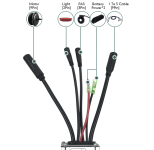
old.png

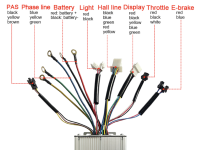
to use 50A model instead:

schema1.png

The wires are different and all the wires in my bike are julet, so I have to adapt them.

There are two special considerations:

- The 9 pins motors = motor phase lines (3 wires) + motor hall lines (5 wires), but I don't know in which position related with the 9 pins connector.
- The 1 to 5 Cable = e-brakes x2 (6 wires) + throttle (3 wires) + display (5 wires) + front light (2 wires). Again, I didn't find a schema to know how they should be fit.


It's my first time doing this, and I feel so close and yet so far. Any idea/suggestion of what I can do to pair them correctly?
 
Last edited:
I'd open up your old controller and measure where each wire on the board inside goes to on it's respective connector pin, and write those down for each pin and each wire for reference.

If the wires on your new controller are marked the same on it's board inside, you can transplant the connectors/cables from the old controller to the new one, replacing the entire new harness with the entire old one, to make things "easy". If they're not marked the same then you'd need more verification before doing this.

But that's where I'd start if I was doing this. taking good clear direct-sunlight-lit pics of everything in every step as I go, and documenting it all, so it could be undone if necessary, or making it easier to troubleshoot later.


FWIW, there are diagrams out there of the common pin connection order for most of these Julet and Higo connectors, some of which can be found in image searches like this:
etc

and on ebikes.ca's connectors page
 
Or you can keep the existing wiring and cut off the ends. Use a kit similar to….

QLOUNI 560pcs 2.54mm Pitch 2 3 4... Amazon.com

…..to make your own ends. Then you don’t need to solder to the PCB. Like Amberwolf says, though, document, test, and compare all leads. You can trace leads to the PCB for identity. Take lots of pictures.

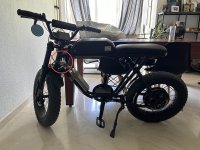
I was thinking something in that way: If I allocate the new controller properly in my bike, I actually don't need 1-to-5 julet

IMG_6641.jpg

Just cutting and making waterproof connectors in the new controller wires will be made the magic.

The cons are motor wire it's going to be longer, probably not good idea for temps?

Still 1-to-5 julet can give me more option, but It seems it will be need more investigation work to make it possible.
 
Last edited:
Hello, I'm finally doing this. However, it seems there is some incompatibility between the controller (kt48svprk-ff01l) and the display (lcd8h).

Although the wires are the same colors, the button for turning on the display turns off if I release the button. Also, the voltage in the display is reported wrongly. I suspect this is some low-voltage protection, but it's unsure what I can do to fix it.

Maybe this display is newer than the firmware running in the controller. I don't, I'm desperate ☹️
 
Short answer, if your motor and peripherals want Julet plugs, get a controller with Julet plugs.

Nuanced answer, if your motor has a typical 9 pin plug on it, you'll cook the wires by using a 50A controller, unless you limit it electronically. Those are good for 25A in my experience, though some sellers will go to 30A. I prefer to use them with 22A controllers so I don't have problems.
 
That's pretty far away from the current problem 🙂 I started doing this because the motor is 1500W, and the most powerful KT controller with Juliet waterproof wires is 25A, so the motor is far from it's power peak. Although your assumption is right, you can always change the motor wires. I'm missing something.
 
Well, if you want to use 50A, you'll need to remove the 9 pin plug and address the wires with heftier connectors. I find 14ga motor phase wires adequate for 60A if they're short, but 16ga not adequate. But okay for 40A.

Use thicker conductors for the cable that connects battery to controller, and controller to motor.
 
im exactly in the same situation, 1500w motor hub with a juliet 26 amp controller.. so my wheelchair not able to climb up hill, my bms is 40 amp i would love to put a 40 amp controller to get full power of my hub. what is the best conection (also easy to instaall)
 
im exactly in the same situation, 1500w motor hub with a juliet 26 amp controller.. so my wheelchair not able to climb up hill, my bms is 40 amp i would love to put a 40 amp controller to get full power of my hub. what is the best conection (also easy to instaall)
Better to get a geared hub with lower RPM at the power level you have. 1500W hubs are usually designed to go 50 km/h or faster with a 26" wheel, so what you need is more torque per amp and lower RPM per volt, not more amps.
 
Better to get a geared hub with lower RPM at the power level you have. 1500W hubs are usually designed to go 50 km/h or faster with a 26" wheel, so what you need is more torque per amp and lower RPM per volt, not more amps.
T-Rocks - Triride please take a look of this its a 1500 w hub with a 16 inc 4 "'tyre
 
What is a good torque number?
The point is that you need to choose the right motor for the job, and in this case a geared hub motor is much better suited than a direct drive. The trike you referenced has 65Nm of torque from a 1500W motor.
You can get more torque from a smaller geared motor, using less power.
The example below is a 500W geared motor, at 48V and 26A (assuming that's what you're using now). Instead of 65Nm that the trike you linked has, this smaller motor is producing 80Nm. If you ran it at 40A, it would be 125Nm of torque.
Knowing exactly what motor and controller you are using would make the model more accurate, but it's still easy to see that the geared motor is better suited for achieving your goals. Knowing your desired top speed would allow you to choose a motor with the right windings to maximize your torque, but you haven't provided that information (the example motor in the simulation is a standard wind, so a slow wind would give you even more torque.

1741880918203.png
 
The example below is a 500W geared motor, at 48V and 26A (assuming that's what you're using now). Instead of 65Nm that the trike you linked has, this smaller motor is producing 80Nm. If you ran it at 40A, it would be 125Nm of torque.

When quoting amps, is that battery? If so then I believe that's a bit off since it's the phase current that results in the torque, no the battery current.

It's very easy to get higher phase current with a bigger controller even without going with higher battery current/max power. I have two example bikes:

* slow 7x9T 30H motor, 30A KT, 29" - Unloaded vmax = 42km/h
* fast (likely 10x6T) motor, 45A KT, 26" - unloaded vmax = 55km/h

Between those two, despite the higher vmax, despite reduced max power, the 45A one can still win a drag race from standstill. I don't have the exact data on the motors, but I believe they have 1.8Nm/A and 1.35Nm/A, respectively. Thus the torque increase from the larger controller is far bigger than the relative current ratings would lead you to believe.
 
The torque peaks at stall. At that point, in the example, the motor is producing 80Nm, while pulling 13.9 battery amps, and 69.8 phase amps. The motor is going to consume whatever the controller can supply, and at peak torque, it's not bumping up against the controller's battery current limit, just the phase current limit (26A battery, 70A phase in this case, so a pretty robust controller with respect to phase vs battery amps).

The example was provided in order to demonstrate what a big difference in torque there is based on gearing and motor windings, and why one motor is better for the job than another.

1741965337144.png
 
Back
Top