• Hello ES! We could use some help to get us past the finish line on building the new knowledgebase for the forum.
    Can you donate? Please see our fundraising page. Thank you!

"The Mule" calls for your help to speed up Phaserunner setup with hub rear motor with unknown characteristics

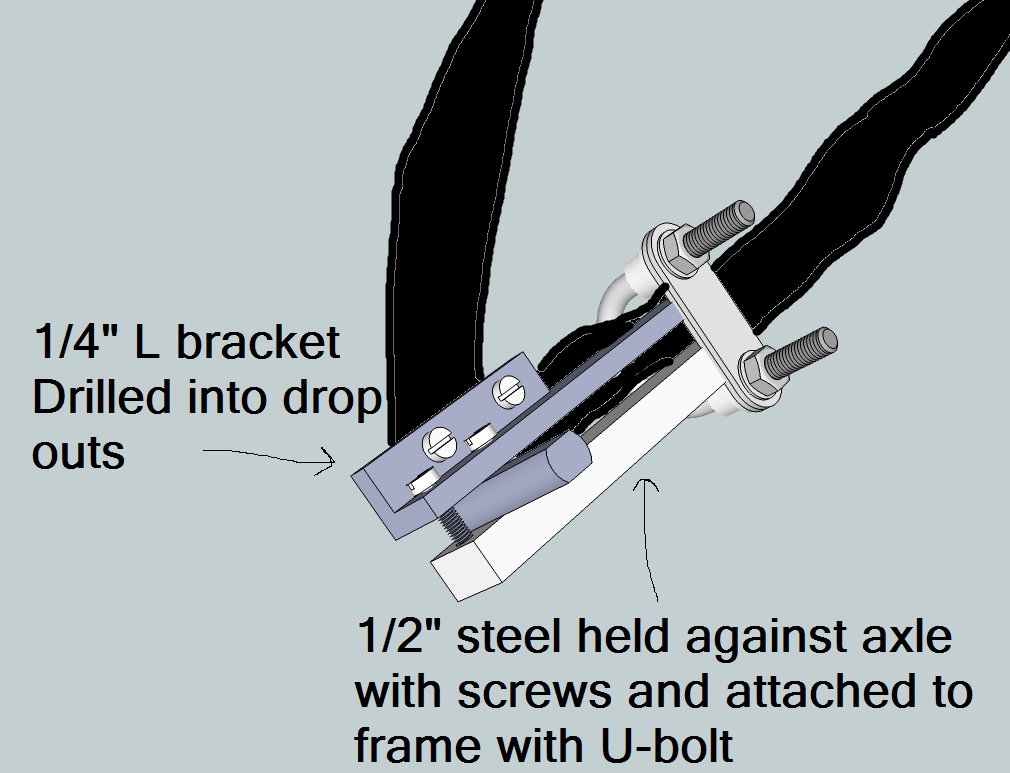
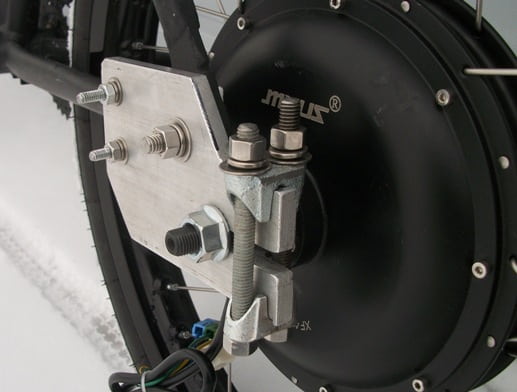
Some examples of bolt-on clamping TAs:

mongoose-pinch-dropout-jpg.298628


SXqlx.png


This one looks like a dropout extension. See how the new location of the axle is further back than the original (where the chain stays and seat stays meet):
file.php


file.php


This is also a dropout extension:
2022-08-02-19-18-48-jpg.321563


From torque arm picture thread
 
Hello everyone, thank you for all your answers. I've just been using the bike a little bit in the past few days and it has been GREAT if not awesome ... But now I need to tidy up a great number of things and your help would be invaluable with the following questions :

1/ Is there any thread or guide to explain how to fine-tune the PAS control and to setup usage profiles on the CycleAnalyst ? That might also solve my issue with the throttle, as I would actually prefer to control entirely the bike with its pedals (for maximal compliance with local regulations).

2/ how can I make sure I don't burn the Phaserunner's L1019 connector ? Is it a good idea to adapt a cylindrical heatsink that I would slide over the screwed connector ? Am I right to expect that the greatest heat will flow from there (points of contact within the connector), or should I double up with more heat sinks running around the wires ? I will put them as much as possible within a flow. I will be monitoring manually but I am concerned that this could go quickly during a very steep climb, and the location of the plug isn't very practical. Advice from anyone experienced with running currents in the 50A DC range (48V architecture in my case) would be very appreciated.

Thank you !
 
Forgot about this one (bolt-on clamping dropout extension):
file.php


tacoyote3-jpg.184022

(note the clamping pinchbolt has not been installed yet)

From Coyote DIY Torque-arm, open source 2600W DD hub
Thank you so much, very very interesting. For some reason, the pictures wouldn't display earlier ... Maybe because I was checking from a device without being logged in ?

For now, I will probably go for something as simple as the first system, just with a bit more rounding, sanding and painting.

Extensions might actually be a really good way to go ... especially as it allows you some margin to modify the overall geometry on a not necessarily ideal scavenged frame, or to build a stronger structure. Or to adapt a motor wheel not suitable for the frame.

Really really interesting and clever ...
 
Extensions might actually be a really good way to go ... especially as it allows you some margin to modify the overall geometry on a not necessarily ideal scavenged frame, or to build a stronger structure. Or to adapt a motor wheel not suitable for the frame.
Or run wider tires (more clearance rearward along the stays?)
 
boy.. how steady is that, really? i'd expect there to be some flex.
Depends on the forces it is subjected to. Could be made stronger by using a larger plate that clamps also to the seat stay as well as the chain stay.
 
It is also potentially a way to make a frame motor-independent. By making extension plates suited to this or that motor, but compatible with the same frame.

I side with neptronix, though, on the need to confirm if the structural design makes sense ... For the motor rigged, for alternating intense propulsion and breaking, given the torque increases arising from such a new geometry (with frame extensions).

Actually, it goes against my intuition of the need to strengthen and stiffen the rear triangle of a frame designed for a muscular use, when rigging an engine with several times the mechanical power of a human ... As well as the design of industrial electric bikes, that precisely have stronger and stiffer frames.
 
Last edited:
Hi everyone,

Sorry as I realise my questions are somehow confused ... More trials and I'm really wondering what might be a good control strategy for such a heavy bike and powerful motor in mountaineous conditions. How to also manage a wide range of wanted uses, from high speeds (max start accelerations, high average or cruise speeds, etc), to max autonomy with adequate assistance, including "no worry about remaining capacity" for local usage within more reasonable speeds ...

Is there also a way to setup "profiles" or is it only possible to modulate PAS, in a rather mathematical way ? I am unclear as to how to setup all these regulations in regard to my terrain, so any suggestions for managing and simplifying usage would be greatly appreciated.

I run a PAS sensor, and I am also wondering if a torque sensor would be particularly useful to deal with rapidly changing slopes, by regulating electric assist power on the human torque input, instead of RPM that requires a more intensive use of my transmission than I wish ...

I am also wondering what happens if I go down my mountain and I run hundreds of watts (if not more) of regen into my battery during more or less an hour ... Since I am planning to run a double battery during ascent (with a chinese module upstream the phaserunner), can the charging somehow be "distributed" across two batteries during descent, and if so how ?

Can the electric energy generated during descent be also dissipated in heat to limit charging currents ?
 
I am also wondering what happens if I go down my mountain and I run hundreds of watts (if not more) of regen into my battery during more or less an hour ... Since I am planning to run a double battery during ascent (with a chinese module upstream the phaserunner), can the charging somehow be "distributed" across two batteries during descent, and if so how ?

Can the electric energy generated during descent be also dissipated in heat to limit charging currents ?

If the start of your ride is at the base of the mountain, the subsequent regen ride down the mountain will replenish the charge (minus the efficiency losses). If the start of your ride is at the top of the mountain, best to start with a discharged (or partially discharged-- you'll have to calculate the amount) battery.

What is a "chinese module upstream the phaserunner?"

Are you batteries wired in parallel?

Regen current can be dumped into a bank of resistors, but why not use it to recharge the batteries?
 
If the start of your ride is at the base of the mountain, the subsequent regen ride down the mountain will replenish the charge (minus the efficiency losses). If the start of your ride is at the top of the mountain, best to start with a discharged (or partially discharged-- you'll have to calculate the amount) battery.

What is a "chinese module upstream the phaserunner?"

Are you batteries wired in parallel?

Regen current can be dumped into a bank of resistors, but why not use it to recharge the batteries?
Thanks for your reply. I am concerned about damaging my batteries by dumping high regen currents during such a long descent, even if the battery is partly charged to absorb the dump ...

Regarding the chinese module, you can have a look at what it is here. Although I've asked lots of questions about it to the seller, I don't know how it works. I've only be advised that batteries should not be charged through it. I am about to integrate and test it this week.

Dumping regen currents partly in batteries could be a way to manage (stabilise, reduce, optimise) charging currents and optimise durability of my batteries. If I do such a descent, I will not be able to charge to ascend the same or even the next day. So electric breaking is super useful, but regen is not so useful and might even reduce the battery's lifecycles ...
 
Back
Top