• Hello ES! We could use some help to get us past the finish line on building the new knowledgebase for the forum.
    Can you donate? Please see our fundraising page. Thank you!

Cycle life tests of High Power density cylindrical cells

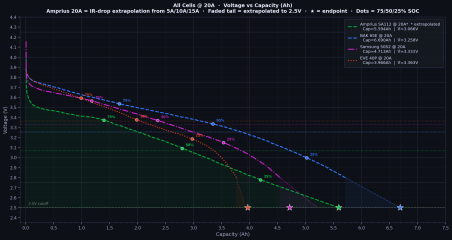
Hello everyone! I have analyzed recent advancements in battery technologies and create this table and generate extrapolated image for 4 cells. What I found: IDK why BAK named cell 65E, because I think it would be on par with Molicel M65A and much better than older cells like 50E, 53E or 57E, also Amprius cell is much worse than BAK. Technically we can say that BAK create a beast with Samsung 40T, EVE 40P capabilities, but with higher capacity, cell easy can be used for a short period of time at 30-50A load, plus it can be charged at up to 12.7A. Reliance RH60 is also worse a bit than 65E. Currently preproduction BAK cells cost a lot more than Reliance RH60 or similar 6+ Ah cells, but I hope they found a way to decrease production price or some other company create a cheaper cell.
So if we analyze this data (data is not physically correct, its a combo of real estimation + extrapolated in a range of 2.5-2.8V) we can see that 6+ Ah cells have a lot of capacity below 3V, so if we limit cell to 3-4.15V than we loose a lot of capacity, in a situation with Amprius that will be ~40-45% at 20A. BAK and Samsung looks much better with there ~20-25%. So internal resistance and speed at which its growing became very important for modern high capacity cells.
SOC (%)Amprius SA112 @ 20A *BAK 65E @ 20ASamsung 50S2 @ 20AEVE 40P @ 20A
Voltage (V)Wh remainingVoltage (V)Wh remainingVoltage (V)Wh remainingVoltage (V)Wh remaining
100%4.038617.153.887221.7924.157817.0173.879813.185
95%3.495216.2933.735520.7023.683816.1663.750512.526
90%3.465915.4353.692219.6133.65115.3153.712511.867
85%3.437714.5783.642218.5233.626214.4643.678811.208
80%3.412413.723.602217.4333.599313.6143.64710.548
75%3.395112.8633.562216.3443.568212.7633.60919.889
70%3.357412.0053.519315.2543.526911.9123.57469.23
65%3.303711.1483.485514.1653.488911.0613.53338.571
60%3.253710.293.448913.0753.450510.213.49537.911
55%3.20049.4333.408911.9853.40529.3593.45747.252
50%3.14568.5753.372210.8963.36148.5083.41146.593
45%3.08557.7183.32899.8063.31587.6583.36925.933
40%3.02366.863.27728.7173.26516.8073.3285.274
35%2.95916.0033.21767.6273.22115.9563.29194.615
30%2.88985.1453.14346.5383.17175.1053.2543.956
25%2.82064.2883.06545.4483.10624.2543.21783.296
20%2.75973.432.97564.3583.02953.4033.17122.637
15%2.69582.5732.86953.2692.92692.5533.11261.978
10%2.63221.7152.75362.1792.79121.7023.02181.319
5%2.5670.8582.62981.092.64960.8512.8720.659
0%2.502.502.502.50
Capacity (Ah)5.5946.694.7133.966
Capacity (Wh)17.1521.79217.01713.185
V_avg3.06593.2583.3313.363
* Amprius 20A: extrapolated via IR-drop model from 5A/10A/15A measured curves
SOC defined by ENERGY: SOC% = Wh_remaining / Wh_total × 100
→ 50% SOC means exactly half the stored energy remains, regardless of voltage curve shape
→ Wh_remaining = ∫[current_Q .. Q_max] V dQ (trapezoidal)all_cells_20A_V_vs_Ah_v2.png
PS: Kudos to Mooch for discharge graphs for this cells. My graphs based on them.
 
Also I have question to Pajda: do you have plans for a cycle test, for example with Samsung 50S, because of its fast degradation to investigate what is the main factor for cells IR growth: charging at up to higher levels or using battery below 3V? So something like 3-4.1V vs 2.75-4.0V. As I know currently there no ways to decrease IR, so I think with capacity growth IR will became main factor of battery degradation and loose in battery abilities for power tools, fast charging/discharging devices, not drop in capacity. As an example my phone battery is 9 years now, it still have 80% capacity, Im charging it to 75% at 0.5C, but I have a problem: it shut down, if I try to open camera with battery level 50% or less. Kudos to all work that you already did.
Best regards to community, weter11.
 
Also I have question to Pajda: do you have plans for a cycle test, for example with Samsung 50S, because of its fast degradation to investigate what is the main factor for cells IR growth: charging at up to higher levels or using battery below 3V? So something like 3-4.1V vs 2.75-4.0V. As I know currently there no ways to decrease IR, so I think with capacity growth IR will became main factor of battery degradation and loose in battery abilities for power tools, fast charging/discharging devices, not drop in capacity. As an example my phone battery is 9 years now, it still have 80% capacity, Im charging it to 75% at 0.5C, but I have a problem: it shut down, if I try to open camera with battery level 50% or less. Kudos to all work that you already did.
Best regards to community, weter11.
Considering it detests charging at full voltage, the most probable cause is that its cathode gets very unstable at more than 4.15V.
 
Last edited:
Also I have question to Pajda: do you have plans for a cycle test, for example with Samsung 50S
Check this https://www.patreon.com/posts/1-he-samsung-50s-136539826 it should be free access, maybe you just need a Patreon account. However, the answer is no; I don't plan to conduct any further tests with the Samsung 50S. It is a very outdated product that no longer offers any advantages, other than the company's name.

Today I’m focusing on the new Reliance RH60, which promises similar features to the 50S did in its day. The BAK 65E is also in the waiting room, but it will likely remain unavailable for a few more months.
 
Hello everyone! I have analyzed recent advancements in battery technologies and create this table and generate extrapolated image for 4 cells. What I found: IDK why BAK named cell 65E, because I think it would be on par with Molicel M65A and much better than older cells like 50E, 53E or 57E, also Amprius cell is much worse than BAK. Technically we can say that BAK create a beast with Samsung 40T, EVE 40P capabilities, but with higher capacity, cell easy can be used for a short period of time at 30-50A load, plus it can be charged at up to 12.7A. Reliance RH60 is also worse a bit than 65E. Currently preproduction BAK cells cost a lot more than Reliance RH60 or similar 6+ Ah cells, but I hope they found a way to decrease production price or some other company create a cheaper cell.
So if we analyze this data (data is not physically correct, its a combo of real estimation + extrapolated in a range of 2.5-2.8V) we can see that 6+ Ah cells have a lot of capacity below 3V, so if we limit cell to 3-4.15V than we loose a lot of capacity, in a situation with Amprius that will be ~40-45% at 20A. BAK and Samsung looks much better with there ~20-25%. So internal resistance and speed at which its growing became very important for modern high capacity cells.
SOC (%)Amprius SA112 @ 20A *BAK 65E @ 20ASamsung 50S2 @ 20AEVE 40P @ 20A
Voltage (V)Wh remainingVoltage (V)Wh remainingVoltage (V)Wh remainingVoltage (V)Wh remaining
100%4.038617.153.887221.7924.157817.0173.879813.185
95%3.495216.2933.735520.7023.683816.1663.750512.526
90%3.465915.4353.692219.6133.65115.3153.712511.867
85%3.437714.5783.642218.5233.626214.4643.678811.208
80%3.412413.723.602217.4333.599313.6143.64710.548
75%3.395112.8633.562216.3443.568212.7633.60919.889
70%3.357412.0053.519315.2543.526911.9123.57469.23
65%3.303711.1483.485514.1653.488911.0613.53338.571
60%3.253710.293.448913.0753.450510.213.49537.911
55%3.20049.4333.408911.9853.40529.3593.45747.252
50%3.14568.5753.372210.8963.36148.5083.41146.593
45%3.08557.7183.32899.8063.31587.6583.36925.933
40%3.02366.863.27728.7173.26516.8073.3285.274
35%2.95916.0033.21767.6273.22115.9563.29194.615
30%2.88985.1453.14346.5383.17175.1053.2543.956
25%2.82064.2883.06545.4483.10624.2543.21783.296
20%2.75973.432.97564.3583.02953.4033.17122.637
15%2.69582.5732.86953.2692.92692.5533.11261.978
10%2.63221.7152.75362.1792.79121.7023.02181.319
5%2.5670.8582.62981.092.64960.8512.8720.659
0%2.502.502.502.50
Capacity (Ah)5.5946.694.7133.966
Capacity (Wh)17.1521.79217.01713.185
V_avg3.06593.2583.3313.363
* Amprius 20A: extrapolated via IR-drop model from 5A/10A/15A measured curves
SOC defined by ENERGY: SOC% = Wh_remaining / Wh_total × 100
→ 50% SOC means exactly half the stored energy remains, regardless of voltage curve shape
→ Wh_remaining = ∫[current_Q .. Q_max] V dQ (trapezoidal)View attachment 386855
PS: Kudos to Mooch for discharge graphs for this cells. My graphs based on them.

Do you have any idea what is the Si material BAK 65E is using? How is the HT cycle life performance?
 
I think its a silicon-carbon (Si-C) composite, using nanostructured silicon (so called carbon-caged structure) with 7-8% of silicon from anode material. Real cycle life is unpredictable, cant say anything about that.
Also I'm apologize, maybe I was blind because of tabless cells and didn't take into account 50S tests, thats a nice experiment! If we look futher at cells like BAK 65E, compared to Samsung 50G/S, they shoud have higher instability/electrolyte oxidation at 4.1V or higher, so it would be nice to see tests like 4.12V VS 4.15V vs 4.18V and +1C/-1C VS +2C/-1C. My previous 4.0, 4.1V looks was too strict, 50S cells can have a good cycle life even at 4.15V charge voltage, but they still have a big degradation in internal resistance: 30-35% after 1000 cycles even at 4.15V, thats really bad and still far from LFP.
PS: Samsung cells for me is also a past, that BAK 65E looks very promising, I wrote about 50S because didn't saw patreon link. There no any problem if it takes months, my small project is in yearly alpha stage, still a lot of work should be done, will wait for any results.
 
I think its a silicon-carbon (Si-C) composite, using nanostructured silicon (so called carbon-caged structure) with 7-8% of silicon from anode material. Real cycle life is unpredictable, cant say anything about that.
Also I'm apologize, maybe I was blind because of tabless cells and didn't take into account 50S tests, thats a nice experiment! If we look futher at cells like BAK 65E, compared to Samsung 50G/S, they shoud have higher instability/electrolyte oxidation at 4.1V or higher, so it would be nice to see tests like 4.12V VS 4.15V vs 4.18V and +1C/-1C VS +2C/-1C. My previous 4.0, 4.1V looks was too strict, 50S cells can have a good cycle life even at 4.15V charge voltage, but they still have a big degradation in internal resistance: 30-35% after 1000 cycles even at 4.15V, thats really bad and still far from LFP.
PS: Samsung cells for me is also a past, that BAK 65E looks very promising, I wrote about 50S because didn't saw patreon link. There no any problem if it takes months, my small project is in yearly alpha stage, still a lot of work should be done, will wait for any results.
Are there any cells in the market that use Silicon Oxide‑based anodes? If yes, I would like to compare their performance with conventional graphite‑based or other SiC anode cells, focusing on cycle life and how DCIR evolves with cycling....
 
The Amprius pouches that recently appeared in stores with a very high price tag are probably the closest to this. As far as I know, Amprius's cylindrical production currently uses standard Gr+Si, just like everyone else.
 
1777015384421.png
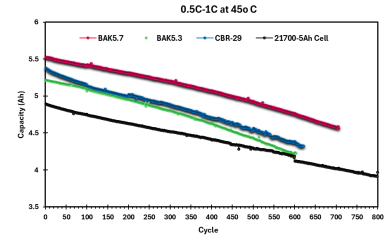
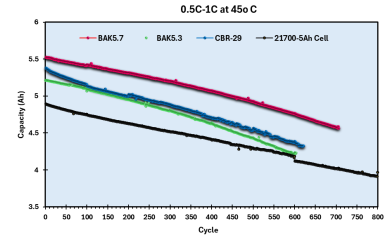
According to the information available, BAK’s 5.7 Ah cell uses a SiOx‑based anode; yet I still observe higher capacity and a very linear DCIR growth, which raises some eyebrows.....
 
Both BAK 65E and 58E have listed a Si-O Graphite, CAS: 7782-42-5 / 10097-28-6 as anode materials in their MSDS.
Do you have more information on these two variants? I am very interested to understand the exact chemistry they chose. It appears to be a cost‑effective design that does not sacrifice performance.
 
Currently on the market, there are 4 Si-anode implementations being used.

1. Low % SiOx; Si embedded into a SiO2 matrix. Limited to around <1-10% Si loading since the pesky SiO2 is non conductive, and high fractions tend to make the anode non conductive. The SiO2 and lithium silicate form during lithium-silicon alloying is what limits silicon expansion.

2. Si-C carbon: There are a few implementations floating around, but Group 14's SCC55 version is nano silicon deposited via high throughput CVD into a carbon based scaffold with internal voids to allow for silicon to expand without electrolyte interaction.

This allows for higher Si loading, but costs more than metallurgical silicon and limits Si loading to aboit 45-55% due to the high carbon contents. However, it does have the property of being about as tough as most graphite anodes and can even be tougher. Do note that a specialized electrolyte is still required for absolute best performance, so proper binder, better tougher separators that don't just use flame central polypropylene/polyethylene.

3. Pure Si: by mechanically engineering the silicon directly in the form of nano wires, pillars or rods, you can increase silicon anode loading to 100%. Even with these implementations to minimize mechanical stresses and electrolyte interactions, pure silicon has a tendency to reduce battery lifetime by a decent margin. Even those will employ special coatings and even special alloys to minimize E X P A N S I O N. Highest capacity, but that comes with the previously mentioned tradeoffs.

4. Fully encased SiOx: you greatly increase SiOx loading to near 100%, but you add a high ionic conductivity layer to allow the SiOx to interact with the rest of the cell at high loadings. You can also dope the SiOx itself. Then you add a much more conductive carbon layer and you finish with an outer coating that can handle the expansion and interaction with the electrolyte, so probably a crosslinked/mechanically stable coated layer.

That is how Amprius made their SiCore anode. It does have downsides like lower Si loading relative to a 100% Si anode due to the other components and use of SiOx. HOWEVER, one big advantage is that it technically allows for the use of no other active anode material, so no need for extra graphite or tin to lower your costs :)
 
Back
Top