• Hello ES! We could use some help to get us past the finish line on building the new knowledgebase for the forum.
    Can you donate? Please see our fundraising page. Thank you!

Fixing No Throttle, Empty Battery Meter & No Brake Sensors on KT Controllers!

BAZ

New here
Joined
Aug 10, 2018
Messages
11
HI All! I'd like to share my fix to a problem I had. Posting this a bit of a reference for anyone else who has this issue with their KT controller!

For reference my controller is a: KT36/48SVPKRD-SPS03. I imagine this will work on other similar KT controllers that use 5V.

Went down a bit of a rabbit hole this week when my ebike of 7 years (!!) starting playing up one morning. The screen would turn on and it would seem normal, but using a throttle or brake level sensor would not move the bike nor trigger any change on the screen. The screen wouldn't record any display any speed (0mph) when I manually pedalled it down a hill either!

The only odd thing on the display was the Battery Meter reading 0 bars and Empty, while the Battery Voltage read a happy 52V! No error codes at all.

With a bit more investigation I noticed that the 5V lines (Red/Black) or the throttle, sensors and Hall-sensor plug all read 0.4V instead of the nice ~4.5V i'd expect. I unplugged everything but had the same results. Something must have broken on the 5V circuit which is used for Brake Sensors, Throttles, Etc. So I cracked open the controller for the first time since owning it (5 screws on the non-wire end and 5 on the wire end and lift off the top panel, mine was lightly glued)

The 5V circuit is powered the following way:

48V (Battery Voltage) <-> Current Limiting Resistor (180 Ohms) <-> LM317T Regulator <-> 15V <-> 78M05 Regulator <-> 5V Circuit

TLDR:
The large 2W resistor (180 Ohms) had blown and prevented the entire 15V and 5V circuit from getting any power. The circuit is needed for throttle, hall motor sensing and brake sensors. I replaced it with an uprated 5W 180 Ohm resistor and everything now works!

The offending resistor:
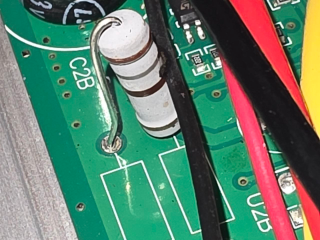
1758980404892.png


Working backwards with a multi-meter, I found the 5V 78M05 had 0.4v input and 0.4v output. Not the problem. Next up the 15V LM317T regulator. The output of this was also 1V, well below the 15V expected. The input for the LM317T was ALSO 1V. So this means it is not the problem.

The next obvious thing in line was the large Current Limiting Resistor between the 48V (Battery Voltage) and the LM317T Regulator. This looked as if it had got a bit warm and the ceramic coating had cracked (and it had touched a nearby ground wire and melted the insulation). Testing with a multi-meter showed no connection between the ends of the resistor. It had fried preventing the entire 15V and 5V circuits from getting any power!

The fix:
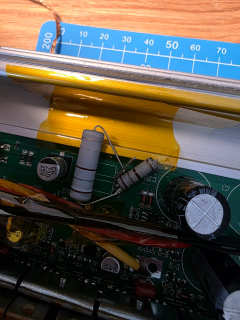
- I simply snipped and desoldered the leads of the faulty resistor and replaced it with a larger 5W resistor soldered onto the same pads. I put some kapton tape around for good measure to prevent any accidental contact between anything else.
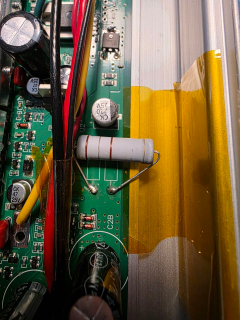
1758980481920.png

Old vs New Resistor size! (2W vs 5W):
1758980523074.png

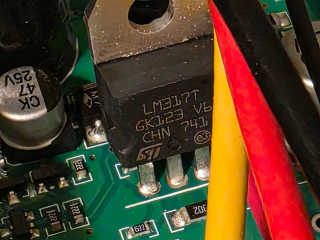
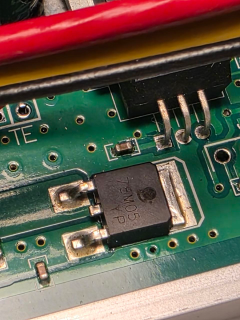
The 15 & 5V components for reference: 78M05 and LM317T
1758980428135.png1758980433670.png

Got a bit more life out of my controller yet!
 
Good work, BAZ!

As long as you pointed them out, both the resistor and the LM317T also limit what you can apply as far as over volting a controller. And it seems like all the inexpensive controllers use this same circuitry.
 
FWIW, many modern controllers do use a DC-DC instead of the old resistive-drop / lm317 kludge, partly because of the wasted power of the resistive method, partly because it could be cheaper to use the dc-dc than to use the resistor/317/7805 and associated parts.

The main fault with the resistor thing that happens is that the 317 can only draw so much current or have so much voltage on it's input, and the higher the pack voltage is, the hotter the resistor to drop that down to what it can tolerate will get.

if the resistor / etc was setup / designed for a lower voltage pack, the 317 can get mroe current or voltage than ti was designed for, and fail. if that' doesnt' happen, the resistor tiself can get so hot that it fails, or even unsolders itself.

it doesn't have to be the user running it at too high a voltage--it can be just the factory that made it used the wrong resistor / etc for the batch of controllers, and used one for a lower voltage system, or the designer of that version miscalculated the resistor, or it can even be that the pennypinchers buying the parts bought a too-low-wattage part for that run (or they just always do that).

In many environmental conditions it might not even be an issue, but when a controller is not in the airflow, or is inside a box or bag, or inside a frame but not affixed to it so that heat can be conducted out thru the frame quickly enough, the heat buildup inside means the resistor has nowhere to send it's heat, and it and surrounding parts can fail from that heat. :(


but it makes so much heat in some systems that it will fail even if you used it in the arctic wastes. ;)
 
What's a good modern controller these days? The KT has done me well and I'm glad it's still working now after 7+ years but I can tell it's not going to last forever!
 
Unless you're replacing it now, or very soon, you might as well wait until you do need to replace it, becuase what is modern now will probably be obsolete by then. ;)

And you should also make yourself a list of functional requirements, and desired functions, and how you would like the system as a whole to operate for you, so you can make sure that whatever controller you go looking for has all of those things (or as many as you can find in a single device / system).

For instance, do you want torque sensing or cadence-control? Or are you happy with simple on/off "am I pedalling at all" control? Throttle? Do you want the system to control motor torque? Or just speed? Do you need assist levels? Or do you want all available power always available to you? Do you want a display? What do you want the display to tell you or be able to do (menus, settings available, etc)? What current limit does it have to have to protect your battery? How much power does it have to provide to the motor to overcome the conditions you ride in?

Lots more detail you'd need to list for yourself to pick a controller.

A controller can be as simple as a dumb generic controller that just spins a motor for a throttle. Or it can be a part of an integrated system with many funcitons.

So, what you want to get depends on what you want it to do.
 
A screen is certainly nice! All I'm looking for really is a reliable, efficient modern Sine wave controller for 48V 40A battery. Throttle, no PAS needed that works with a hub motor.

I have brake sensors, screen, power switch and throttle. Not much need for anything else.

The KT ones work but seem like a bit of a black box and the interface is a bit dated to me. I've looked the VOTOL and the Fardriver ones, they look very neat.
 
A screen is certainly nice! All I'm looking for really is a reliable, efficient modern Sine wave controller for 48V 40A battery. Throttle, no PAS needed that works with a hub motor.

I have brake sensors, screen, power switch and throttle. Not much need for anything else.

The KT ones work but seem like a bit of a black box and the interface is a bit dated to me. I've looked the VOTOL and the Fardriver ones, they look very neat.
So you actually have a lot of requirements there, and imply others that aren't stated directly, but you'll need to break them down, along with all the stuff implied by them but not stated. The way you state some things makes them not requirements. If they are requirements you must make them definite.

I'll break down what you've said into what it means. If you intend a differnet meaning, you'll need to convey that more precisely.

All that said...if you want a more modern controller that can be used within the limitations actually stated in your post, you could chekc out the ebikes.ca Phaserunner. It can be used with their smartcable and a few different types of displays, so you can at least pick from among those.


Breakdown below, to help you see the problem with interpretation. ;)


--screen (lcd? oled? ??) nice, but not required?

--you have a screen and the way you make that statement implies you don't need a new one? If so, that means you must get a controller that's compatible with the one you already have, which greatly limits your choices. You don't state the type, so I don't know what would work with it.

--unspecified UI design for a screen if you get one, but different from what you've listed (KT, of which there are several varieties). You don't specify which specific V or FD display you're referring to, or what specifically about htem is "neat". You don't state which specific things you require the display to show you, or be able to do for you. Do you need buttons? Touchscreen? ?? Color? setup menus? For what functions? Etc.

Note that all displays are a "black box" as is the controller. You don't know what's going on in there, and you can't change them. Exceptions are open-source ones like VESC, or user-installed open-source firmware on some like lishui, kt, etc., if you can / want to rewrite the code to do things the way you want them to.

--no pas for a hubmotor (do you want pas for something else? the way you state that implies that you might, since you don't simply say "no pas"

--the controller must accept brake inputs you already have, but you don't specify which ones they are. Do they need to just turn the motor off? Do they need to provide regen braking? On/off? Variable? ??


--you have a power swithc, but don't state the type. So if it's one that connects to the controller to do it's job, the controller must be compatible with it. If its' one that cuts off the battery itself, it doesn't matter what systme you have, as long as the switch can handle the full current that system will ever draw under worst-case conditions.

--Since the battery is only 40A, then whatever controller you get cannot have a current limit higher than that, and must be a kind that honors that current limit (many do not, and can have much higher momentary currents during startup from a stop, etc).

--you have a throttle, this implies you need a controller that directly uses one. (some don't). Presumably it's a common hall throttle type, most controllers accept those. Also implies that you don't want assist levels, just all power always available, since you don't state otherwise.


--sinewave: there are mutliple types. Simple lookuptable sinewave, FOC, etc. FOC are more efficient than lookup table, and can be more torquey for the current drawn, but must be correctly setup for hte specific motor being used. Some FOC controllers have good autotuners, some don't, and a few have no (or faulty) autotuning and require you to know your motor's parameters (not marked on any of them, not available from manufacturers or sellers either, mostly), to manually input those into the controller, or play guessing games until you eventually get it working right. If a controller is not user programmable (meaning it has no setup program on a computer or app on a phone, or complete access to all parameters via a screen built into the system), it is probably not FOC, and if it claims sinewave it will probably be simple lookup table.


Etc.
 
The main fault with the resistor thing that happens is that the 317 can only draw so much current or have so much voltage on it's input, and the higher the pack voltage is, the hotter the resistor to drop that down to what it can tolerate will get.
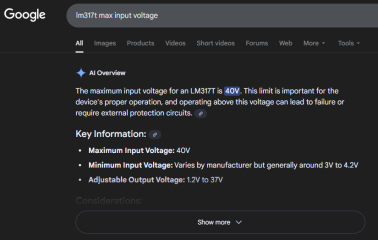
I think the issue is far more obvious, as even AI knows;
lm317t_issue.png

Yet it is being used w/voltages way above. Decided not to accept that, and went w/removing it myself.

edit: oh and yes, i'm aware ^is actually just the max input-output voltage differential, but 48V is at very near that limit when full, and 52V full is already above it.
 
Last edited:
I think the issue is far more obvious, as even AI knows;
Yes, that's why I said (which you quoted ;) ) that it can "only...have so much voltage on it's input."

And that the resistor heat problem is caused by the amount of current thru it, and the voltage across it, which both are exacerbated further the higher the pack voltage is to start with.

That's all I was trying to get across--not that the resistor or 317 are the right solution...just explaining to other readers now and in the future that this is why it was done that way, and what happens because of it. (I didn't specify the voltage because it isn't important for this point)

Decided not to accept that, and went w/removing it myself.

Could you show us your solution?

Since this thread by BAZ is showing us theirs, it'd be a good enough place to keep any of these that people come up with.
 
Back
Top