• Hello ES! We could use some help to get us past the finish line on building the new knowledgebase for the forum.
    Can you donate? Please see our fundraising page. Thank you!

I need advice to choose the best AGM deep cycle batteries.

YellowBuzzaroundEX

🔋 Established
Joined
Dec 19, 2021
Messages
62
I own 3 identical small travel type (can store scooter in a car trunk/boot) mobility scooters that use two 12V AGM batteries in series to power its 24V system. I'd prefer to continue using deep cycle AGM batteries in my scooters. I used to be a battery tester for AGM mobility batteries for a large local battery store. Also, I'm handicapped and use my scooters for local transportation in a city.

AGM deep cycle batteries deliver a higher sustained wattage to the motor than gel batteries can. My scooter has its speed limiter removed. So it goes faster than stock and needs higher sustained wattage from the batteries than it did when stock. I drive 65% faster than stock and much farther distances than normal for a small travel scooter. I work the batteries hard. Often to 50-80% DOD. Occasionally to 90% DOD.

I don't want to switch to LiFePo4 batteries.

My scooter controller and battery voltage monitor are setup for AGM batteries. My charger is setup for AGM. I don't want to reconfigure for gel or LiFePo4. My 3 wheeled scooter needs to continue using lead batteries (located in scooter floor) for ballast for low COG and stability so I don't tip over.

My Golden Buzzaround XLS-HD 3 wheel scooters need new batteries. I need advice to choose the best AGM deep cycle batteries available.

In the past, I used the following batteries with the following results:

3 pairs MK AGM batteries. 6-12 months service life. 3.2 miles range IRL city driving. MK sets the standard for mediocrity. These are the brand of batteries the scooter came with when stock.

Note: East Penn Batteries makes MK, Duracell, and Deka. Same battery. Just different name on the label.

2 pairs Full River DC (deep cycle) AGM batteries. 4-6 weeks service life. 3-4 miles range IRL city driving.

2 pairs Discover EV (deep cycle) AGM batteries. 12 months service life. 5-6 miles range IRL city driving.

3 pairs Powersonic PDC (deep cycle) AGM batteries. 3-5 years service life. Typically 3 years service life, but one pair lasted 5 years. 6-7 miles range IRL city driving.

As you can see, the Powersonic Deep Cycle (PDC) AGM batteries kick butt. They cost the same as MK batteries. Lower cost than Discover batteries. I don't remember what Full River DC cost.

I recently discovered CSB EVH batteries and have been reading their spec sheet. CSB EVH 12240 specs are better than the Powersonic PDC 12200 specs, which makes me hopeful that CSB EVH 12240 would be an upgrade, but I don't take spec sheets seriously because some companies lie.

For example, Full River DC's spec sheet claims to have the best specs, but it performed the worst of any brand I tried. Discover EV claims good specs and performs well, but Powersonic PDC performs the best (of batteries I used/tested) and the PDC spec sheet is modest. So manufacturer claims don't mean much. Real world results are what matters.

Should I buy Powersonic PDC 12200 again, or buy CSB EVH 12240 this time? Does anyone have experience using CSB EVH in a scooter or wheelchair?

Does anyone have experience using CSB EVH batteries in a scooter or wheelchair?

A secondary consideration is Powersonic is a Chinese company with its batteries made in China. CSB is a Taiwanese company with batteries made in Taiwan, Japan, China, and Philipines. Aside from any patriotic considerations... There's more tariffs on Powersonic and less on CSB. I'm not aware of any good deep cycle AGM batteries made in USA.
 
Last edited:
A rare day indeed for me to recommend lead acid anything.

Some years back I converted an English mobility scooter for my aging father. For batteries, I opted for a pair of cordless Milwaukee M28's in parallel. Easy to remove from the trike and pop into a designated Milwaukee charger. He rode that trike regularly (at its 12mph limit) for the better part of 5 years, and then somehow toasted the controller. By that time, he was too old to safely ride it again, so I parked it. And yes... the batteries were still well within 90% capacity.
 
Last edited:
Why don't you want to switch to LFP packs?
My 3 wheeled scooter needs to continue using lead batteries (located in scooter floor) for ballast for low COG and stability so I don't tip over.

Powersonic PDC (deep cycle) AGM batteries work well for my needs. The Powersonic PDC is much better than the Powersonic PS that many people use. However, I theorize that CSB EVH might be the best deep cycle AGM, which is why I asked about the CSB EVH.
 
Last edited:
A rare day indeed for me to recommend lead acid anything.

Some years back I converted an English mobility scooter for my aging father (I'll post an image if i can find it).

View attachment 379157
For batteries, I opted for a pair of cordless Milwaukee M28's in parallel. Easy to remove from the trike and pop into a designated Milwaukee charger. He rode that trike regularly (at its 12mph limit) for the better part of 5 years, and then somehow toasted the controller. By that time, he was too old to safely ride it again, so I parked it. And yes... the batteries were still well within 90% capacity.
That's a beautiful custom scooter you made, but it's much too low for me to use. My knees wouldn't allow me to get down and up from a seat that low. I need my scooter seat to remain at stock height, and I need to retain its stock swivel/rotating seat feature.

So with seat remaining at stock height... My 3 wheeled scooter needs to continue using lead batteries (located in scooter floor) for ballast for low COG and stability so I don't tip over.

Good quality deep cycle AGM batteries are adequate for my needs. Specifically, a pair of Powersonic PDC 12200 batteries is adequate for my needs. However, I theorize that a pair of CSB EVH 12240 might be better. That is why I asked if anyone has experience using CSB EVH 12240 batteries (or other sizes of CSB EVH batteries) in a scooter or wheelchair.
 
Last edited:
You could get lifepo4 batteries, they'd be cheaper per year of ownership by a lot, usually last 10 years. A much better buy, and, not a lot more expensive than lead acid these days.

Bricks are cheap to make up the difference in weight ;)
 
When I worked in the hospital, we had lots of equipment that used smaller lead-acid batteries. We had several suppliers. My experience is the CSB and Powersonic were about equal in terms of lifespan. The really good ones were Hawker Genesis, but those were more expensive.
 
Lead acid longevity is greatly influenced by the ability of charger to truly fully charge them after every cycle.
I got my best service life from a group 27 Northstar AGM in deep cycle and engine starting duty, but it needed the occasional high amp recharge to full, opposite of what most say about lead acid batteries.
 
My 3 wheeled scooter needs to continue using lead batteries (located in scooter floor) for ballast for low COG and stability so I don't tip over.

Powersonic PDC (deep cycle) AGM batteries work well for my needs. The Powersonic PDC is much better than the Powersonic PS that many people use. However, I theorize that CSB EVH might be the best deep cycle AGM, which is why I asked about the CSB EVH.
Well, my recommendation then would be to fill the scooter floor to the brim with batteries and compensate the rest with bricks or iron weights.
 
for ballast for low COG and stability so I don't tip over.
Can you modify area where batteries go? Bigger lead batteries will go farther. Look at fork lift batteries.

So it goes faster than stock
Slow down when going around corners and you will be less likely to tip over. Also careful with hills.

I also am looking for scooter batteries. Look here.

merits-pioneer-4-battery-recommendation

It's hard to decipher all the different mobility scooter battery sizes. Size I need is U1. Look at this.

[Like New] Power Queen 12V 45Ah Group U1 Lithium Battery $97.99

I know nothing about that ipowerqueen.com place.

After looking at the internet. U1 lead acid mobility scooter batteries. They all all about $75 each with free shipping. So $150 for 2

$75...... 1 - 2 years.

$98...... 10 years.

Stop being stubborn. Stop worrying about tipping over. Think the difference in weight between lead and lithium batteries is about equal to 2 gallons of milk.

On the subject of milk. Ever try to walk a mile with a gallon of milk? THAT IS WHY I WANT A SCOOTER!
 
Last edited:
Used lead wheel weights are denser. Easy to get cheap from tire shops.
Today most all wheel weights are steel. Gold is heaver then lead.

Re: cheap? If you paying more then $0. You been cheated. Bring some plastic buckets and a hand truck to move them.

Separate out the brass valve stems.
 
Can you modify area where batteries go? Bigger lead batteries will go farther. Look at fork lift batteries.
There's no extra room in the battery box.
Slow down when going around corners and you will be less likely to tip over. Also careful with hills.
I already do those things.
I also am looking for scooter batteries. Look here.

merits-pioneer-4-battery-recommendation

It's hard to decipher all the different mobility scooter battery sizes. Size I need is U1. Look at this.
U1 is a good size, is very common, and widely available from many brands. My battery size is smaller than that. Often referred to (slang) as half-U1.
[Like New] Power Queen 12V 45Ah Group U1 Lithium Battery $97.99

I know nothing about that ipowerqueen.com place.

After looking at the internet. U1 lead acid mobility scooter batteries. They all all about $75 each with free shipping. So $150 for 2

$75...... 1 - 2 years.

$98...... 10 years.

Stop being stubborn. Stop worrying about tipping over. Think the difference in weight between lead and lithium batteries is about equal to 2 gallons of milk.
Two 12V LiFePo4 batteries in series won't stay balanced for long if you charge them in series. My battery box is configured to hold two small batteries. If I were to use LiFePo4 batteries, they'd need to be two 24V batteries connected in parallel so they could be charged by one charger and stay balanced. One single large battery would be even better, but my battery box only fits two smaller batteries.
On the subject of milk. Ever try to walk a mile with a gallon of milk? THAT IS WHY I WANT A SCOOTER!
Get bright colored (for visibility safety) backpack (frameless day pack) and strap it into the back of the scooter seat. Then you can carry a full grocery bag of groceries in it, plus whatever fits in your scooter basket.
 
When I worked in the hospital, we had lots of equipment that used smaller lead-acid batteries. We had several suppliers. My experience is the CSB and Powersonic were about equal in terms of lifespan. The really good ones were Hawker Genesis, but those were more expensive.
I will research Hawker Genesis AGM. Thanks!
 
I've seen that video before. Two 12V LiFePo4 batteries wired in series won't stay balanced for long. Then you'll have problems.

Two 24V LiFePo4 batteries wired in parallel would stay balanced much better. That is how I'd do it if I was going to use LiFePo4.

Even better would be one large 24V LiFePo4 battery, but that wouldn't fit my battery box.

As for Dakota batteries... I watch a battery testing channel were a professional electrician who's an amateur electronics expert tests various brands of LiFePo4 batteries and then disassembles them on camera to inspect quality. Dakota failed the battery tests miserably, including safety tests. It even failed the short circuit battery disconnect test. It's a fire hazard. No thank you.
 
Would 2 - 12V Lithium chargers eliminate that fear?

OR how would you charge 2 - 12V Lithium batteries in series?
The battery box is sealed to be water resistant. The only way to charge batteries is via the plugin on tiller. So only 1 charger (24V) can be used.
 
There's plenty of 24v lithium batteries out there, don't know two 12v would be useful. Not like you need to occasionally split the battery. :)
Just buy a single 24v battery, a charger for it, and a brick. :)
 
Two 12V LiFePo4 batteries wired in series won't stay balanced for long.
Hogwash.
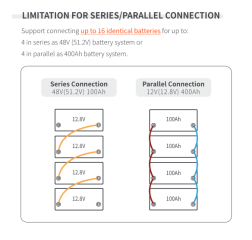
I have not 2... but four Litime 12V 100Ah Lithium LiFePO4 batteries, all connected in SERIES for a total nominal output of 48V. Wired exactly as Litime recommends in the manual. I charge with 16 PV's feeding a single Victron 150/35 MPPT controller. The batteries have been in service now for about a year (when I pulled my final set of dying fla's). Absolutely NO balancing has been required so far.

Copied from the manual....
1760584800076.png
 
Hogwash.
I have not 2... but four Litime 12V 100Ah Lithium LiFePO4 batteries, all connected in SERIES for a total nominal output of 48V. Wired exactly as Litime recommends in the manual. I charge with 16 PV's feeding a single Victron 150/35 MPPT controller. The batteries have been in service now for about a year (when I pulled my final set of dying fla's). Absolutely NO balancing has been required so far.

Copied from the manual....
View attachment 379189
Yes, but how are you charging them? One 48V charger or four 12V chargers? I don't understand the details of what you posted because you used abbreviations and jargon without explanation of what they mean.
 
Last edited:
There's plenty of 24v lithium batteries out there, don't know two 12v would be useful. Not like you need to occasionally split the battery. :)
What?
Just buy a single 24v battery, a charger for it, and a brick. :)
As I said in earliers posts, I can't use one large 24V battery because my scooter's battery box physical shape does not fit one large battery.
 
The jargon PV means Solar Panels. The charger is a Victron 150/35 MPPT. This takes energy from solar panels or other sources and converts it. The details of the charger is online. Normal I would guess it would take up to 150V with a maximum of 35A. This is just what he is using.
 
Back
Top