

I would like to share my experience with this type of controller.
The controller does not respond to the pedaling force, nor to its cadence. Hence the “imitation”. It would be better to describe it as a “power mode”. It works in such a way that after selecting the assistance level, the motor constantly helps you with the programmed force, regardless of the riding speed. Conventional controllers have a so-called “speed mode” and at each assistance level they only help up to a fixed speed programmed by the manufacturer. In practice, this is usually around 10 km/h at assistance level 1, a little more at level 2 and the maximum at level 5. So if you want to ride such a bike briskly, e.g. 25 km/h, you have to choose assistance level 5. Unfortunately, with such strong assistance you will not be able to do any sports at all, because the bike will do all the work for you. Of course, at the expense of range. That's why I prefer power-limited controllers over speed-limited ones. This allows me to achieve high average speeds and maximize range with minimal motor support.
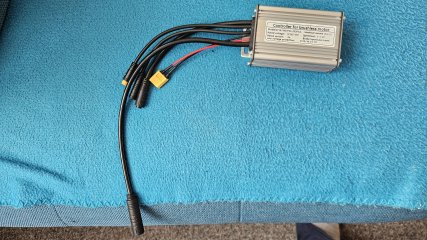
On my bike with a "no name" motor with a 36V/250W rear gear, I originally had a very cheap 15A controller with torque simulation. In principle, it suited me and I wouldn't want another system. However, the motor was not running smoothly, so I was looking for a better quality, but not too expensive controller. I couldn't find any specific tips for such a controller on professional forums, so I contacted several sellers on Aliexpress. One seller wrote back to me that the Kunteng KT36/48V SVPR controller with the KT-LCD5 display has the option of such a setting. It even works in the so-called sine mode, which should guarantee smooth motor operation. I purchased it and installed it on my bike. After setting the necessary parameters and testing it, I confirm that it met my requirements. The motor runs smoothly and quietly at higher speeds than with the previous controller.
I repeat again that the controller is suitable for cyclists who do not want all the work from the bike, but also actively help it. The speed limit is the same for all assistance levels and can be easily set with one parameter (theoretically up to 72 km/h). The resulting riding speed therefore depends only on the cyclist's performance and the selected assistance level. If you are not lazy, you can move briskly (25-30 km/h) with minimal engine support and thus increase your range. Below I will list the parameters with which this mode is set:
The current mode is selected by setting parameter P3=1 (if you set P3=0, the bike will be in classic speed control mode).
Parameter C14 sets three sets of assistance power:
C14=1 support power for assistance 1-5 is approximately 6/17/30/45/100% of the maximum motor power
C14=2 support power for assistance 1-5 is approximately 12/22/40/55/100% of the maximum motor power
C14=3 support power for assistance 1-5 is approximately 17/30/45/66/100% of the maximum motor power
The level of individual stages cannot be changed, but I believe that everyone will find one that suits them in the default settings.
Parameter C5 allows you to gently (in eight stages) reduce the maximum current of the controller by up to 50%. All support stages will react proportionally to the current reduction.
The controller has the ability to connect throttle, brakes, front and rear lights.
I am attaching a link to the purchased controller with display, PAS sensor and 1T5 cable (which is unnecessarily long). The price for these 4 components was less than 77€.
The controller does not respond to the pedaling force, nor to its cadence. Hence the “imitation”. It would be better to describe it as a “power mode”. It works in such a way that after selecting the assistance level, the motor constantly helps you with the programmed force, regardless of the riding speed. Conventional controllers have a so-called “speed mode” and at each assistance level they only help up to a fixed speed programmed by the manufacturer. In practice, this is usually around 10 km/h at assistance level 1, a little more at level 2 and the maximum at level 5. So if you want to ride such a bike briskly, e.g. 25 km/h, you have to choose assistance level 5. Unfortunately, with such strong assistance you will not be able to do any sports at all, because the bike will do all the work for you. Of course, at the expense of range. That's why I prefer power-limited controllers over speed-limited ones. This allows me to achieve high average speeds and maximize range with minimal motor support.
On my bike with a "no name" motor with a 36V/250W rear gear, I originally had a very cheap 15A controller with torque simulation. In principle, it suited me and I wouldn't want another system. However, the motor was not running smoothly, so I was looking for a better quality, but not too expensive controller. I couldn't find any specific tips for such a controller on professional forums, so I contacted several sellers on Aliexpress. One seller wrote back to me that the Kunteng KT36/48V SVPR controller with the KT-LCD5 display has the option of such a setting. It even works in the so-called sine mode, which should guarantee smooth motor operation. I purchased it and installed it on my bike. After setting the necessary parameters and testing it, I confirm that it met my requirements. The motor runs smoothly and quietly at higher speeds than with the previous controller.
I repeat again that the controller is suitable for cyclists who do not want all the work from the bike, but also actively help it. The speed limit is the same for all assistance levels and can be easily set with one parameter (theoretically up to 72 km/h). The resulting riding speed therefore depends only on the cyclist's performance and the selected assistance level. If you are not lazy, you can move briskly (25-30 km/h) with minimal engine support and thus increase your range. Below I will list the parameters with which this mode is set:
The current mode is selected by setting parameter P3=1 (if you set P3=0, the bike will be in classic speed control mode).
Parameter C14 sets three sets of assistance power:
C14=1 support power for assistance 1-5 is approximately 6/17/30/45/100% of the maximum motor power
C14=2 support power for assistance 1-5 is approximately 12/22/40/55/100% of the maximum motor power
C14=3 support power for assistance 1-5 is approximately 17/30/45/66/100% of the maximum motor power
The level of individual stages cannot be changed, but I believe that everyone will find one that suits them in the default settings.
Parameter C5 allows you to gently (in eight stages) reduce the maximum current of the controller by up to 50%. All support stages will react proportionally to the current reduction.
The controller has the ability to connect throttle, brakes, front and rear lights.
I am attaching a link to the purchased controller with display, PAS sensor and 1T5 cable (which is unnecessarily long). The price for these 4 components was less than 77€.
Attachments
Last edited:

 then you can do about anything in the ASI that you can do in the PR, eventually.

