• Hello ES! We could use some help to get us past the finish line on building the new knowledgebase for the forum.
    Can you donate? Please see our fundraising page. Thank you!

Orange Surge Recumbent

lordricker

🔌 New-ish
Joined
Sep 15, 2025
Messages
19
Location
Ohio
I have decided to build a new ebike.

Currently i drive a viola mart 1500w rear hub kit and its served me for almost 4 years now.


Parts ive bought so far:

Qs 3kw 50h hub motor

Jk smart BMS 8-24s

Lot of 18650 cells (qty 260)

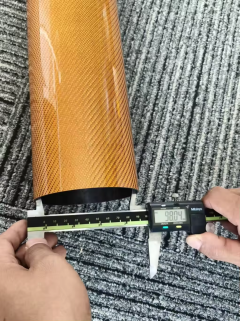
4in round carbon fiber tube for the main frame piece.

Rockshox air shock for rear

Planning to buy a 250a 85v spintend Ubox VESC

4in wide copper strip and nickle plated steel


Right now im working on the battery.

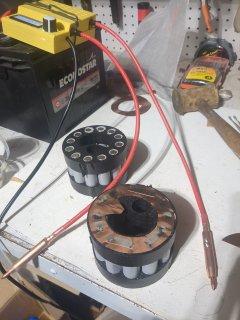
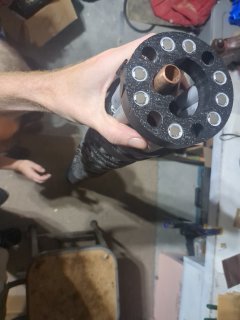
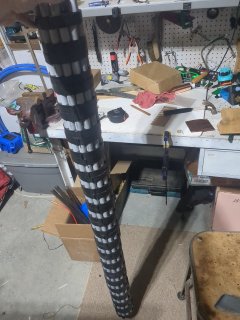
I have access to a cnc and lots of scrap HDPE plastic so I cut cell holders out of that. Will cut matching copper donuts to spot weld. The pack will be 20s12p and stacked up like donuts in the carbon tube. A wrapped copper pipe runs through the center of the donuts and so will the balancing wires. (See pics)


Plan for the rear wheel is to use custom hdpe tube clamps on the carbon as to not put any holes in the carbon, and that will create a hinge for the stainless tubing wheel carriage.


Im not really settled on a plan for the front, like what wheel size, under seat or over seat steering ect.

Another note is i am planning on a full lighting system but no details on that yet.

Im open to discussion on any of this since its my first custom build and there is a lot of knowledgable people here!
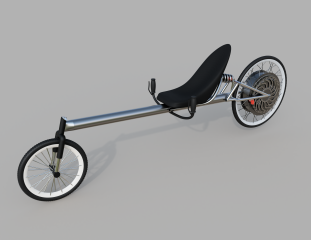
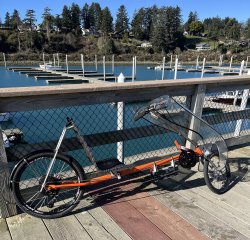
Ebike Render.png
 

Attachments

  • IMG_20260808_151832_473.jpg
    IMG_20260808_151832_473.jpg
    1.4 MB · Views: 17
  • IMG_20260808_121455_801.jpg
    IMG_20260808_121455_801.jpg
    1,008.3 KB · Views: 15
  • IMG_20260808_121423_857.jpg
    IMG_20260808_121423_857.jpg
    1.3 MB · Views: 15
  • IMG_20260808_120209_409.jpg
    IMG_20260808_120209_409.jpg
    1.2 MB · Views: 12
  • Alibabafa0f258df3b035b86bad6e02ec952fe2_original.png
    Alibabafa0f258df3b035b86bad6e02ec952fe2_original.png
    2.2 MB · Views: 17
How are you going to push it home or towards rescue while it is teething? You have a pile of technical problems to solve but have chosen a bike format that severely complicates any option B.
 
How are you going to push it home or towards rescue while it is teething? You have a pile of technical problems to solve but have chosen a bike format that severely complicates any option B.
Im not quite sure what you mean? Like as in its too heavy to push down the road?
 
Im not quite sure what you mean?
I'm guessing here, but your mock-up picture shows no pedals.

Your profile suggests you are in Ohio. No pedals means no ebike - legally it can't be a bicycle or be ridden under bicycle laws without pedals - it is a motorcycle.

Perhaps your mock-up is incomplete?
 
I'm guessing here, but your mock-up picture shows no pedals.

Your profile suggests you are in Ohio. No pedals means no ebike - legally it can't be a bicycle or be ridden under bicycle laws without pedals - it is a motorcycle.

Perhaps your mock-up is incomplete?
The mock up is incomplete, but it would be a motorcyle due to speed anyway.
 
This build has a bit of a Electrom vibe . . . without the pedals.
 
This build has a bit of a Electrom vibe . . . without the pedals.
Ooh that is pretty cool! Im aiming for more ultra light but yeah very similar concept. Im hoping for like 50 mile (80km) range. Pedals on something like that seem like mostly a gimmick for law avoidance
 
Ooh that is pretty cool! Im aiming for more ultra light but yeah very similar concept. Im hoping for like 50 mile (80km) range. Pedals on something like that seem like mostly a gimmick for law avoidance

Couple problems with this idea..

On a recumbent bike, pedaling can extend the range massively.
It's also important to have a place for the feet to rest.

Without pedals, and a very large motor ( easily capable of highway speeds on this setup ), you are building something very obviously not legal at a time where laws are tightening and actually getting enforced at times.
You will not be able to legally argue it's a motorcycle unless you somehow get a VIN and register it.

Another big problem is the QS hub motor weight will make the rear suspension basically useless. That QS is the heaviest hub motor ( ~30lbs ) in it's power class.
Due to the weight balance of this bike, and the small rear wheel, you really need a rear suspension.
This will work against your goal of running high speed.
 
Couple problems with this idea..

On a recumbent bike, pedaling can extend the range massively.
It's also important to have a place for the feet to rest.

Without pedals, and a very large motor ( easily capable of highway speeds on this setup ), you are building something very obviously not legal at a time where laws are tightening and actually getting enforced at times.
You will not be able to legally argue it's a motorcycle unless you somehow get a VIN and register it.

Another big problem is the QS hub motor weight will make the rear suspension basically useless. That QS is the heaviest hub motor ( ~30lbs ) in it's power class.
Due to the weight balance of this bike, and the small rear wheel, you really need a rear suspension.
This will work against your goal of running high speed.
Ill ask the bmv here about custom motorcycles and if its not a possibility ill add pedals.

Im not quite following what you mean on suspension. Like the motor is a large percentage of the total weight so unsprung mass is the issue?
The current plan should allow quite a bit of variability in the lever arm where the shock will go between the back of the seat and the top of the motor carriage
 
Your selected motor is ~30lbs and the problem is that this is a massive amount of unsprung weight.
You also have a 20 inch wheel and that's a disadvantage over bumps in itself.

I'd consider a way lighter, maybe even chain driven motor... or at the very least, maximizing the size of the rear wheel to counter compensate for the enormous reduction in suspension ability.

Rear bumpiness is still a big problem on my semi recumbent due to wheel diameter, even while using a nice quality air shock. It cannot handle these broken mountain state roads well at the very best. Consider that i have this NVH problem with zero added unsprung mass.... so, the scale of problem you're up against with NVH is high!

2025-11-28-15_27_39-yeah-neptronix-gmail-com-gmail-jpg.381366


If you insist on the QS, using a MC tire would help NVH.. i'd still think about an 18" ( 22" in bike sizing ) wheel at a minimum.

But with a 10lbs DD ( Grin all axle ), you could be doing 50mph easy... which is way beyond the cornering & NVH abilities of these kinds of bikes.. so do you really need so much motor?
 
Your selected motor is ~30lbs and the problem is that this is a massive amount of unsprung weight.
You also have a 20 inch wheel and that's a disadvantage over bumps in itself.

I'd consider a way lighter, maybe even chain driven motor... or at the very least, maximizing the size of the rear wheel to counter compensate for the enormous reduction in suspension ability.

Rear bumpiness is still a big problem on my semi recumbent due to wheel diameter, even while using a nice quality air shock. It cannot handle these broken mountain state roads well at the very best. Consider that i have this NVH problem with zero added unsprung mass.... so, the scale of problem you're up against with NVH is high!

2025-11-28-15_27_39-yeah-neptronix-gmail-com-gmail-jpg.381366


If you insist on the QS, using a MC tire would help NVH.. i'd still think about an 18" ( 22" in bike sizing ) wheel at a minimum.

But with a 10lbs DD ( Grin all axle ), you could be doing 50mph easy... which is way beyond the cornering & NVH abilities of these kinds of bikes.. so do you really need so much motor?
I was thinking to use a full size rear tire, i can make the carriage whatever diameter is needed, the one in the picture is a 26".
trying to research how exactly moped or motorcycle tires are sized is a little confusing, like if the carriage has a 30" diameter clearance what is the motor cycle rim spec for that?
I havent looked into the Grin all axle much, (looking at it now its probably because it was out of my price range) if you dont mind me asking what would you recommend under $300?

"do i need so much motor" well um technically of course you dont. but alas many a man is afflicted with the curse of driving a sports car with enough horse power to put a ranch out of business.

I also really like tinkering an building things so half of this project is driven by that desire as well.
 
Another big problem is the QS hub motor weight will make the rear suspension basically useless. That QS is the heaviest hub motor ( ~30lbs ) in it's power class.
Due to the weight balance of this bike, and the small rear wheel, you really need a rear suspension.

Considering what fraction of rider weight is on the rear wheel I am not sure useless is the best description. I note that in this bike architecture seat suspension would be about as effective as swingarm suspension and probably easier to implement.
 
Bicycle size = 4 inches larger than what moto size is, across at least the 16 inch to 22 inch ( motorcycle size ) range of tires.

Under $300, if you don't mind a 12-14lbs version of the grin all axle, a gazillion chinese companies will sell you a "750w rated" DD motor. The only challenge is that you need to get a really low turn count instead of a standard winding if you are using a small wheel. The right winding depends on your wheel size, voltage, and desired top speed.

As the wheel size goes up, we need more motor since we've lost RPM. If we have a 24"-26", then the Grin RH212 is a great power to weight to dollar motor.

10lbs of motor is still a lot of unsprung mass, and you will feel it. 26", bike size will offset that poor NVH.. plan for a 2.4" wide tire or larger because you will also need air volume in the tire to help you out.

Considering what fraction of rider weight is on the rear wheel I am not sure useless is the best description. I note that in this bike architecture seat suspension would be about as effective as swingarm suspension and probably easier to implement.

I've never seen seat suspension done before on these ( outside of the mesh seat's natural suspension ), but i agree with that.
Your second best bet is a MTB sized 29" on the rear if you can figure that out 😅

The suspension on my Cannondale recumbent was really frickin' good despite the 20" wheel, and i think the reason was long travel. The ~50mm suspension on the maxarya is just too short.

Ride quality, design and performance notes by me covered here:


This bike got handling and speed right, the achilles heel was the 16" front wheel, this made me nervous to do north of 35mph.

This bike design is much lower, i think some lowness could be sacrificed in the name of taller tires, and the better bump compliance would enable faster speed. I'd chose a 24" front and 26" rear and contort the geometry/shape around making that happen to minimize added height as a result.
 
Last edited:
Considering what fraction of rider weight is on the rear wheel I am not sure useless is the best description. I note that in this bike architecture seat suspension would be about as effective as swingarm suspension and probably easier to implement.
Im interested, any examples or can you describe that bent seat suspension
 
Bicycle tires / wheels are generally measure by total outside diameter.
Example : a 26" mountain bike tire is measured from the ground to the top of the tire and the rim "bead seat diameter" is 559mm so is an odd mix of metric measurement for the rim and inches for the tire.
Motorcycle rims bead seat diameter is in inches with actual overall diameter of the tire often taking a little more investigation.
For higher speeds and weights, bicycle tires are not appropriate.

Here is an example of suspended mesh seat.
The horizontal portion is laced with stretchable shock cord to absorb the road bumps.
Vertical section is laced with a low elongation rated cord such as Paracord, Kevlar, Spectra or sometimes Zip Ties.
While it is a simple, low weight solution it has no dampening.
The motor is a reprogrammed Bafang BBSO2
9-speed-eBike.jpeg
 
Bicycle tires / wheels are generally measure by total outside diameter.
Example : a 26" mountain bike tire is measured from the ground to the top of the tire and the rim "bead seat diameter" is 559mm so is an odd mix of metric measurement for the rim and inches for the tire.
Motorcycle rims bead seat diameter is in inches with actual overall diameter of the tire often taking a little more investigation.
For higher speeds and weights, bicycle tires are not appropriate.

Here is an example of suspended mesh seat.
The horizontal portion is laced with stretchable shock cord to absorb the road bumps.
Vertical section is laced with a low elongation rated cord such as Paracord, Kevlar, Spectra or sometimes Zip Ties.
While it is a simple, low weight solution it has no dampening.
The motor is a reprogrammed Bafang BBSO2
View attachment 391481
The suspension seat is a good idea, ill probably incorporate that.

would you not recommend a bicycle tire for the front or is it mainly an issue on the back?
 
Im interested, any examples or can you describe that bent seat suspension
I'm thinking gas struts like for a hatchback instead of solid struts to hold up the seat back, plus a hinge at the front edge of the seat. You could get more elaborate and tunable by using one or two MTB air shocks between the boom frame and a seat subframe. That would take more fabrication.
 
The suspension seat is a good idea, ill probably incorporate that.

would you not recommend a bicycle tire for the front or is it mainly an issue on the back?
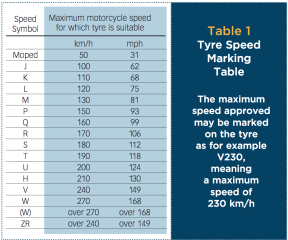
If the goal is a proper street legal motorcycle > DOT < approved tires are required.
(Department Of Transportation)
Weight and speed are the basis of the rating.
Bicycle tires have no such requirement.
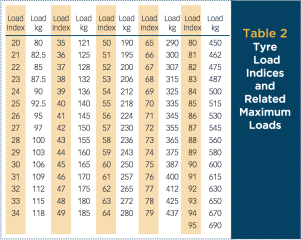
Screen Shot 2026-08-09 at 8.09.20 PM.pngScreen Shot 2026-08-09 at 8.09.43 PM.png
 
The fanciest seat suspension for the rider is of no benefit to the 15-30 pound motor and spokes and rim when you strike a pothole at 30+ mph.

Apart from the damage to these parts is the effect of the movement imposed on the entire vehicle when you hit that obstacle - suspension has the effect of preventing large frame/vehicle movements. At speed, with any side force, you are facing tires not in contact with the road so you are losing control and you won't be able to use 'body english' to regain it as you might with a light bicycle at lower speeds.

With a two-wheel upright frame, your legs can be your suspension to separate you from the wheels and manipulate the vehicle. You have an avenue to respond and reposition the wheels.

You definitely will not be able to use 'body english' when you are riding a recumbent - you are reclining on your back, facing upwards. You will go down at speed, and use your body to slow yourself to a stop.

I have ridden a recumbent (with rear suspension) and now a trike without suspension. There are reasons motorcycles and mopeds are made with heavy components and in most cases, suspensions - and it's not to lower the price. Racing motorcycles do not remove the suspension to save weight and increase acceleration and increase maneuverability - just the opposite.

Absurd speeds with bicycle components and geometry are a mistake without refined knowledge of the working envelope. @The Toecutter seems knowledgeable and I'd be interested in his thoughts if he's willing (otherwise, apologies for dragging you in, mate).

As to 'absurd speeds' I'm going by your choice of motor power. Power decides sustainable top speed. If it's rather quickness you want, meaning acceleration, then torque is what you want, not power. My trike has serious reduction 'gearing' (via sprockets, hence the quotes around 'gearing'). It accelerates quite well in addition to my chosen design criterion of climbing steep hills with large loads and not overheating. As long as I'm pedaling I can use the throttle and the machine jumps when I do - I'm happy about that accidental bonus when I'm crossing busy roads. It's torque, not power, that provides this.
 
Last edited:
Oh, also, about the carbon fiber backbone to your design.

I did my development of all three vehicles in my signature with Quantum Bicycles in Perth, so I spent many hours (over several years) in his shop watching his work and talking with him. He can do just about anything (he's a Raleigh frame builder) and he's the go-to guy for carbon frame bicycle repairs in Perth, so I've seen a lot of frame failures in his shop.

Carbon fiber splinters when it breaks - I've seen a lot of it. Look at where your crotch is in your current depictions. The price of failure is rather high, perhaps?
 
A cool low production recumbent motorcycle :


BTW a typical Harley is a feet forward "recumbent"

This full enclosed pedal powered recumbent with obvious "body english restrictions" worked rather well on race courses and the open road.

Watsonville 1989 600dpi.jpg
 
Last edited:
The fanciest seat suspension for the rider is of no benefit to the 15-30 pound motor and spokes and rim when you strike a pothole at 30+ mph.

Apart from the damage to these parts is the effect of the movement imposed on the entire vehicle when you hit that obstacle - suspension has the effect of preventing large frame/vehicle movements. At speed, with any side force, you are facing tires not in contact with the road so you are losing control and you won't be able to use 'body english' to regain it as you might with a light bicycle at lower speeds.

With a two-wheel upright frame, your legs can be your suspension to separate you from the wheels and manipulate the vehicle. You have an avenue to respond and reposition the wheels.

You definitely will not be able to use 'body english' when you are riding a recumbent - you are reclining on your back, facing upwards. You will go down at speed, and use your body to slow yourself to a stop.

I have ridden a recumbent (with rear suspension) and now a trike without suspension. There are reasons motorcycles and mopeds are made with heavy components and in most cases, suspensions - and it's not to lower the price. Racing motorcycles do not remove the suspension to save weight and increase acceleration and increase maneuverability - just the opposite.

Absurd speeds with bicycle components and geometry are a mistake without refined knowledge of the working envelope. @The Toecutter seems knowledgeable and I'd be interested in his thoughts if he's willing (otherwise, apologies for dragging you in, mate).

As to 'absurd speeds' I'm going by your choice of motor power. Power decides sustainable top speed. If it's rather quickness you want, meaning acceleration, then torque is what you want, not power. My trike has serious reduction 'gearing' (via sprockets, hence the quotes around 'gearing'). It accelerates quite well in addition to my chosen design criterion of climbing steep hills with large loads and not overheating. As long as I'm pedaling I can use the throttle and the machine jumps when I do - I'm happy about that accidental bonus when I'm crossing busy roads. It's torque, not power, that provides this.
Seat suspension would be more for ride comfort-ability.
I see what you are saying, the only thing suspending the motor and rim from impacts is the tire and air between them and the road.
Im interested in making it 50 mph capable and planned on front and rear suspension to keep the tires on the road as much as possible, I guess that wasnt clear.
I feel like you maybe oversimplified motor power, doesnt hub diameter and stator width and stuff like that have a large impact on torque?

As for the carbon fiber, what causes the failures?
 
maybe oversimplified motor power

What one does to increase power also may have effects on other outcomes - size, weight, torque, etc.

'power' is explicitly defined as a rate of energy delivery - that is, how much energy is delivered in a defined amount of time. Power is a rate. Power is not energy. Infinite power for 0 duration does no work - no energy is passed.

For a wheeled vehicle traveling through a resistive environment (friction from road, resistance from air, bearing friction, etc.) the maximum rate of energy delivery (power) will eventually be balanced by the resistance, and this leads to a top speed - where the opposing inputs balance. That's why there is a top speed - even when suspending the wheel in the air 'without a load'.

In ideal space, absent matter and other resistances, the smallest power input will lead to acceleration approaching the speed of light (infinite energy is required to attain the speed of light, so I write "approaching"). Yeah, it will take a long time, but there's nothing that will stop it happening.

On the road, you'll reach a speed limit. And it's more power that will be needed to exceed that limit (or less resistance - I can lose some fat to streamline me).

A larger motor can pass more power. As we can't pack twice the matter into the same space, that often means a motor with a greater diameter. This also means longer lever arms, and so that motor may produce more torque. But it doesn't produce more torque because it can pass more energy per time unit - power. It produces more torque because the diameter is greater.

As for a wider stator, this is quite identically putting two of the original motors side by side on the same axle, so yes total power as well as total torque will increase. This does not change the distinction between power and torque.

This is a coincidence, rather than an equivalence. Power != torque.
 
As for the carbon fiber, what causes the failures?
Load exceeds strength of material and geometry.

Keep in mind that this is a leverage problem. Time * acceleration = energy accumulated. Time * deceleration = energy dissipated.

This means you accelerated to your speed and thus your assembly (vehicle + you) is now carrying a certain quantity of energy. When something more substantial imposes itself (tree, car) all that energy will be dissipated somehow as you decelerate to a stop. In the case of a tree or a car, the distance and the time that energy is dissipated over is probably quite a bit less than the distance/time required to reach that original top speed.

The ratio shows up as a multiplier of the forces involved. On your body, and on the frame members of your trike.

I remember a 'Dennis the Menace' cartoon from long ago with Dennis standing on the sink in the bathroom about to jump off onto a bathroom scale below with the caption "Watch me weigh a 100 pounds!"

Two feet of acceleration divided by 1 inch of deceleration is a 24x multiplier. The scale will probably break, as may your trike frame under those loads

The only other factor to consider is that an automobile driver will decide if you crash. You can't avoid that. You can mitigate it. No, it didn't happen today. That has no bearing on it happening. It will happen, so design for it.

Carbon fiber (meaning carbon fiber in a resin matrix) is NOT STRONGER than steel, alumin(i)um, titanium, wood. It is only stronger per weight and then only in some dimensions. You can always achieve the same strength with other materials (aside from water, I suppose) by arranging them differently or using more. Carbon fiber is not used to achieve strength - it used to achieve strength for less weight.

And it brings along the problem that when you do exceed it's strength, it splinters into spears that shred your body parts.

If you want strength, design for the strength you want. I would not use carbon fiber without extensive experience and enough engineering training to be comfortable doing the stress calculations (which I went to school for). It's not a magic material.
 
Last edited:
Back
Top