• Hello ES! We could use some help to get us past the finish line on building the new knowledgebase for the forum.
    Can you donate? Please see our fundraising page. Thank you!

Orange Surge Recumbent

Im interested in making it 50 mph capable and planned on front and rear suspension to keep the tires on the road as much as possible, I guess that wasnt clear.

Think about a chain driven motor to let that rear wheel do it's job at such speeds.

I'm not sure what your handling limit is on such a frame considering it's so low. Hopefully it corners like a sports car.
 
The only other factor to consider is that an automobile driver will decide if you crash. You can't avoid that. You can mitigate it. No, it didn't happen today. That has no bearing on it happening. It will happen, so design for it.

Carbon fiber (meaning carbon fiber in a resin matrix) is NOT STRONGER than steel, alumin(i)um, titanium, wood. It is only stronger per weight and then only in some dimensions. You can always achieve the same strength with other materials (aside from water, I suppose) by arranging them differently or using more. Carbon fiber is not used to achieve strength - it used to achieve strength for less weight.

And it brings along the problem that when you do exceed it's strength, it splinters into spears that shred your body parts.

If you want strength, design for the strength you want. I would not use carbon fiber without extensive experience and enough engineering training to be comfortable doing the stress calculations (which I went to school for). It's not a magic material.
I am a little confused on your argument here.
If this device is in an accident involving any significant speed Id almost certainly be headed to the hospital regardless of what material the main shaft is made out of. (im imagining it turns into a road harpoon). The claim that an accident is guaranteed is catastrophized.

if your argument is about running loads and stresses id be interested to know your thoughts on this specific material.
The tube is 4" round with 4mm wall, t700 roll wrapped carbon. The idea would be to not put any holes in it.

"Any idiot can build a bridge that stands, but it takes an engineer to build a bridge that barely stands"
I thought I was leaning more towards the first half but could be mistaken.
 
A seat of the pants estimate . . .
4mm wall by 100mm diameter with a t700 layup should be plenty strong.
How the metal bits are attached to the carbon tube is important, meaning the design geometry and adhesive.

high-strength Toray T700 unidirectional prepreg sheets wrapped on a mandrel and oven-cured. They offer high bending stiffness and strength-to-weight ratios compared to pultruded tubes or metal alternatives


Motorcycle with hub motor :


My sense is, there is some engineering modesty being put forward.
Looking forward to your build thread.
 
I am a little confused on your argument here.
If you read the message by @PaPaSteve just after mine, you can get a sense of part of my communication - that is, you need to educate yourself and carbon fibre is not a magical material that just "is better" than others, such as steel, alumin(i)um, etc. Read what he writes a few times and look into the link, etc. Let it soak in.

I won't use carbon fibre as it has one and only one claim - it can be lighter. But unlike the metals, it has strength in one direction only - tension. In compression, you are dealing instead with the strength of the resin matrix, which is the only component resisting crushing forces. To mitigate this, you must then introduce clever geometry so that there is some other carbon fibre arranged so that it takes up compression loads as tension, and on an on. This means clever material build-up which must also adhere well to the original parts.

Do it if you want, but it's a crap-shoot if you don't already have experience with the material. That you are thinking of using it suggests to me that you don't know much about it. That you are thinking of a 50mph recumbent lightweight bicycle suggests to me that you know little about bicycles, which reinforces the idea that you don't know much about fabricating with carbon fibre either, and probably not much about designing for loads.

Steel? Sure. You can easily add bracing and it's strong in all axes. Alumin(i)um? Sure. You need to learn how to weld it and what alloys need heat treatment after, but otherwise it's like steel. Carbon fibre is a different animal, and it seems you don't know that.

I think your eyes are bigger than your head, in the vernacular my father used. I think you latched onto an idea - "I know! I'll put the batteries in a tube and use that as the main frame member!" - and you are stuck on that idea.

And the other part of my communication is that carbon fibre shatters into little spears. I've seen it. And it's up to other road users whether or not that happens to you, as well as being up to you if you don't design your frame for the loads.

Go for it. You'll learn a lot.
 
Personally, i'd go for chromoly. And i would make sure the bike is not too stiff, just noodley enough ( particularly in the middle ) to help absorb a bit of the irregularities on the road. Need all the NVH help you can get at these speeds, and the extra weight is warranted.
 
If you read the message by @PaPaSteve just after mine, you can get a sense of part of my communication - that is, you need to educate yourself and carbon fibre is not a magical material that just "is better" than others, such as steel, alumin(i)um, etc. Read what he writes a few times and look into the link, etc. Let it soak in.
Your comment and his have opposite messages. You have made some assumptions about the project as well as me as a person, I asked for legitimate advice from you since based on your comments you seemed like you would be knowledgeble on the subject but you laced your entire message with belittling remarks and didnt really add any new information.

If you could id rather you not comment anymore on this thread.
 
Personally, i'd go for chromoly. And i would make sure the bike is not too stiff, just noodley enough ( particularly in the middle ) to help absorb a bit of the irregularities on the road. Need all the NVH help you can get at these speeds, and the extra weight is warranted.
I originally looked at chromoly (thats why the mockup is that color) i couldnt really find a good source within budget.
 
Because a boom frame is governed by stiffness rather than materials strength, chromoly may have little or no advantage over regular old mild steel. That was true before you ballooned the tube to make room for an annular cylindrical battery. So maybe look at chromoly for things like dropouts, stays, seat struts or other geometrically constrained pieces. That gigantic boom tube will be structurally more than adequate made out of anything that would work for a fence post. I bet I could use PVC pipe in that role.
 
Metal doesn't seem super expensive. The largest size they list without contacting them is 2-3/4", but aircraft spruce sells that for 4' * $31.69/ft:

Seems similar price to carbon tubes?

Pretty sure we have similar laying around the free materials rack at the free maker space at work too. I usually ignore the tubes and go for the strut channel or angle iron or 80/20 aluminum extrusions there, though, so haven't paid much attention.
 
When developing a new concept the first place to start is adding up the weights and then calculate material needs based on total weight, expected G forces and target speeds.
From information in this thread, battery and motor are 60 lbs ?

Early in my previous design and fabrication career - before building anything I'd measure the desired materials by loading, bending and torque testing with simple mock ups.
Now days, much of the stress testing can be done in CAD.

For Lordricker's idea, the load test of the main beam is a little more complicated due to the internal battery and plastic connection rings etc.

Speaking as an experienced recumbent maker :
Main tube for hundreds of mono tube recumbents I've built were 2" X .049 cro/mo
The math and mock up testing showed 1-7/8" X .049 would work but that size was far less available.
Main tubes for the Titanium frames used Grade 5 (6al-4v) 54mm X 1mm
1020 carbon (mild steel) was a quick failure due to lack of memory (springiness).
Never considered aluminum for a mono tube frame.
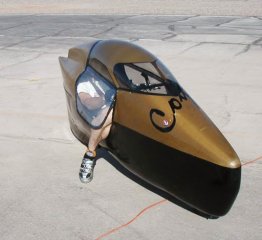
Carbon / Kevlar construction was reserved for bikes like this :

coyote-casagranda.jpg

As always
Your results may vary.
 
Last edited:
Without pedals, and a very large motor ( easily capable of highway speeds on this setup ), you are building something very obviously not legal at a time where laws are tightening and actually getting enforced at times.
You will not be able to legally argue it's a motorcycle unless you somehow get a VIN and register it.
Checked this out with local title/bmv. Fully custom motorcycles are allowed. (Not using existing frame)

Must have receipts for all parts used on the bike.
Must pass a self assembly inspection.
Will assing a VIN for the vehichle.

The estimated $55 for inspection.
 
Expect the BMV will have a published check list for things they will inspect.
That will help define the bill of materials such as DOT approved lights, brake parts and tires.
Regarding the carbon main tube, a seat of the pants estimate is the beam deflection for t700 will be over kill by several factors and geometry of 4" diameter will more then cover torque deflection.

One more item to add to the list : Insurance . . . custom builds can be higher rates.
 
Last edited:
If carbon fiber is stronger in tension than compression, maybe a front wheel motor should be used instead of rear. Pull the bike instead of push it.

No idea how to fix front wheel drives typically slipping due to lack of weight on them, though. Maybe that's why some recumbents have the chainwheel and pedals in front of the front wheel.
 
No idea how to fix front wheel drives typically slipping due to lack of weight on them, though. Maybe that's why some recumbents have the chainwheel and pedals in front of the front wheel.

I've found myself using the widest tire i can fit on the front of my recumbents for traction purposes and also, the frontend is so light that suspension barely works, so we need that air volume to pretend to be suspension too ( i run my front tire at 1/3 the PSI versus the rear )
 
Checked this out with local title/bmv. Fully custom motorcycles are allowed. (Not using existing frame)

Must have receipts for all parts used on the bike.
Must pass a self assembly inspection.
Will assing a VIN for the vehichle.
The estimated $55 for inspection.

Wow, that's a lot easier than in most states, awesome!!!!
 
If carbon fiber is stronger in tension than compression, maybe a front wheel motor should be used instead of rear. Pull the bike instead of push it.

No idea how to fix front wheel drives typically slipping due to lack of weight on them, though. Maybe that's why some recumbents have the chainwheel and pedals in front of the front wheel.
Interesting thought, its probably not quite that straight forward tho. if all the power is in the front wheel it could make steering awkward, also the front wheel already takes significant portion of braking force, if the back tire holds more of the weight when stopping it would put less compression on the tube during a hard stop.

something else to mention in my current design the power would be translated through the tube but also through the shock that connects to the seat directly behind the rider, the whole goal is to propel a person so the thought was to put the power where its needed
 
It's funny to think of this but yeah.. the ideal amount of tube stiffness is probably based on what a front brake or motor is doing.
MC tires can be purchased which are very 'sticky' relative to what you can buy in a bike tire. Something like 2.75" wide is probably the minimum for the front traction needs. The Electrom picked a MC tire for traction reasons too.
 
No idea how to fix front wheel drives typically slipping due to lack of weight on them, though. Maybe that's why some recumbents have the chainwheel and pedals in front of the front wheel.
Pretty sure the favor-ability of the short wheelbase design is convenience.
They more easily fit common place things like bus racks, bike racks, inside cars etc.
The one major aspect of a long wheelbase design is stability during high speed descents.
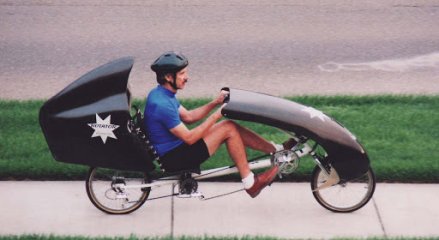
A real asset when combined with improved aero efficiency.

Interceptor.JPG
 
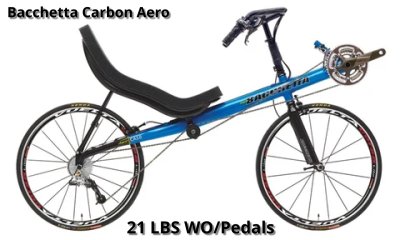
Bacchetta Carbon Aero - Arguably, the fastest currently produced CARBON FIBER hi-racer available today - Introduced in 2006

1786610625202.jpeg
 
Last edited:
Back
Top