• Hello ES! We could use some help to get us past the finish line on building the new knowledgebase for the forum.
    Can you donate? Please see our fundraising page. Thank you!

Should I Store My eBike Outside?

PeteCress

Regular
Joined
Dec 15, 2009
Messages
363
Location
Paoli (near Philadelphia) Pennsylvania USA
Seems like most battery fires occur while the battery is in use.

But what about inactive batteries charged to 80% ot less?

Am I being foolish by parking my eBIke in the garage below the bedroom?

Should I be thinking about an outdoor "Garage" for the bike?

Winter temps occasionally down in the twenties or even single digits F.
 
Have a battery in my room under my bed. It is at a storage voltage. Don't think batteries do things on their own. Charging, discharging and plugged in is a real worry for me. Not sitting at a mid voltage not plugged in to anything.

This is just my option. If your battery is getting old then more of a worry. My battery when I charge it, will take it out in the yard.
 
Have a battery in my room under my bed. It is at a storage voltage. Don't think batteries do things on their own. Charging, discharging and plugged in is a real worry for me. Not sitting at a mid voltage not plugged in to anything.

This is just my option. If your battery is getting old then more of a worry. My battery when I charge it, will take it out in the yard.
Well I guess it's about time to get one of these "Explosionproof" ebike battery bags!
 
I have a detached garage I hang a remote smoke detector over where I park the bikes. It rings inside the house if it detects anything in the garage. Since I cycle batteries on my workbench in the basement of the house I keep them in a galvanized metal footlocker.
 
But what about inactive batteries charged to 80% ot less?

Probably safer than any other situation as long as it's not also plugged in at the same time, or drained below 20%.

A battery burning up is $$$. A battery setting your house on fire, or your body, is bad news.

Burning batteries spray burning stuff that lights other stuff. A completely closed box around the battery holds pressure until it gives - which is what causes explosions (and in this case then also spraying burning stuff that lights other stuff).

An explosion proof container means it vents pressure, but doesn't permit burning stuff to spray out. A metal toolbox might work as far as I know as long as it doesn't seal gases inside.

I am relying on Grin's finding that batteries composed of cells from one of the big foundries don't ignite if they are used within spec. I'll also be buying a toolbox or something soon, as my landlord has expressed some concern.
 
If at all worried stick a temperature sensor to a strap to wrap your battery while parked. there are many off the shelf and diy project templates for temperature monitoring/alarm systems.. I would use a $5 xiaomi/clone b/tooth temp sensor and node red on a raspberry pi, but you could buy an $25 plug in inkbird controller with a temp sensor and a 'heating or cooling' socket you can plug any alarm into..

A project under 'discussion' elswhere details a mechanism to yeet the battery pack out a window ;)

Joking aside, a simple temperature alarm set to trigger say when 15-20 degrees (30-40 Freedumb degrees) above anything expected as ambient under normal conditions should placate even the most anxious?
 
Some questions to ask yourself when deciding how to store / park your bike (or whatever battery-powered thing).

If you don't know the answers, or you find yourself wondering about them, or you find yourself concerned about any of them, it's probably a better idea to store them in a safe fire-containment system away from dwellings, just in case.


How "good" are your batteries?

Were they really cheap, relative to advertised specs, compared to similar ones at the time?

What was their source?

What cells are they built with?

How are they interconnected?

How are they packed into their casing?

What physical construction methods were used for the casing, etc?

If they are not cylindrical cells, is the pack built with correct compression hardware?

Is the casing *really truly* waterproof (not water "resistant"), especially if it's *ever* been used, stored, ridden, etc in a humid environment, or rain, splashes, puddles, lawn sprinklers, etc?

How are they monitored / protected?

How is the charger built?

How good is the charger?

Does the charger have safety features to prevent overvoltage, overcurrent, etc?

Is the charger set to a voltage *below* the maximum safe voltage for the pack?

Has the pack ever experienced excursions outside the normal / safe operating ranges? (voltage, current, temperature, impacts, vibrations, etc).


I won't say that any particular cell or battery is definitely safer than any other, but packs built from large-format ex-EV cells, especially if they were left in the modules that they were originally factory built into, with proper compression hardware, etc., are probably a lot less likely to experience catastrophic failure than the average ebike battery, for many reasons associated with the questions above.

While cost isn't a direct measurement of quality, the cheaper the battery originally was, relative to similarly-spec'd ones, the less likely that the pack is built of good matched cells with proper interconnections, containment, protection, etc., and for the really really cheap ones, they could be built of literal recycled garbage cells (and maybe other parts too), with completely unknown specs, capabilites, lifespan, previous history, etc.
 
Regarding inactive batteries, just sitting there, not being charged or discharged by the user:


If they have a BMS, they're active, being discharged, albeit slowly.

Some BMS are powered at the main pack +/-, some are powered by only one or a few cell groups (and thus always cause pack imbalance, and also will eventually kill those cells if left sitting long enough, sooner than a BMS powered by the entire pack as there is far more Wh in a whole pack than a few cell groups).


If they are connected to a bike or device with a soft-power-switch, like bikes with displays where you press or hold the power button to turn them on, then they're active, being discharged, a bit faster than the BMS alone would, by the standby power required to operate the electronics in the display power-on circuitry.

In this event, the BMS *should* turn the output off once a cell group drops to LVC, but if the BMS is also powered by that group, it will continue draining it and could damage it by draining it further (below save voltage, possibly to zero), if the system sits unused long enough vs the charge state of the battery when parked).


If the pack is poorly designed or constructed, with wire routing that allows for pinches, etc., just the weight of the cells on the wiring could eventually push thru the insulation on the wires and allow them to short to each other or cells, etc. Depending on what's shorted and what (if any!) protections exist against this kind of short, enough current could flow to start a fire in the wiring itself, if not in the cells. There are a few fires (a couple here on ES) where this type of failure was suspected (but there is rarely enough left to tell for sure what started a fire).


If the pack is not truly environmentally sealed, water or other contaminant intrusion could cause interconnect damage that can allow similar shorts to the above, or cause cell casing failure.


If cell-level protections don't work, or don't exist, cells can be overcharged or overdischarged, damaging them, and once the damage exists, then depending on the specific damage, the possibility of catastrophic failure at any instant in time also exists.

Short of cell disassembly and examination microscopically, there's no way to know for sure that there *isn't* cell damage in these cases...and since that's a non-reversible destructive test, it's simpler to assume that any cell that experiences an excursion of any type is damaged and must be replaced.
 
Yes, will be taking my old battery out to the pool table room AKA converted detached garage. Before it will end my life hopefully.
 
A few years back, I fielded some questions from others at the consultancy I was working at about electric bicycles, and I posted guidelines for Li-ion battery care.

In response, one of my co-workers who was also long-term with West Australian State Emergency Services (many are volunteers) posted that he had lost count of the fires he had attended started by people leaving batteries on the charger in their garage. This includes portable electric tool batteries.

People think that it's for sale, then they must not need to think about it, but many of the electric "vehicles" sold are cheap items for children, and the legislation has not caught up with the reality yet, as this is still a fairly new item in society.
  • Don't smack it, drop it, or pretend that you didn't drop it.
  • Don't leave it on the charger - some of the battery management systems are shit, or too cheap to be reliable. Not most, but it only takes one.
  • Don't pull more amps from it than it's rated for - stay under it's rating at all times. The problem with Li-ion batteries is due to "thermal run-away" due to an initial local over-heating. it's self feeding and self-accelerating after that initial event. So just never go there.
  • Don't buy a battery if you don't know what brand of cells it is made from, and who assembled it. The big foundries make reliable cells - but used cells, unmatched cells, damaged cells, cheap cells, and lies about the origin of the cells are the source of the great majority of battery fires. Yeah, it costs more - so does your house and your life. You get what you pay for. Don't pretend.
  • Don't overheat it, don't run it in deep cold without knowing how. Learn how to charge and run batteries in the weather you are using them in - it matters. It's different.
  • Don't be lazy about this - educate yourself. It matters. My ego will not prevent any fires - it does not matter what I do or don't "feel like" about it.
Electric vehicles still have fewer fires than petrol vehicles. Just know how to deal with EVs properly.

I do look forward to battery chemistries that are inherently safe. I use Li-ion chemistries now because the power-weight and power-cost ratios are unmatched (yet), and with attention to the very reasonable guidelines they are safer than petrol vehicles. Ignorance, cheapness, and/or pretending are the dangers here.
 
Well... I'll admit I'd be more interested in seeing you move the battery out to the pool table room after it ends your life, to be honest. That's something you don't see every day.
I'm with you, would like to see that too. The battery was in my room to keep my brother from taking it. He has passed on now. Don't have a good reason to have it in here, yes it is totally crazy. When I build my trike was going to put two batteries on it never did just swapped them once a month. Not the best batteries but did not abuse them.
 
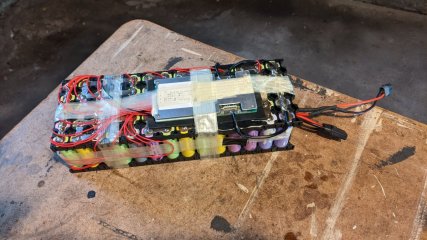
This thread got me to thinking and I dug out the oldest battery I made (14s5p - 7 years ago?) from my battery footlocker. It was the second battery I ever made, is soldered and it used different types of cells but all with the same measured capacity. (I was pretty ignorant and had unlimited 18650s available at the time.) The pack has been retired and sitting a couple years now and I checked the voltage at 52.7 which is only a tenth or two lower than when I parked it. Last fully cycled measured it at 12.8 ah. It was rarely charged over 80% and I never had a problem with it but won't risk anymore using random unknown cells in any pack. (...and to think I almost converted a Citicar to run on 18650s - heh!) I missed an opportunity with this pack and should have measured individual cell groups before sending it to its 0 (zero) volt end to see how this random pack was holding up.

bat18.jpg
 
Ok, What is the rule. Batteries are not the Bombs everyone thinks they are. If you treat it well and store it correctly not much an issue or we on borrowed time. So can he store his bike in the house?
 
Batteries are not the Bombs everyone thinks they are.
Charging is the part that worries me. Storage is pretty much a non-issue IMHO. Quality matched cells make very durable and safe packs.

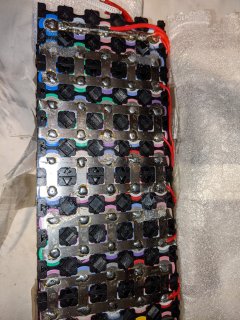
BTW - I've posted it before, but the first pack I ever made was soldered, used random cells and I'd charge to 100% and ride until it quit. After the rides got very short I opened up the pack and as you can see below (in high-res), electrolyte was leaking from many cells. Yet, no excitement, no smoke and fire. Still held some charge when I sent it to its zero volt death. It died peacefully.

PXL_20201223_174126883.jpg
 
Last edited:
So can he store his bike in the house?

It's Ok until it's not. I don't wear seat belts because I plan to crash. I wear seat belts because it's not in my power to decide. The rest of you are out there, too.. I can't control you so I hedge my bets against you.

In this case, when it's not Ok, it's really not Ok - the gasses will get you while you are asleep and you won't wake up to do anything about it. If a smoke alarm happens to catch it quickly enough, then you are attempting to grab a flaming bike that is literally spraying flaming material at you and get it out of the door (locked?) in your pajamas while choking on the fumes.

The rule you choose is up to you. I stack the odds in my favour.
 
Charging is the part that worries me. Storage is pretty much a non-issue IMHO. Quality matched cells make very durable and safe packs.

I had a shrink wrapped pack from China seem abnormally warm last summer while charging. I opened it up, and found one cell group feeling hot.. A heater cell? Had heard about them. Didn't take much thinking. I scrapped the pack.

I did have three other inexpensive shrink wraps from China with unknown cells that had worked well. Thought about it all winter and when Spring came, I scrapped them too.

I do store my spare and unused batteries at 20-30% SOC, They'll sit all year and not lose much charge, Yes, I've lost several batteries with dead cell banks,, but I believe that was cell quality, Not seen it happen with quality cells.
 
The problem with battery fires is that they are a low-probability extremely-high-consequence event.

It's very unlikely that most batteries will ever have a catastrophic failure such as a fire.

But if one does happen, it can be very quick, very hot, and all you may be able to do, if anything, is run away from it. :(

It may happen so fast that in the wrong circumstances, you could be trapped in the same space it's in. :(


So...assume that there *will* be a fire, and plan around that, and then if there is one you'll be as safe as possible. ;)
 
Back
Top