• Hello ES! We could use some help to get us past the finish line on building the new knowledgebase for the forum.
    Can you donate? Please see our fundraising page. Thank you!

Geared hub motor - How to prevent planetary gear from shearing?

Potato011

New-ish here
Joined
Aug 2, 2024
Messages
45
Location
San Diego
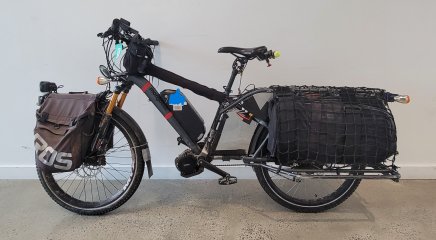
I have a mongoose envoy cargo bike with a grin gmac 10t geared hub motor in the back wheel. The motor is connected to a flipsky 75100 vesc and is used to drive the bike as well as regen braking. I took the bike on a trip and after about 100 miles of rough riding and towards the end, all 3 nylon planetary gears sheared. The total riding weight is around 350 lbs with an average speed of 15mph. During this trip, the hub motor was primarily used for regen. All propulsion came from the middrive and legs.

What I suspect happened was when I was bouncing down rough hills with max regen power, the rear wheel would lift off the ground and the regen would instantly bring the wheel to a stop. Then when the wheel reconnects with the ground, this would shock the gears back into motion. Repeat this over 100 miles and the gears would probably fail. My question is is there some kind of control system in the vesc or otherwise that can detect when the motor is airborne and stop regenning until the motor recontacts the ground and spins up. The goal is to prevent sudden shocks to the gear while maximizing regen energy. The vesc gets regen commands from an adc twist throttle and has a speed sensor from the motor. I have a few ideas but want to see if there's a more reliable solution. The worst case would be to use the disk brakes and thus lose out on regen energy.
 

Attachments

  • 20250606_163535.jpg
    20250606_163535.jpg
    860.9 KB · Views: 6
I have a mongoose envoy cargo bike with a grin gmac 10t geared hub motor in the back wheel. The motor is connected to a flipsky 75100 vesc and is used to drive the bike as well as regen braking. I took the bike on a trip and after about 100 miles of rough riding and towards the end, all 3 nylon planetary gears sheared. The total riding weight is around 350 lbs with an average speed of 15mph. During this trip, the hub motor was primarily used for regen. All propulsion came from the middrive and legs.

What I suspect happened was when I was bouncing down rough hills with max regen power, the rear wheel would lift off the ground and the regen would instantly bring the wheel to a stop. Then when the wheel reconnects with the ground, this would shock the gears back into motion. Repeat this over 100 miles and the gears would probably fail. My question is is there some kind of control system in the vesc or otherwise that can detect when the motor is airborne and stop regenning until the motor recontacts the ground and spins up. The goal is to prevent sudden shocks to the gear while maximizing regen energy. The vesc gets regen commands from an adc twist throttle and has a speed sensor from the motor. I have a few ideas but want to see if there's a more reliable solution. The worst case would be to use the disk brakes and thus lose out on regen energy.

If it never heated up much then it was probably shock loading as you say. If it heated up much, then that softens the plastic of the gears by some amount (more the hotter it is) which eases the ability to shear the teeth off.

I don't know if any of the controllers have a function like you want. If you're using VESC then it could be coded into it ( don't know how, sorry).

Otherwise, you could make something external to the controller that detects wahtever lever, switch, whatever input you have for that to the controller, and the motor (or wheel) RPM via whatever sensor you have (motor internal sensor is better)
--if brake function = engaged?
--and motor RPM change (delta) > ?? (value that it can't decelerate at unless it's unloaded (airborne)).
--then regen control input to controller is disabled. (throttle, separate regen input, brake input, etc) to disallow continued regen / braking.

Could be done with analog electronics, but easier wtih an MCU (arduino, etc). Probably work with one of the itsy bitsy chewing-gum-sized things like Nano, etc. Doesn't need any analog inputs.

If you have a separate wheel speed sensor on the unpowered wheel, you can direclty compare the two wheels, and the motor wheel will be the one decelerating, as even if the unpowerd wheel goes offground, ifyou are not braking it, then it won't slow detectably whiel the powered wheel will either accelerate rapidly if under thrust, or decelerate rapidly if under braking.

You could even use the last (comparison) to have the device actively keep the rear wheel from going any faster or slower than the front wheel by direclty controlling the throttle and brake.

If you want to ensure it doesn't operate when on smooth roads, you can add an accelerometer and then determine limits that it's data must exceed before the device is allowed to interfere with motor operation.
 
If it never heated up much then it was probably shock loading as you say. If it heated up much, then that softens the plastic of the gears by some amount (more the hotter it is) which eases the ability to shear the teeth off.

I don't know if any of the controllers have a function like you want. If you're using VESC then it could be coded into it ( don't know how, sorry).

Otherwise, you could make something external to the controller that detects wahtever lever, switch, whatever input you have for that to the controller, and the motor (or wheel) RPM via whatever sensor you have (motor internal sensor is better)
--if brake function = engaged?
--and motor RPM change (delta) > ?? (value that it can't decelerate at unless it's unloaded (airborne)).
--then regen control input to controller is disabled. (throttle, separate regen input, brake input, etc) to disallow continued regen / braking.

Could be done with analog electronics, but easier wtih an MCU (arduino, etc). Probably work with one of the itsy bitsy chewing-gum-sized things like Nano, etc. Doesn't need any analog inputs.

If you have a separate wheel speed sensor on the unpowered wheel, you can direclty compare the two wheels, and the motor wheel will be the one decelerating, as even if the unpowerd wheel goes offground, ifyou are not braking it, then it won't slow detectably whiel the powered wheel will either accelerate rapidly if under thrust, or decelerate rapidly if under braking.

You could even use the last (comparison) to have the device actively keep the rear wheel from going any faster or slower than the front wheel by direclty controlling the throttle and brake.

If you want to ensure it doesn't operate when on smooth roads, you can add an accelerometer and then determine limits that it's data must exceed before the device is allowed to interfere with motor operation.
Thanks for the advice. There is a temperature sensor in the wheel and I haven't seen any unreasonable spikes so shock is most likely the cause for failure. As for control scheme, I think the best way is your option to figure out how to detect acceration change and stop regenning if there is a mismatch between the two wheels. They way I'm envisioning is if there is a sharp deceleration in the rear wheel but the front wheel is still spinning at a good speed, stop regenning until the rear wheel exceeds a certain rpm then restart regenning.
 
It's known that geared motors are weak offroad because the plastic gears can't handle the continual bashing.
In this case, you'll see gear teeth breaking and other signs of blunt force trauma.

Way too much power from a stall tends to look like the above

Overheating will produce a peanut-butter like texture on the gears from melting in addition to some breakage.

What kind of phase amps/battery amps + voltage are you running? and what are the settings for regen?
 
Thanks for the advice. There is a temperature sensor in the wheel and I haven't seen any unreasonable spikes
For plastic deformation / softening, it's not about the spikes, but about the average temperature over time.

The sensor is in the windings, so spikes are momentary excursions only there. That then dissipates throughout the motor over time.

If you have an IR gun, you can measure the case temperature on the gear side, and it'll be a little below whatever the gears are probably at, depending on ambient air conditions and airflow.


But, generally the average temperature in the windings will eventually become the average temperature of the whole motor internals, so you can use that as a guide.

It doesn't have to be overheating to soften the plastic just a little, and any softening decreases shear resistance.

There is probably some difference in the way a sheared tooth root looks based on temperature effects, but I don't know the specifics for the plastic used in Grin's blue gears.
 
For plastic deformation / softening, it's not about the spikes, but about the average temperature over time.

The sensor is in the windings, so spikes are momentary excursions only there. That then dissipates throughout the motor over time.

If you have an IR gun, you can measure the case temperature on the gear side, and it'll be a little below whatever the gears are probably at, depending on ambient air conditions and airflow.


But, generally the average temperature in the windings will eventually become the average temperature of the whole motor internals, so you can use that as a guide.

It doesn't have to be overheating to soften the plastic just a little, and any softening decreases shear resistance.

There is probably some difference in the way a sheared tooth root looks based on temperature effects, but I don't know the specifics for the plastic used in Grin's blue gears.
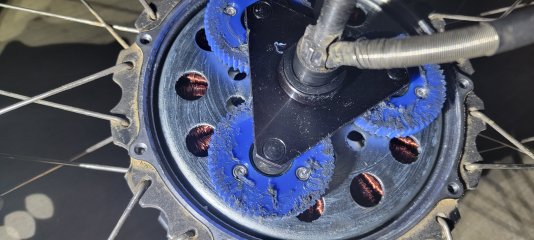
I see. Here is a pic of the sheared gears. On the closest gear, it looks like only one side of the gear failed which I think was caused by a sudden force. The other two gears have a similar smooth spot. I don't know much about heat deformation but I assume it would be somewhat gradual and experienced by all the gear teeth equally. If this is the case, is it reasonable to assume all teeth would have some degree of deformation?
 

Attachments

  • 20250421_180922.jpg
    20250421_180922.jpg
    2.4 MB · Views: 15
that's very strange. There is probably some portion of the rotation where the gears got overtorqued. It looks like some of them want to become nubs. I wonder if that's possible because they slipped or were overtorqued for a moment.
 
I see. Here is a pic of the sheared gears. On the closest gear, it looks like only one side of the gear failed which I think was caused by a sudden force. The other two gears have a similar smooth spot.

Well, once teeth shear off preventing contact with the other gears that turn the planets (sun and ring), the gear can't spin anymore. The sun has less teeth engaging the planet vs the ring, so there are fewer teeth involved in any torque transfer in or out of the motor core than at the hub shell. Once the teeth that can engage the sun have sheared off, and the rest of them that engage the ring can't be pushed far enough to engage the sun by the remaining teeth engaging the ring, there won't be any further tooth destruction. ;)

How quickly or slowly the damaged occured I couldn't say by the image; there are probably plastics experts in failure analysis labs / etc that could.

I don't know much about heat deformation but I assume it would be somewhat gradual and experienced by all the gear teeth equally. If this is the case, is it reasonable to assume all teeth would have some degree of deformation?
The heat doesnt have to cause deformation. It only has to change the hardness of the plastic during operation so that the torque can do the damage.

It doesn't have to be much change if the torque is already anywhere near the limit of the plastic's capability anyway, and a sudden change in torque (from the sudden engagement as the wheel hits the ground) makes that worse.

I don't know what specific plastic is used in those gears, so I don't know what temperature range begins to affect it this way, so I don't know if this was a factor at all or not--but it usually is.


Typically, traction heats the motor relatively continuously during operation, and torque generally is generated relativley continuously, applying forces to the gears relatively evenly.

Tyipcally, braking heats it mostly in pulses, and the torque is typically applied in pulses. Braking heat can be higher than traction heat, but usually it averages out the same. Long descents using the motor as a continuous brake can cause more heating than using it for traction, depending on how much braking current and how braking is performed within the controller itself (there are at least several ways). When the braking is interrupted the way you suspect, the heating still applies but the torque pulses (at impact ) also exist.
 
BTW, I don't think Grin provides them, but you could have brass gears made to replace the plastic ones. The motor will probably be a LOT noiser, probably sounding like a meat grinder on high ;) but it won't fail from heat issues. You could still strip teeth off with excessive torque, but it would take a lot more and it'd probably shear whatever key secures the sun gear to the motor output first.
 
The heat doesnt have to cause deformation. It only has to change the hardness of the plastic during operation so that the torque can do the damage.

It doesn't have to be much change if the torque is already anywhere near the limit of the plastic's capability anyway, and a sudden change in torque (from the sudden engagement as the wheel hits the ground) makes that worse.
Yea that makes more sense. I was beginning to realize the failure would occur a lot sooner than the presence of visual deformations. I think I'll still stick to plastic gears for now since I don't want to strip out a non replacable component in the motor core. Will need to run more tests on temperature changes but given the number of miles I've put on it, the problem doesn't seem to occur unless there is offroad riding with heavy cargo.
 
I think I'll still stick to plastic gears for now since I don't want to strip out a non replacable component in the motor core.

The shear pins are usually replaceable too. I didn't get that far in disassembling mine, IIRC, but it's usually a version of woodruff key, and there are many of those in many sizes available from many places.


Will need to run more tests on temperature changes but given the number of miles I've put on it, the problem doesn't seem to occur unless there is offroad riding with heavy cargo.
It's likely that it requires the specific total chain of conditions to do it. I haven't seen many reports of damaged gears on the GMAC or even the original MAC (though that one usually doesn't have a locked clutch so those can';t be used for regen, saving a lot of possible failures).

I used a GMAC on the heavy heavy-cargo SB Cruiser trike for a while, but because of the noise (gears are very loud in a 20" wheel at 20mph) and even more because of a control issue related to a motor spinup then sudden slowdown in a specific spot on my ride home from a drop off on the road over a bridge. (see my SBC thread for details if interested). So I know something about the GMAC, but no longterm usage experience and data. I doubt I put over a hundred miles on it.
 
Some of the stripped nylon gears I've seen (and caused) from shock loads (i.e. abrupt resumption of wheel traction) had only a single planetary gear stripped, with negligible damage to the other two planetary gears.

You'd think they'd all be equally engaged with the sun gear, but fact remains that it seems common to lose five, ten, fifteen teeth on a single planetary gear.

Hard to tell what the damage is without you cleaning off the grease, but looks to me like heat might've been a factor.
 
Back
Top