• Hello ES! We could use some help to get us past the finish line on building the new knowledgebase for the forum.
    Can you donate? Please see our fundraising page. Thank you!

'lightest.bike' 1.7kg 1000w mid drive

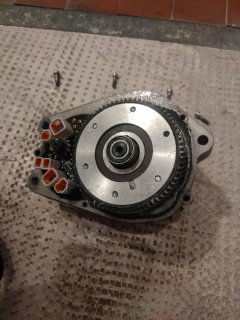
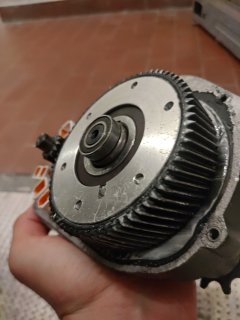
The actual freewheel is no longer a one way needle bearing, but a proper freewheel.
It is pressed onto the hardened steel shaft.
It has a key to retain it from rotating onto the shaft.
Shaft has been machined with a groove for the key.
They made an alu carrier that is mounted on the freewheel and i suppose glued with the plastic outer sprocket (that has been machined too in order to remove all of it, other than the most outer diameter that supports teeth).
Nicely done.
It would survive any load now for sure.
Inner bearings would fail first (and thats exactly what happened, the inner shaft support bearing has been replaced with a new one too).
Only problem of the unit is, now, the pressed freewheel on the hardened steel shaft needs a proper extracting tool to be removed if necessary (later design with one way roller bearing is hand-removable).

I'm not able to test the motor as the bike went for another conversion, but it should be totally good now.
 

Attachments

  • P_20250829_171257.jpg
    P_20250829_171257.jpg
    1.6 MB · Views: 46
  • P_20250829_171231.jpg
    P_20250829_171231.jpg
    1.7 MB · Views: 44
Probably doesn't need to. It works as you imagine, like a standard smcsk20pp freewheel (that is whats mounted now under the alu carrier you see in the pics)
 
Yes, you would have to change many things with precision tools. Hardest thing would be to mill a keyseat on the hardened steel shaft.
But also have a carrier machined for the csk20pp freewheel (also keyed) and turn the plastic wheel to remove ots inner material.
Key tolerances are somewhat hard to machine by hand, a cnc mill helps.
 
Given that i cannot remove the new assembly, you can search back in this conversation pages to understand how the csk20pp freewheel is mounted there for visual reference (there is a screenshot of my design done in cad software).
 
If by "utilizing that" you mean swap pieces from my unit to yours, then you probably could by removing and swapping completely the shaft and the reduction assembly altogether and slapping it on yours.
 
But probably no need: the unit is in working conditions and being high torque amd maxed out power version, i could more or less see the power values you saw after your vesc hookup.
 
Checking in.

I have a short mount ( to increase the stealth factor ) and these new quieter plastic gears on the way.
I'll do a sound comparison once i've done the swap.

My recumbent is currently in pieces while i work on:
- lowering the frontend
- lowering the seat
- mounting the battery on the bottom of the tube instead of the top

And in general getting the CoG right as i prepare to hook this thing up to it and see if i can break 40mph ( should be easy )

More later!
 
Hi
After looking at their website I notice the output is 390rpm. I would like to know if there is gear réduction inside the casino and what is the gear ratio, just to have an idea of the motor rpm before réduction.
Thkx in advance
R
 
Easily 10:1 or more, in two stages

PS - I didn't get newer plastic gears, i got old ones :(
This is maybe my fault, it's possible i wasn't specific on what i wanted. I'll reorder a green gear.
 
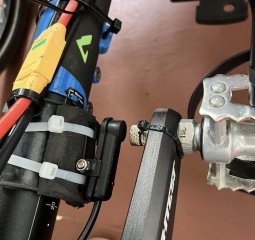
I just did my second installation of a Lightest but this time on a recumbent trike. The speed sensor wire was too short to reach the wheel, so I spliced in some wire using those gel filled dolphin or B connectors for telephone and alarm wires for a good connection. Seemed to work for a while, but then it started cutting out when I was going uphill. Assuming the connection was not adequate, I then placed a new speed sensor on the Trike boom with the magnet behind the pedal. Again, it seemed to work, except when I was going uphill. When I say cutting out, I mean no matter what assist level I was in, it would go to zero. There was no error code. At first, I thought it had to do with cadence because I downshift and increase my cadence going up hills. but that wasn’t consistently what caused the motor shut down. If anyone has some thoughts, it would be much appreciated.
 
Hmm, that's supposed to be monitoring a wheel, not cranks. it's reading a fraction of the RPM.

Your distance from sensor to magnet looks long. When you are cranking on it uphill, you'll tend to bend the crank a bit left-right. Try shimming something to get it a few millimeter closer.
 
I jostled it when I was pulling out the trike, but I did set it in the correct gap. When I used the speed sensor that I spliced wire into, I did have it on a wheel. I was careful using the correct connectors, and I’m just assuming that it was a bad wiring connection, but maybe not. Either way, I’m still having the same problem. I couldn’t think of any other option other than to put it on the crank. My other trike has a BBS02, and Bafang makes sensor wire extenders. That’s where I pirated the wire from.
 
When you're pedallinjg uphill, is your cadence slowing?

If so, then it probably stops assisting because of dropping below some minimum rpm that it expects at the sensor.

If the sensor is meant for a wheel, rather than cranks, you'd probably have to add proportionally more magnets to the cranks to get the right RPM at the sensor, *and* it will still not do the job it was intended for, which would be to have the system do whatever it does to compensate for wheel RPM changes.

If it is meant for a crank to sense when you are pedalling, there will usually be a *lot* of magnets, as many as possible, so that it can detect small changes in cadence and respond appropriately and quickly.
 
When you're pedallinjg uphill, is your cadence slowing?

If so, then it probably stops assisting because of dropping below some minimum rpm that it expects at the sensor.

If the sensor is meant for a wheel, rather than cranks, you'd probably have to add proportionally more magnets to the cranks to get the right RPM at the sensor, *and* it will still not do the job it was intended for, which would be to have the system do whatever it does to compensate for wheel RPM changes.

If it is meant for a crank to sense when you are pedalling, there will usually be a *lot* of magnets, as many as possible, so that it can detect small changes in cadence and respond appropriately and quickly.
It did seem as if the motor would cut out if my cadence slowed on a hill but not always. Maybe I will reinstall the sensor that I spliced with extension wire and then add more wheel magnets to see if that helps. Because I encountered this problem on the trike but not my bike, I assumed that the wire connections were faulty. Having it on the crank was the only option I could think of but obviously not ideal for many reasons. Thanks for your input!
 
It did seem as if the motor would cut out if my cadence slowed on a hill but not always. Maybe I will reinstall the sensor that I spliced with extension wire and then add more wheel magnets to see if that helps. Because I encountered this problem on the trike but not my bike, I assumed that the wire connections were faulty. Having it on the crank was the only option I could think of but obviously not ideal for many reasons. Thanks for your input!
I emailed Lightest, and Victor said that the motor cutting out when the cadence slows going uphill is usually because the torque sensor calibration is slightly off. He sent a more detailed instructions with links to two videos. Thought I’d post it in case anyone else has this problem.
 

Attachments

  • VERIFY_CALIBRATION_ENG.pdf
    1.7 MB · Views: 19
@neptronix

Hello,
I have read your posts about your Lightest middrive setup, and it looks great. It's really something I would like to build for myself.
I have a similar 29er hardtail with road tyres, I would like to keep the bike lightweight and I need a small Q-factor (last 6 months I have a BBS02 750 on, and the wide stance started to bother my knees).
My questions are, are there many modifications needed for this motor to work reliably for commuting at 24-25 mph? Like your external controller modification? I commute every day, also in rain, I guess the motor is waterproof like it should be? Does the chainline occasionally needs any correcting? Do you recommend dual chain system?
I live quite close to the Lightest manufacturer, so I could also visit them, in regards to installation...

Thank you for answer,
I wish you good luck in your future projects!
Regards,
Dule
 
Howdy.
The only reason you'd want an external controller:
- get the last couple hundred watts of power you were promised by the manufacturer, or more
- don't like the dynamics of how the controller works
- don't mind a huge downgrade in the user interface

I would strongly suggest going the dual chainring route. The single chainring route is rife with problems, added noise, and a gritty feel in the drivetrain as you pedal. Many have had problems with that.

If you are taller than most, this mid drive may present a problem to you. It comes with 165mm cranks only. It's very hard to find a 170mm replacement crank. I'm tall and my legs like 175mm-180mm. This disqualifies it for me as a mid drive on an upright bike.

That is why mine lives on a semi recumbent bike. It has two bottom brackets, so i can bypass the cranks problem.

maxarya-jpg.381202
 
Howdy.
The only reason you'd want an external controller:
- get the last couple hundred watts of power you were promised by the manufacturer, or more
- don't like the dynamics of how the controller works
- don't mind a huge downgrade in the user interface

I would strongly suggest going the dual chainring route. The single chainring route is rife with problems, added noise, and a gritty feel in the drivetrain as you pedal. Many have had problems with that.

If you are taller than most, this mid drive may present a problem to you. It comes with 165mm cranks only. It's very hard to find a 170mm replacement crank. I'm tall and my legs like 175mm-180mm. This disqualifies it for me as a mid drive on an upright bike.

That is why mine lives on a semi recumbent bike. It has two bottom brackets, so i can bypass the cranks problem.

That recumbent looks like a comfy ride! I have to try one some day, on an open road :) I guess this is not for busy town...

About the Lightest on a hardtail:
The 165mm cranks wouldn't bother me, I'm short. I have tried 165mm before, on my friends bike, I like it.

If I go the dual chainring route, I loose torque sensing. That's fine, but I'm left only with a throttle, right?
Because PAS, while possible, it would be jerky, and no option to gradually increase power, like with BBS02 programming. Do I understand this correctly? And this can't be fixed even with an external controller. Or it can?

Are you OK riding with throttle only?
Thanx!
 
Regarding the question if the motor is waterproof -

Yes, the controller and motor/inner gearing are properly sealed.
The outer motor plug connectors have a shared plastic cover
that is not totally waterproof.

To protect against eventual winter road salt, I sealed it
with (black) MS Polymer, which makes it even air-tight.

Tip: That stuff is the stickiest ever invented!
Rubber gloves and acetone for cleaning before,
and the mess following treatment is advised.

Edit:
MS polymers Performance and durability
-----------------------------------------------------------------
High flexibility and bond strength: MS polymers combine elasticity with higher mechanical strength, so they are often preferred where joints move and also need structural‑type bonding.

Excellent weathering in many conditions: MS polymers show very good resistance to UV, moisture, and temperature cycling, and can even outlast silicone in abrasion or vibration‑heavy applications due to stronger adhesion and no oil migration.

Wet‑surface application: Many MS polymer/hybrid sealants can be applied on damp or slightly wet substrates
without major loss of performance, something that is more limited for typical construction silicones.
---------------


"Modifications needed for this motor to work reliably for commuting at 24-25 mph?"

To select the optimal gearing combinations (like at 80% of max motor RPM out to get
good Wh/Km) for single or dual chains, I made an Excel sheet here to enter your
specific conditions:

 
Last edited:
Back
Top