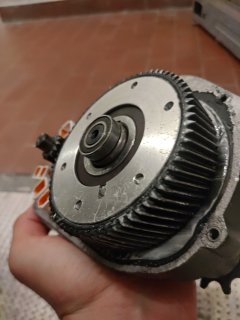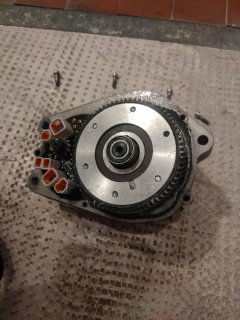
The actual freewheel is no longer a one way needle bearing, but a proper freewheel.
It is pressed onto the hardened steel shaft.
It has a key to retain it from rotating onto the shaft.
Shaft has been machined with a groove for the key.
They made an alu carrier that is mounted on the freewheel and i suppose glued with the plastic outer sprocket (that has been machined too in order to remove all of it, other than the most outer diameter that supports teeth).
Nicely done.
It would survive any load now for sure.
Inner bearings would fail first (and thats exactly what happened, the inner shaft support bearing has been replaced with a new one too).
Only problem of the unit is, now, the pressed freewheel on the hardened steel shaft needs a proper extracting tool to be removed if necessary (later design with one way roller bearing is hand-removable).
I'm not able to test the motor as the bike went for another conversion, but it should be totally good now.
It is pressed onto the hardened steel shaft.
It has a key to retain it from rotating onto the shaft.
Shaft has been machined with a groove for the key.
They made an alu carrier that is mounted on the freewheel and i suppose glued with the plastic outer sprocket (that has been machined too in order to remove all of it, other than the most outer diameter that supports teeth).
Nicely done.
It would survive any load now for sure.
Inner bearings would fail first (and thats exactly what happened, the inner shaft support bearing has been replaced with a new one too).
Only problem of the unit is, now, the pressed freewheel on the hardened steel shaft needs a proper extracting tool to be removed if necessary (later design with one way roller bearing is hand-removable).
I'm not able to test the motor as the bike went for another conversion, but it should be totally good now.