


This is the first official public introduction of BatteryRealData.com, and I would like the Endless Sphere community to help shape what it becomes. BatteryRealData.com is a battery-cell testing, comparison, datasheet, and educational project created and operated by DIY500AMP.COM. The goal is simple: make real cylindrical-cell information easier to inspect, compare, and question. Instead of reducing a cell to one advertised capacity or current number, the site brings together manufacturer datasheets, controlled discharge tests, voltage behavior, heat, usable capacity, written reports, and practical pack-planning tools. I am not presenting this as a finished or unquestionable resource. I am inviting technical criticism. Please tell me what is wrong, unclear, missing, or unnecessary. If a score appears misleading, a chart needs better context, a feature should be removed, a calculation needs correction, or the mobile interface creates friction, I want to hear it. Positive feedback is welcome, but detailed criticism will be even more useful.
 What is available now At the time of this launch, the public database includes:
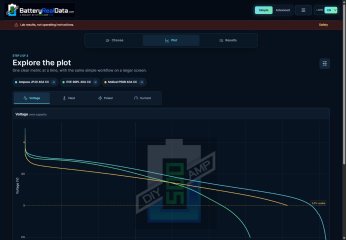
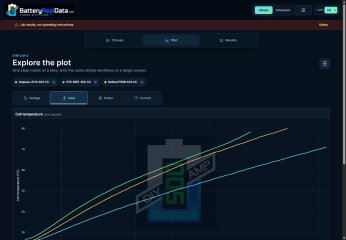
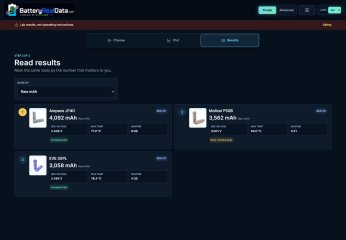
 Compare real cell behavior, not only labels The Compare Cells page has Simple and Advanced views. Builders can filter by format, brand, current, or intended purpose, then compare selected runs using voltage, heat, power, current, capacity, runtime, and other measured results. The examples below use three real 40A tests: Ampace JP40, EVE 30PL, and Molicel P50B. The purpose is not to declare one universal winner. It is to show that the best choice changes with the requirement: voltage support, usable capacity, temperature, runtime, cell format, and the reason a test ended all matter.
 Voltage behavior over discharged capacity for three published 40A runs.
 Temperature behavior for the same three runs. Capacity without heat context tells only part of the story.
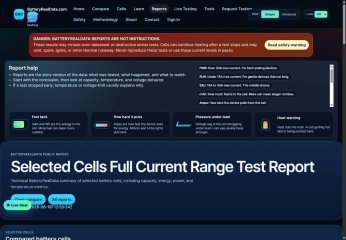
 The result table keeps capacity, end voltage, maximum temperature, runtime, and test-completion status together so an early or limited stop is not hidden. Open this exact three-cell comparison Written reports and test context Charts should not be separated from the conditions that produced them. The Reports Library adds written interpretation, selected-cell context, safety boundaries, and notes about what a result does and does not establish.
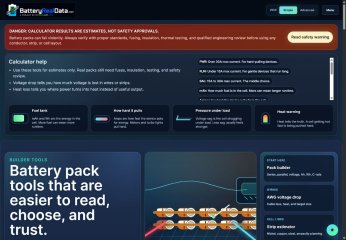
 Example of a published full-current-range report with safety and interpretation context. Public live testing The Public Live Test Monitor can display voltage, current, power, temperature, amp-hours, watt-hours, elapsed time, and test status while a public test is running. When no test is active, the most recent public state remains available for inspection. Builder tools BatteryRealData also includes practical calculators for:
 Mobile experience BatteryRealData is designed to be usable from a phone as a real working interface, not merely as a desktop page reduced to a smaller screen. The mobile layout keeps the main research paths available while you are at the bench, checking a datasheet, or comparing a cell away from a computer.
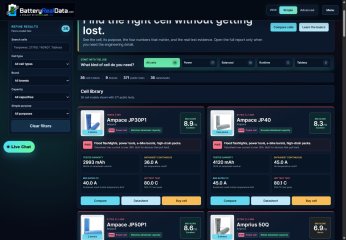
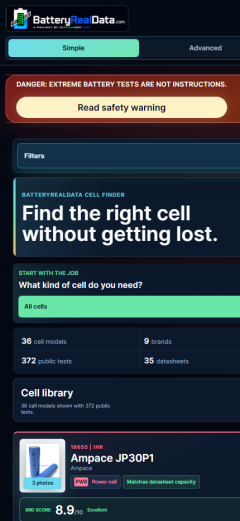
 Mobile cell library with model filtering, datasheet context, test totals, and cell scores.
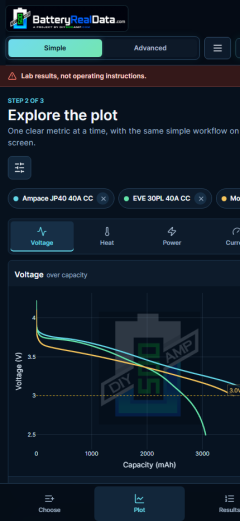
 The cell-comparison workflow on a phone, including Simple and Advanced views and the same published test data used on desktop.
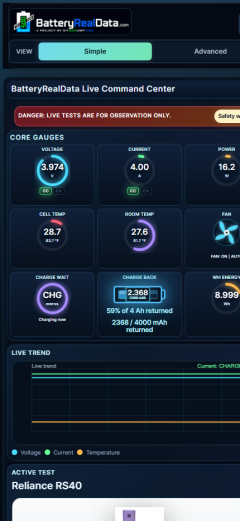
 Public Live Test Monitor on mobile for checking the active cell, core measurements, safety state, and live trend. Transparency about DIY500AMP.COM BatteryRealData.com is a project from DIY500AMP.COM, and DIY500AMP sells battery cells and battery-building supplies. That relationship is disclosed because it matters. The purpose of the testing project is not to make every product look good. Test results may be favorable, average, disappointing, or limited. The data, stop reason, conditions, and relevant datasheet boundary should remain visible. Testing requests are not paid-positive-review arrangements, and a commercial request does not guarantee a favorable conclusion. Where a cell is sold by DIY500AMP, the catalog may include a clearly identified store link. The test data and datasheet references should still be judged on their own evidence. Important safety boundary Manufacturer datasheet limits remain the operating limits for pack design. Any stress test beyond a datasheet condition is laboratory evidence only, not an operating recommendation. Pulse, burst, temperature-limited, and continuous ratings must not be treated as interchangeable. A monitored single-cell fixture is not the same as a finished battery pack. Pack current sharing, conductors, interconnects, BMS protection, fusing, insulation, enclosure, cooling, and fault behavior must all be engineered separately. Please do not reproduce laboratory stress tests without the proper equipment, containment, monitoring, and experience. What I would like the community to review
- 371 published discharge tests
- 36 cylindrical cell models from 9 brands
- 35 manufacturer datasheets
- Testing across 30 current levels
- A mobile-friendly interface for browsing results away from a desktop
- Manufacturer and exact model
- Cell format, chemistry, rated capacity, and purpose
- Manufacturer datasheet and published current limits
- Available discharge tests and temperature observations
- Tested capacity and the hottest published run
- Direct access to comparison tools and written reports
- Battery-pack configuration and C-rate
- AWG voltage drop
- Nickel, copper, and busbar estimation
- Runtime and range estimates
- Charge-time estimates
- I-squared-R heating and voltage-sag estimates
- Browse and filter the cell library, then open model profiles and datasheet references
- Use the Simple and Advanced comparison views and inspect the plotted test data
- Follow the Public Live Test Monitor with phone-readable voltage, current, power, temperature, energy, and test-status information
- Move between test results, reports, safety notes, and pack-planning tools without requiring a desktop
- Is the BRD Score understandable and technically fair?
- Are datasheet claims, measured results, and recommendations clearly separated?
- Which metrics or test conditions need more explanation?
- What cell information is missing from the catalog?
- Which tools should be added, modified, simplified, or removed?
- Does the Simple/Advanced comparison split make sense?
- Are there mobile usability problems I have missed?
- Do you see an incorrect specification, score, unit, chart, or conclusion?
- Which cells or current levels would be most useful to test next?
Attachments
-
 01-mobile-friendly-home.jpg127.5 KB · Views: 43
 -
 05-datasheet-score-and-test-results.jpg159 KB · Views: 41
 -
 02-real-cell-comparison-40a.jpg85.5 KB · Views: 38
 -
 03-real-cell-thermal-comparison-40a.jpg88.5 KB · Views: 38
 -
 04-test-results-ranking-40a.jpg68.2 KB · Views: 38
 -
 07-sample-published-test-report.jpg159.8 KB · Views: 37
 -
 08-battery-pack-builder-tools.jpg171.6 KB · Views: 33
 -
 mobile-cell-library.png148.2 KB · Views: 30
 -
 mobile-compare.png75.4 KB · Views: 30
 -
 mobile-live-test.png204.4 KB · Views: 30
Last edited:


