• Hello ES! We could use some help to get us past the finish line on building the new knowledgebase for the forum.
    Can you donate? Please see our fundraising page. Thank you!

Local idiot tries to build a tadpole.. "dumb bike"

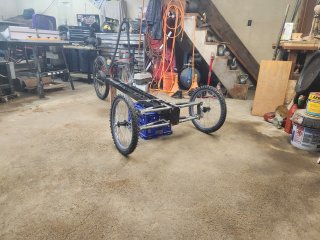
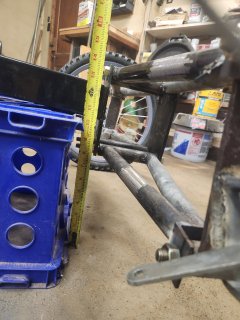
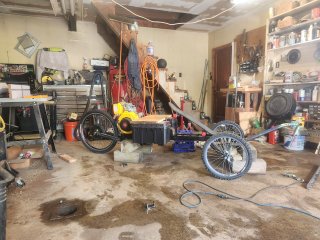
Tonight I was able to take an hour or so and realized I was probably going to need to do some adjustments as discussed in the prior post. I cut a plate to keep the uprights upright and at the proper distance and assembled the front end. I was pretty discouraged when my one side was off camber about 6*. Upon doing some thinking o decided rather than make adjjustments, I could potentially swap one of the arms to another in the chance one may have been a hair longer than the other or who knows. Swapped that sides upper and lower arm and bang on with my jig angles. Gonna be honest....im pretty excited at this point. Still need to true the one wheel. Install brakes and steering but couldn't resist another mockup shot for myself. The right wheel in the picture is not dead straight. I checked my axles and they are <1* off level when the whole.assembly is level.... im very happy with that. Hope it helps my vision make sense.

P.s. please dont mind everything in the background, due to circumstances there are 3 people's worth of stuff in the garage so space is at premium.

20260712_204834.jpg
 
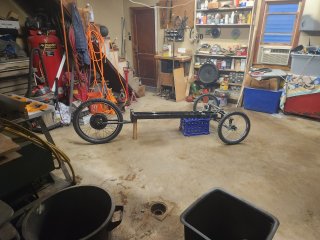
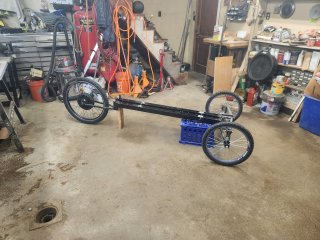
Well i suppose this is a bigger update. Fixed a few stupid issues, got the longer bolts I needed and decided to mock up the basic layout. Here it is. Please share any thoughts
20260725_204104.jpg
20260725_204110.jpg
20260725_204133.jpg
20260725_204147.jpg
20260725_204319.jpg
 
How wide is your front track and how long is your wheelbase? Where are you going to position your seat? It might be possible to make this tip-proof with your current tires, at least when travelling forward on smooth, un-banked pavement.
 
How wide is your front track and how long is your wheelbase? Where are you going to position your seat? It might be possible to make this tip-proof with your current tires, at least when travelling forward on smooth, un-banked pavement.
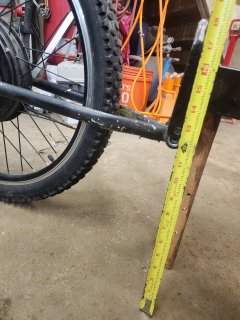
So track is right about 32" wheel base is about 70", front seat it a bit behind the front suspension rear point. Its designed for 2 seats or 1 and cargo. Initial designs were for leaning ability of 15-20*... needed about 6 total wheel travel in front, i didnt have it initially so I did some modifications to the front arms and ended up with 18 inches of available travel, so im pretty sure i can lay the frame on the ground. Batteries will be mounted off the bottom of the framework on either side of the twin beams, with engine (if used) just on top of it at the rear pivot point. Front seat may be just above the frame, with the rear one sitting up to 6 inch inches off the frame to clear the battery boxes
 
Making it lean will allow it to corner very niceley. Getting a tilting mechanism to work properly is a challenge, and not for the faint of heart.
 
Some basic layout done tonight to see if things actually fit. And they do. So design is what it is. The skateboard was representing my seat, just happens to be at a perfect 30* recline for reference. The black boxes are for protecting the batteries, there is room for a 3rd pack should i decide 24s is the way to go instead of 16. The board on top was just to simulate passenger seating, which i fit with my legs fitting beside/ to the side of me and with proper designed hand controls controls will not interfere at all. At 6'2i assumed if I fit...any reasonable passenger should. The engine does fit in this and im designing a tail section similar to a sport bike to cover the back tire and mount up the rear suspension. As it sits, either front tire can lift 7 inches without affecting anything else. This gave me about 30* of tilt angle, but i think.im going to put stops in at 25*. Just thought someone might enjoy 20260728_153513.jpg
 
The way you're setting this up, it's going to be able to corner ell without tilting. Add tilting to it, and I don't think you'll ever need to worry about tipping over from hard cornering on any unbanked, even surface. As with any tadpole, one threat is loss of rear wheel traction. Having such a long wheelbase is going to greatly aid stability, and if you ever decide to build a shell for it, lots of NACA airfoil profiles would be a great fit.

My KMX's biggest flaw was having as short of a wheelbase as it did. Increasing that by 2" with a rear suspension helped stability significantly at high speeds.
 
So track is right about 32"
If accurate, your vertical CoM height needs to be below 16", measured at laden weight from the surface the vehicle is resting on. If above 16"... tipping while cornering at speed becomes possible. Measuring the vertical CoM height is more challenging because It typically requires tilting the vehicle (raising either the front or rear of the vehicle, while monitoring the increasing weight on the stationary axle).

wheel base is about 70"
Weight Distribution;

As with vertical, the longitudinal CoM location needs to be known and is measured at laden weight.
Ideally, for most tadpole trikes (3 wheels) you need 66% of the laden weight on the front axle... and the remaining 33% on the rear axle. Easy to measure. Bathroom scales under each wheel, or a single scale and blocks to keep the vehicle level.

Within reason, altering the vehicle's wheelbase does NOT significantly effect the vehicle's dynamic stability. It only effects the steering response... and is chosen based on anticipated speeds.
 
Last edited:
Within reason, altering the vehicle's wheelbase does NOT significantly effect the vehicle's dynamic stability. It only effects the steering response... and is chosen based on anticipated speeds.
You're correct that lowering the rider height, and thus the center of mass of the vehicle, will have a greatly more significant impact on dynamic stability than a longer wheelbase. So too would widening the front track in the case of a tadpole. Shifting the battery underneath or even slightly ahead of the rider would be a good idea to help lower and shift forward the center of mass, but that would require different packaging than what is shown above.

The question is whether the tires allow enough lateral Gs of acceleration to allow tipping in the first place, when tipping is possible at all.

A longer wheelbase makes it easier to keep 66% of vehicle mass over the front wheels, and from my experience makes the steering more stable when there's road imperfections. That extra 2" of wheelbase on my KMX, which was NOT tip-proof, made the diference between cruising 35 mph confidently over bad roads and cruising 50 mph confidently, but that was also with the addition of a rear suspension to go with it. A longer wheelbase also makes it easier during cornering to keep the center of mass within the imaginary triangle drawn by the wheel hubs, because the triangle has been extended and thus the center of gravity has a longer lateral distance it has to shift under lateral acceleration before the trike tips over. I was at the point where I could corner so hard that my tires didn't have enough traction to allow the trike to pull enough lateral G forces to cause it to tip over, even though my center of mass was high enough that tipping could have happened. I was cornering at about 0.7-0.8G on Schwalbe Marathon Plus inflated to 70 PSI as a trike. My quad does a lot better than that.
 
Last edited:
If accurate, your vertical CoM height needs to be below 16", measured at laden weight from the surface the vehicle is resting on. If above 16"... tipping while cornering at speed becomes possible. Measuring the vertical CoM height is more challenging because It typically requires tilting the vehicle (raising either the front or rear of the vehicle, while monitoring the increasing weight on the stationary axle).


Weight Distribution;

As with vertical, the longitudinal CoM location needs to be known and is measured at laden weight.
Ideally, for most tadpole trikes (3 wheels) you need 66% of the laden weight on the front axle... and the remaining 33% on the rear axle. Easy to measure. Bathroom scales under each wheel, or a single scale and blocks to keep the vehicle level.

Within reason, altering the vehicle's wheelbase does NOT significantly effect the vehicle's dynamic stability. It only effects the steering response... and is chosen based on anticipated speeds.
Definitely appreciate the technical input from you and TC, I know the engine is approx 70lbs and obviously right at the swingarm pivot just above the frame. The battery boxes are mounted below the frame rails and will be about 70lbs between the 2, but are much closer to center frame weight, then there is me at 215ish up front just above the frame. The main spine is about 20lbs in itself. I think front suspension set is probably closer to 30-35 (didnt weight it), and obviously the rear swingarm and motor weighing in 15-20lbs.

End goal is sub 60 cruise on diesel and probably lower on electric alone due to 60v architecture currently. Im hoping to not have stability issues, however if I need to increase width, ill do so with a different material to cut some weight off.
 
You're going to need a lighter engine. I didn't realize it was that heavy. That's going to cause handling problems.

Once you have an aerodynamic shell on it, 1 horsepower is plenty, and you can buy generators in that range that weigh around 10-15 lbs or less. Without that shell, you'll need 5x that power or more.
 
You're going to need a lighter engine. I didn't realize it was that heavy. That's going to cause handling problems.

Once you have an aerodynamic shell on it, 1 horsepower is plenty, and you can buy generators in that range that weigh around 10-15 lbs or less. Without that shell, you'll need 5x that power or more.
If that is the case the diesel should move me like a freight train 😆

But, you do make points, and when someone with experience chimes in, i do listen. I think initially the build will be electric only, then I can test things out using ballast weight for handling and other things. If its too much, I can use this on another project
 
Last edited:
That extra 2" of wheelbase on my KMX, which was NOT tip-proof, made the diference between cruising 35 mph confidently over bad roads and cruising 50 mph confidently,
First you added a motor, battery and related mass. Then you admittedly doubled, approaching triple the speed of a vehicle originally designed for pedal only speeds. I'm not surprised, but I'm also dubious a 2 inch stretch would be sufficient to tame the handling, to my satisfaction, at 50 MPH.
I have NO trike builds shorter than 65" WB. And even at that minimal distance, some have needed the steering geometry massaged.

the imaginary triangle drawn by the wheel hubs
Hubs?... uh no. The tipping reference points are always at the center of the tire's contact patches.

* All of my post in this thread assume NON-tilting designs *
 
Last edited:
First you added a motor, battery and related mass. Then you admittedly doubled, approaching triple the speed of a vehicle originally designed for pedal only speeds. I'm not surprised, but I'm also dubious a 2 inch stretch would be sufficient to tame the handling, to my satisfaction, at 50 MPH.
I have NO trike builds shorter than 65" WB. And even at that minimal distance, some have needed the steering geometry massaged.


Hubs?... uh no. The tipping reference points are always at the center of the tire's contact patches.

* All of my post in this thread assume NON-tilting designs *
Well i can say hearing of longer wheelbase based units does help me feel a little better about mine at 70". Although I think at the size it is, its beyond a normal trike and almost more micro vehicle...made by a sketchy manufacturer
 
Back
Top