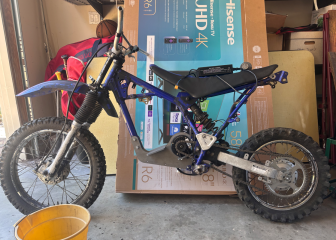
I am currently in the process of converting a 2000s Yamaha TTR-125 to electric. The goal for this project is for the bike to have a top speed of 50mph with decent acceleration.
If you want the accleration to be good up to the top speed, you'll probably want to have a higher real top speed, then just not use that actual top speed; this usually means using either a higher voltage than normally needed or a higher kV motor version or different gearing. The latter two, depending on other system capabilities, can lower your startup torque, though the first does not. You can see how this works in various simulators such as those at ebikes.ca .
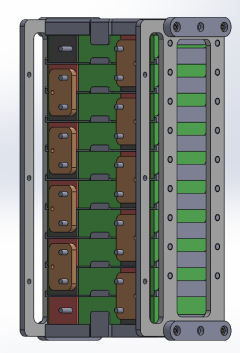
For the battery, I plan on using a 20s 1p configuration with the Ford C-Max 25 ah prismatic cell. These have a pretty high max current as they are rated for 15c. I have designed two cell towers that will connected in series and mounted on each side of the bike (see the attached photo below).
If you haven't already, you'll probably need to design your pack with cell compression of the stacks, or the cells will degrade over time (or quickly) as electrolyte decomposes and outgasses and splits layers apart. Prismatics and pouches, unlike cylindricals, have no inherent compression of the layers, so you have to provide that with your pack containment/housing mechanical structure. There are examples of cell compression around the forum in various threads; you can see some of them in posts of mine over the years when this subject comes up. You can also look at large-EV packs like the one your cells came from that will have some form of compression mechanism (often at the module level, but if not, at the full pack enclosure level).
The farther from their limits (voltage low or high, current, capacity, temperature, etc) the cells are used, the less outgassing and damage may occur...but some cells are simply prone to it and will happen even just sitting there not being used if they are charged up or sometimes when close to empty.
I have some thundersky LiFePO4 prismatics that did this even sitting at partial charge, unused; once it began to happen it got worse, and none of them can supply the current or capacity that they should be able to because of it.
I also use some EIG NMC C020 pouch cells that have had virtually none of this problem over the >decade I've been using them in uncompressed packs...but there have been some of the cells that did exhibit the problem in recent years that might not have begun to fail if I had had them compressed all this time.
These very expensive marine batteries both exhibit some cells with dramatic swelling from outgassing, not built with any form of compression (unless you count a couple of wraps of packing tape in two places each

), and dont' appear to have other defects (wiring, BMS, etc)--if they had been compressed, it's possible they'd still be operational, instead of expensive blocks of junk.
My questions center around the safety of this pack. Any recommendations for a 20s BMS? I plan on having a nominal voltage of 72volts. Additionally, are there any other electronics that would be good to have to ensure the safety of this pack?
You may want to look around at other battery builds for more info, but the main electrical things are:
--a correctly rated fuse by a known brand, in a wellmade holder for that type (or a bolt-on fuse), installed within the battery housing or immediately outside it on either main power wire. Check the manufacturer guides on how to choose a fuse for your usage.
--wiring and connections/connectors that are more capable than the minimum you need for the intended purpose (personally I prefer bolt-on ring terminals, or Anderson SB series if you have to be able to unplug it)
--BMS that is more than the minimum you need
--safety shutoff switch (like an "RV battery shutoff" or similar but rated for your voltage and current needs; a solar cutoff or solar rated DC breaker can be used for this) mounted in either main power wire either inside the battery casing or immediately outside it, and have this easily accessible from the outside of the bike as a safety feature for you or anyone attempting to help in the event of a crash, etc., if the handle or key of the switch is removable when off, it is also a good antitheft feature.

The BMS should have at least an HVC to disable charging, and an LVC to disable discahrging.
It can use FETs or a contactor for the actual disconection of the pack from the world, *or* it can use some form of signalling (enable/disable line or actaul communication) with the controller and charger to tell them to stop. In the latter version you want the safety shut off so that you can physically disconnect the battery from the system when you're not using it, as otherwise it is always powering hte system and will discahrge it totally without any way to stop it (unless you've added some other automated way to do this).
There are smart BMS with BT to an app on your phone to let you monitor things (some of them let you change settings that way too),